Mallet
Strike the same bowl with felt first, then with metal.
- Listen
- Guess
- See
- Play again
A bell is not a single frequency. Touch the instrument: its modes appear ring by ring, and each fades in its own time.
Himalayan bowl · 196 Hz
| Ratio | Hz | Decay (T60) | Twin | Level | Measured |
|---|---|---|---|---|---|
| 196 | 30 s | 0.9 Hz | — | ||
| 531.2 | 16.5 s | 1.6 Hz | — | ||
| 1,005.5 | 9 s | 1.15 Hz | — | ||
| 1,620.9 | 4.8 s | 1.85 Hz | — | ||
| 2,332.4 | 2.7 s | — | — |
A bell is not a single frequency: each mode fades in its own time. The rings and labels are calculated from this table. The Measured column is read from the device's output while playing (dBFS, slowed down); the ratio button opens the mode shape.
Tuning is a preference: the notes stay the same and the pitch shifts slightly (A4: 440 Hz). For 432 Hz there are small, inconsistent preliminary findings.
Changing the room or position reopens the instrument; the ringing sound fades out.
Put up to five instruments on the stage; a pitch whose partials beat with another's at 2-43 Hz is locked and the reason is shown.
Your instruments
Performance No recording
The link carries the setting after the # in the address; it isn't sent to a server. In the timer the instrument's setting carries over; strength, bed and space are the timer's own choices.
Strike the same bowl with felt first, then with metal.
On the crystal bowl, raise the twin beat from slow to fast.
Strike the gong gently first, then strongly.
Listen to the same temple bell dry first, then in the temple.
On the bronze bell, shorten the decay of the upper modes.
The Resonance Lab is a bench where you play eight instruments by hand: Himalayan bowl, crystal bowl, temple bell, orin, gong, tingsha, bronze bell and sounding bar. Where you touch and how hard decide which modes wake up; the modes appear as rings and each fades in its own time. The sound is generated on your device with modal synthesis; it is not a recording.
Strike a bowl at the rim, then on the body: the rim brings out the upper modes, the body the fundamental; the rings show which mode is ringing.
Draw a circle on the bowl with your finger: the faster the circle, the fuller the rubbing sound; let go and it fades.
Put up to five instruments on the stage; a pitch that would beat against another is locked, so instruments played together stay smooth.
Record what you play: the recording plays back, opens in the room or is saved as a WAV, FLAC, MP3 or Opus file.
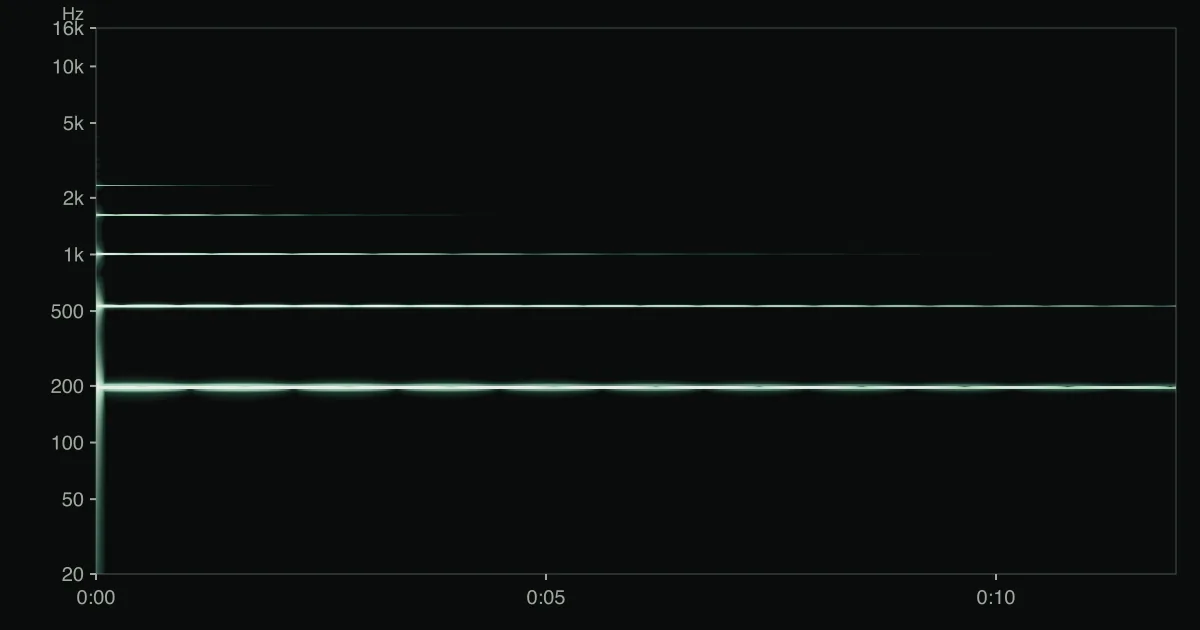
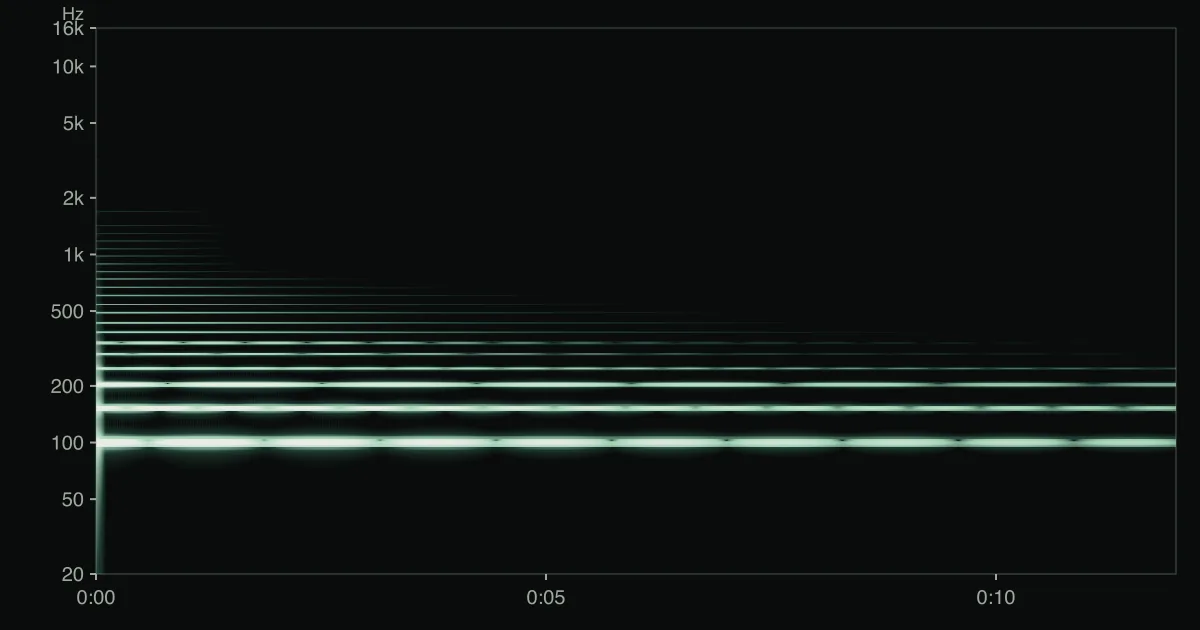
Himalayan bowl: the fundamental and the ×2.71 mode lead. At the default 196 Hz the fundamental falls to −60 dB in 30 s and the ×2.71 mode in 16.5 s. The first four modes have twins; the fundamental's twin undulates slowly at 0.9 Hz. It can be struck or rubbed.
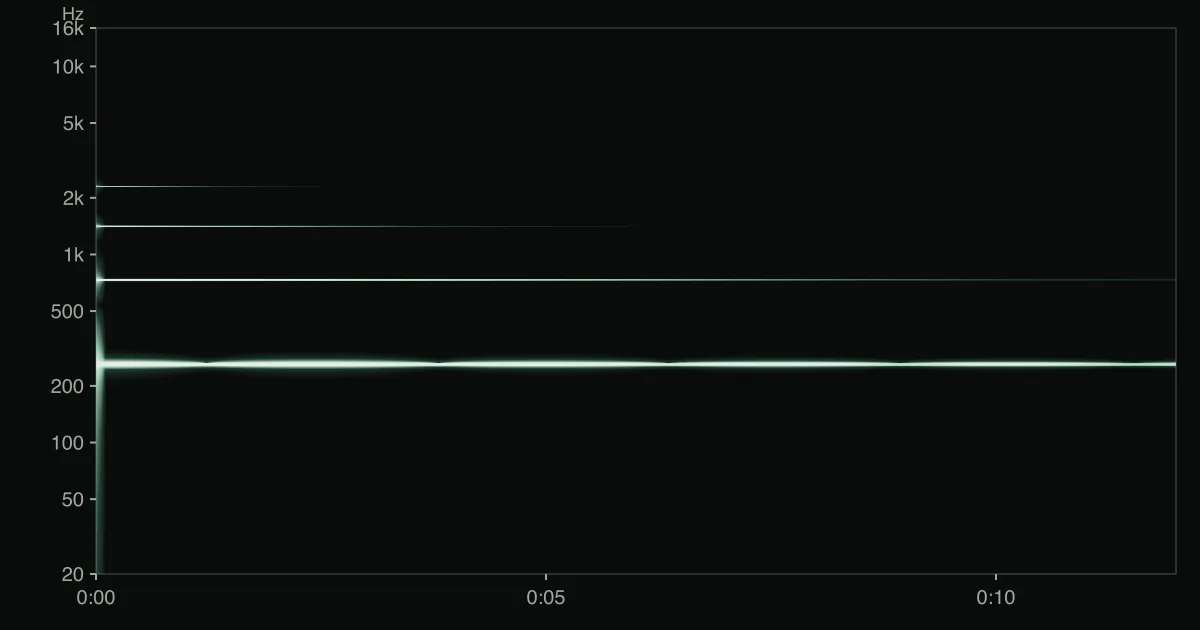
Crystal bowl: an almost pure fundamental. The ×2.8 mode starts at half the fundamental's level and fades in 12.6 s; the twin beat is a slow 0.4 Hz. It swells when you press and hold.
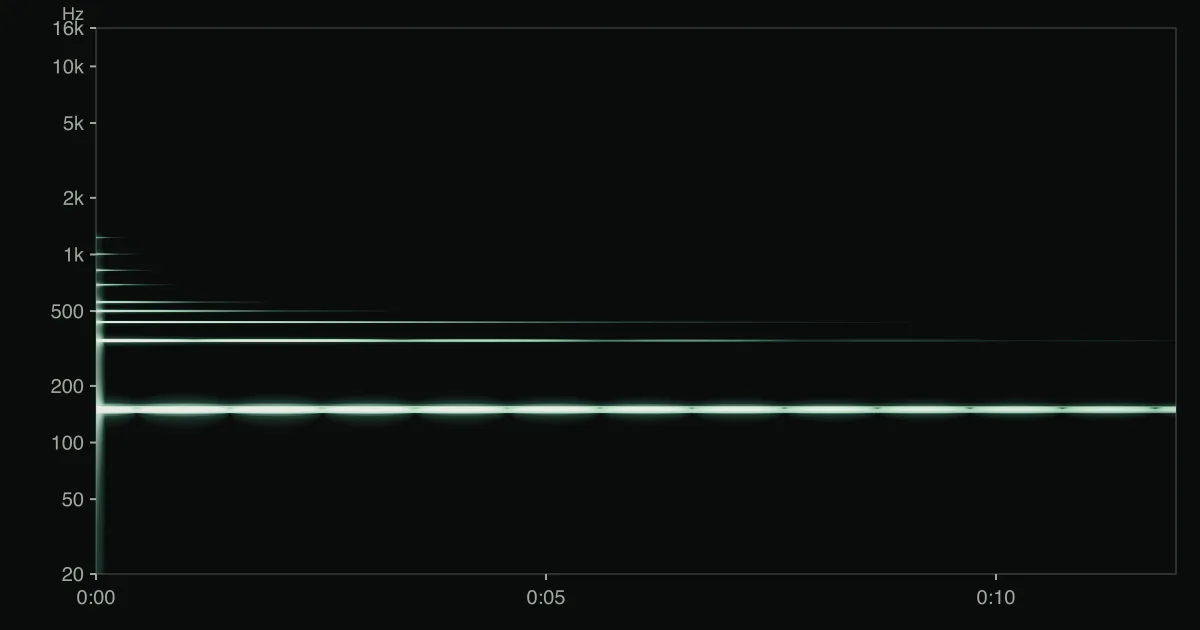
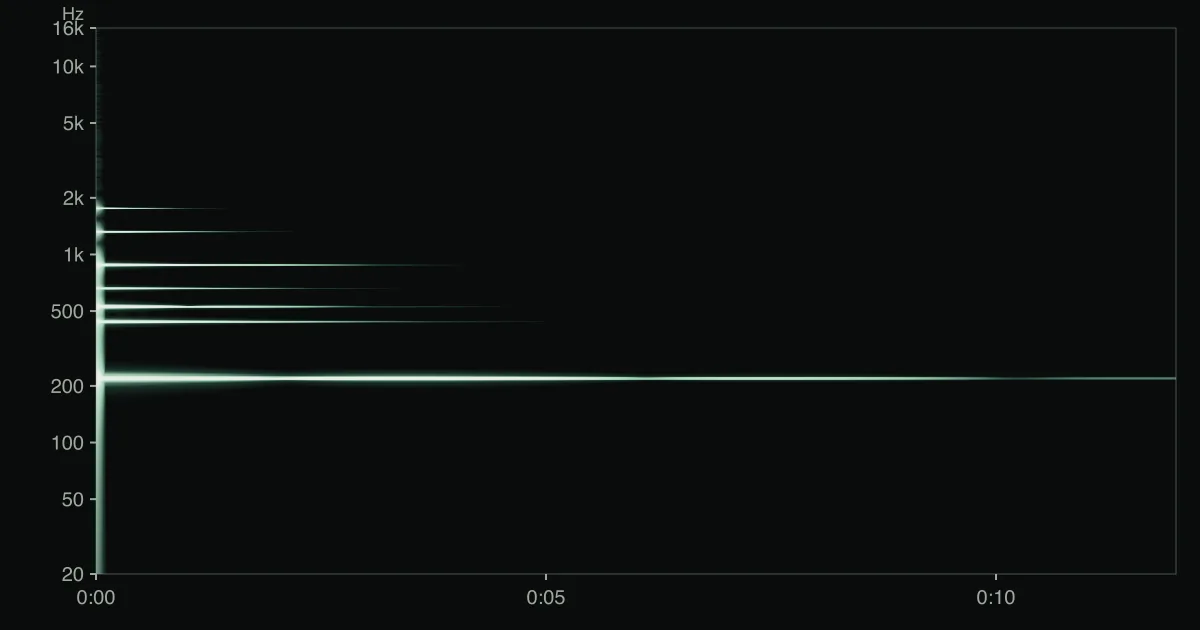
Temple bell: a heavy bell with nine modes. The fundamental rings for 40 s; the ×2.32 and ×2.91 modes start strong but fade in 8-10 s. The fundamental's twin is at 1 Hz. The pitch range is 60-250 Hz.
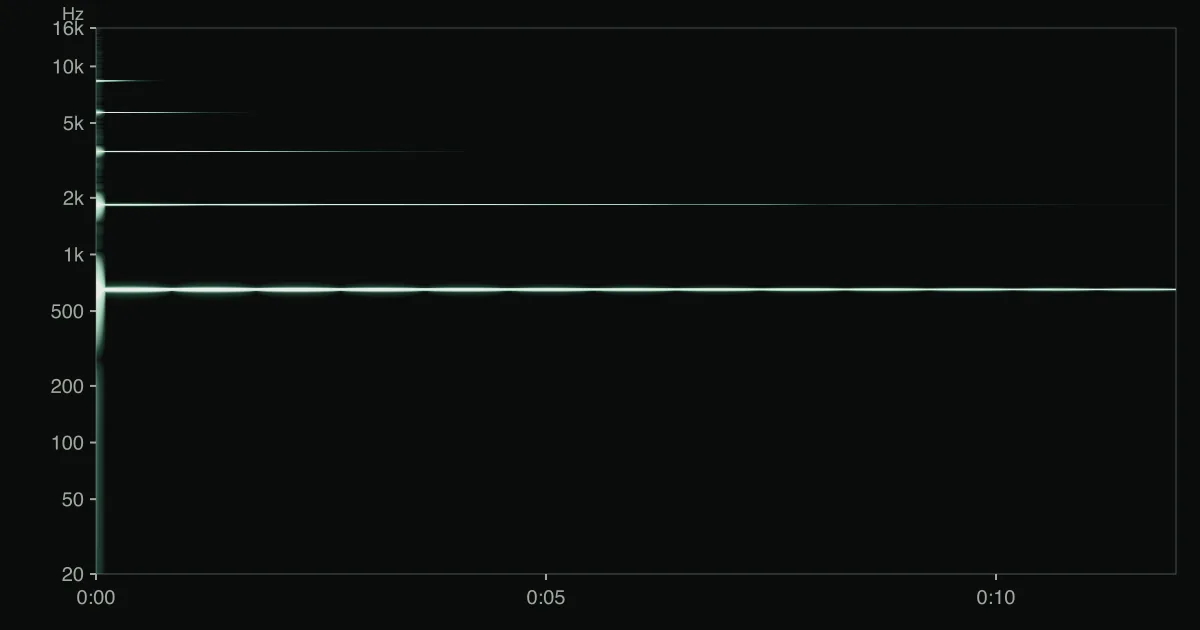
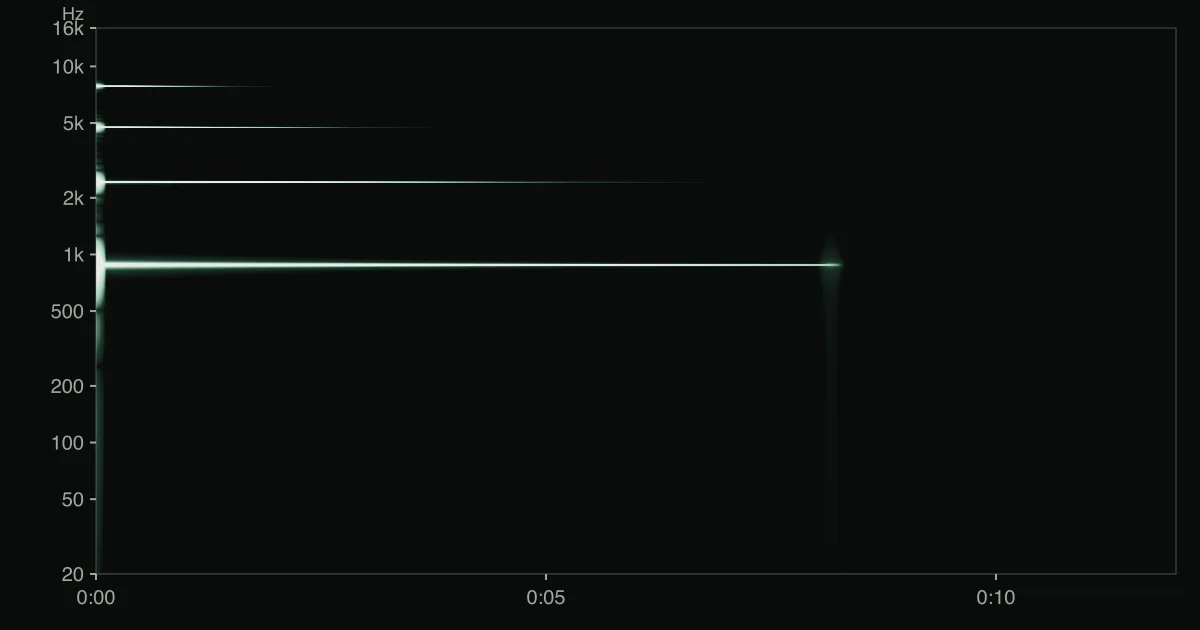
Orin: the ×2.83, ×5.42 and ×8.77 modes follow the ratios of a thin ring, which makes the tone clean and bright. The fundamental rings for 20 s and the twin beat is 1.1 Hz. The pitch range is 300-1500 Hz.
Gong: a dense spectrum of twenty-one modes; close modes such as ×1.52 and ×2.03 overlap. A light strike stays deep and plain; a strong strike opens the upper modes later. The fundamental rings for 30 s.
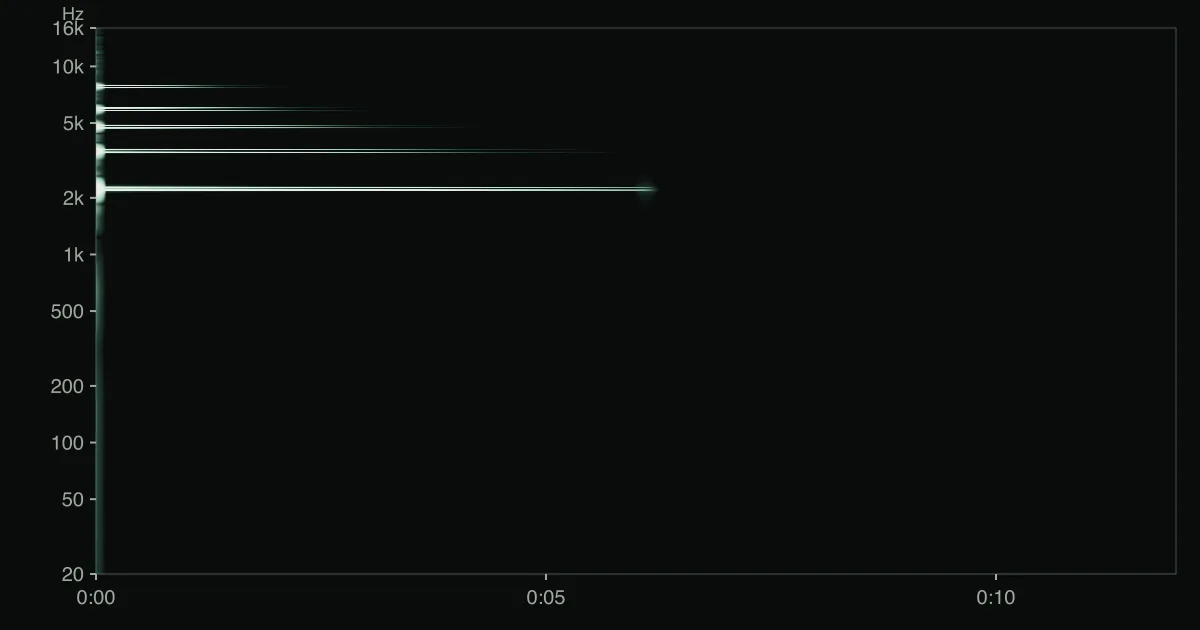
Tingsha: two small cymbals. The modes come in pairs (×1 and ×1.03); at 2200 Hz the difference is heard as fast roughness. The fundamental fades in 6 s, so the sound is sharp and short.
Bronze bell: the modes of the bell family: hum ×0.5, prime ×1, tierce ×1.2, quint ×1.5, nominal ×2. The nominal is the strongest mode and the hum rings longest (12 s).
Sounding bar: the modes of a free bar: ×2.76, ×5.4 and ×8.93 are inharmonic intervals. The fundamental rings for 8 s. A strike at the end excites every mode; at the middle the modes with a node there fall silent.
The sound is not played from a recording. Each instrument is a table of modes defined by ratio, decay and level; the engine generates those modes one by one on your device. The same settings give the same sound everywhere.
Strike place only matters on instruments with published physics: thin-shell modes (Rayleigh) on the bowl, crystal and orin, free-bar modes on the bar. On the gong, temple bell, bronze bell and tingsha the place does not change the sound.
Each image is the measured spectrogram of one strong strike at the instrument's default settings, generated dry by the engine itself. The horizontal axis is time, the vertical axis frequency (logarithmic). The measurement is the physics of the sound and says nothing about any effect.
Singing bowls are a traditional listening practice; the evidence is very uncertain about their effect on relaxation.
What don't we know? There are very few studies and the designs are weak; the authors do not yet recommend singing bowl practices.
Findings and sources· v1.15 · changelog
No cookies, no tracking. Details: Privacy notice (KVKK) On-device storage