440 Hz: the A4 standard and the tunings around it
Tone generator and sweep · 440 Hz
Where did the standard come from?
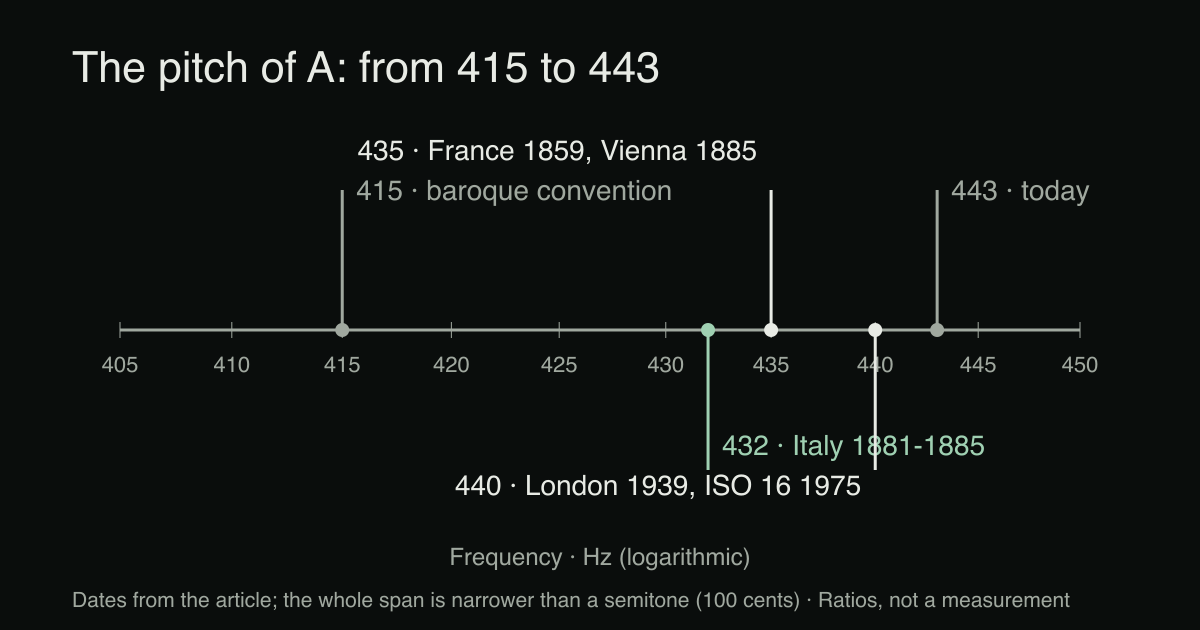
Until the 19th century the pitch of A varied from place to place; France adopted 435 Hz in 1859, and the 1885 Vienna conference accepted it across Europe. 440 Hz spread in the early 20th century, especially in the United States: the National Bureau of Standards began broadcasting a 440 Hz reference tone in 1936, the 1939 London conference recommended 440, and ISO published it as a recommendation in 1955 and as a standard in 1975. The 'imposed by the Nazis' story was examined by a fact-checking organisation and found baseless.
The tunings around it, in cents
Tuning differences are measured as ratios: 1,200 · log₂(f / 440). 432 Hz is −31.8 cents, 435 Hz −19.8 cents, 442 Hz +7.9 cents, 443 Hz +11.8 cents, the 415 Hz of baroque ensembles −101 cents (a semitone flat). A semitone is 100 cents; the difference between 440 and 443 is inaudible on an instrument playing alone and is heard as a slow beat when the two play side by side (3 swells per second).
The harmonics of 440 Hz are 880, 1,320, 1,760 and 2,200 Hz: close to A5, E6, A6 and C#7. Its ratio with 528 Hz is exactly 5:6, a just minor third: played together, their harmonics coincide at 2,640 Hz. That comes not from any 'meaning' of 528 but from 528 = 440 × 1.2.
Evidence
440 Hz itself is a standard, not a treatment or an effect claim. The small studies comparing 432 and 440 are at level C: borderline differences in measures such as heart rate, inconsistent results, pilot samples; the evidence card offers 432 Hz as a tuning preference. Claims that 440 is 'unnatural' or 'creates tension' are not supported by these studies.
How to listen and test
In the tone generator, ?hz=440 is a pure A4; the chromatic tuner measures your instrument's A against this reference and can set the reference to 432, 442 or 443. In the harmonics and tuning tool switch A4 between 440 and 432 and listen; the Tuning experiment tests the two tunings blind and measurably: threshold, ABX, identification and preference.
What does the evidence say?
432 Hz versus 440 Hz tuning
There are small, inconsistent preliminary findings; we offer 432 Hz as a tuning preference.
What don't we know? Results are inconsistent, and two studies favour 440 Hz: in kickboxers and in male athletes, 440 Hz music during warm-up was linked to better performance than 432 Hz.
Findings and sources
Context · not a claim
Between 1750 and 1885 the pitch of A in Italy varied from city to city; France's 435 Hz of 1859 and the 1885 Vienna decision were the first steps towards a unified standard.
The claim that the 440 Hz standard was imposed by the Nazis or the Rockefellers was examined by a fact-checking organisation and found baseless.
Evidence levels and sources come from the database; the article adds no new claims. Evidence methodology
Studies
| Work | Type | n | Finding | Level |
|---|---|---|---|---|
| Bozok 2026[5] | Randomised controlled trial | 162 | 162 healthy university students under exam stress were randomized to no music, 528 Hz music or 432 Hz music. 528 Hz music raised salivary BDNF and CREB, and 432 Hz music raised GRP78; Stroop attention-test performance did not differ between groups. | C |
| Hohneck 2025[3] | Randomised controlled trial | 43 | In 43 cancer patients, a 15-minute live monochord session tuned to 432 Hz was compared with 443 Hz. Both lowered heart rate and brought similar positive changes in emotional well-being, fatigue, anxiety and stress scores; the drops in heart rate and pulse-wave velocity were larger with 432 Hz, while other measures did not differ. | C |
| Jebabli 2025[4] | Randomised controlled trial | 28 | In 28 kickboxers, warming up with music at about 440 Hz was associated with better speed-test performance and lower perceived exertion than music at 432 Hz; both beat no music. | C |
| Jebabli 2025[9] | Randomised controlled trial | 22 | A double-blind crossover study with 22 male athletes: preferred music during warm-up, whether at 440 or 432 Hz, was linked to better performance and a more positive mood than no music. With 440 Hz music, repeated-sprint times were shorter, jumps higher and the feeling score after the sprint test better than with 432 Hz; heart rate, fatigue index and perceived exertion did not differ between conditions. | C |
| Lockhart 2025[10] | Review | — | A history of tuning in Italy. From the late 1860s to the 1880s Verdi was closely concerned with tuning: in the early 1870s he backed the French diapason normal (A = 435 Hz), later leaned towards 432 and sent Arrigo Boito to argue for A = 432 at the Milan congress of 1881. In 1884 the Italian War Ministry prescribed A = 432 for orchestras and military ensembles; the Vienna congress of 1885 adopted 435 for Europe. | |
| Calamassi 2022[2] | Pilot study | 54 | During the COVID-19 pandemic, 54 emergency staff compared 440 Hz music, 432 Hz music and a break without music. State anxiety fell in all three groups, even without music; drops in breathing rate and systolic blood pressure appeared only in the 432 Hz group. Groups were compared only before and after within themselves, not with each other. | C |
| Thompson 2022[11] | Institutional page | — | A = 440 Hz was proposed in Stuttgart in 1834; France moved to 435 in 1859, the American Federation of Musicians adopted 440 in 1917, and a 1939 London conference unanimously recommended 440. There is no evidence for the claim that Goebbels led the conference: none of the German delegates was Goebbels, and French and Italian delegates took part. No evidence was found that Rockefeller grants depended on adopting 440; there has never been a single universally accepted pitch. | |
| Aravena 2020[8] | Randomised controlled trial | 42 | Forty-two moderately anxious patients awaiting tooth extraction were split into three groups: 15 minutes of music at 432 Hz (15), at 440 Hz (15) and no music (12). Anxiety scores were lower in both music groups than without music, with no difference between the two tunings. The abstract reports lower salivary cortisol with 432 Hz; in the full-text table cortisol did not change significantly in any group, and after accounting for baseline values there was no difference between 432 and 440 (p = 0.99). | C |
| Calamassi 2020[7] | Pilot study | 12 | A double-blind crossover pilot with 12 patients with spinal cord injuries: patients listened to their favourite music for 30 minutes a day, tuned to 440 and 432 Hz in two periods. The sleep score improved significantly in the 432 Hz period (+3.6; p = 0.02) but not in the 440 Hz period (−1.50; p = 0.34); perceived stress fell non-significantly with both tunings. Listening times and wash-out periods varied; the authors recommend larger samples. | C |
| Calamassi 2019[1] | Pilot study | 33 | In 33 healthy volunteers, music tuned to 432 Hz was associated with a borderline-significant (p = 0.05) larger drop in heart rate than 440 Hz; trends in blood pressure and breathing rate were not significant. The authors call for larger randomized studies. | C |
| Halbert 2018[6] | Experiment | 16 | A two-visit lab study with 16 people aged 20 to 50 with high blood pressure; the music switched between 440 and 432 Hz tuning every 10 minutes. A mental arithmetic task raised blood pressure and heart rate. Heart rate fell slightly more with 432 Hz music than with 440 Hz (mean −7.20 vs −5.33; p = 0.04); the order of the music also affected the result. | C |
Frequently asked questions
- Why did 440 Hz become the standard?
- It was a convention that spread in the early 20th century; the 1939 London conference recommended it and ISO made it a standard in 1975. There is no single historically 'correct' pitch.
- Can you hear the difference between 440 and 442 Hz?
- Alone, no; side by side, yes, as a beat of 2 swells per second. The difference is 7.9 cents.
Who is it for?
For whom
- Anyone looking for sound for relaxation, focus or a sleep routine; the sounds are generated on your device and promise no effect.
- Anyone who wants to read the evidence level of what they listen to.
- Musicians wondering where the standard pitch comes from, and anyone following the 432 debate; 440 is a convention, neither 'natural' nor 'harmful'.
Not for whom
- If you have epilepsy or a history of seizures, a psychiatric diagnosis, a medical device such as a pacemaker, tinnitus or any other health condition, or if you are pregnant, consult your doctor before use.
- Do not listen while driving or operating machinery.
- Keep your device volume comfortable, preferably below 60%. You can also use your device's headphone-safety settings.
Frekans Studio is not a medical device; it does not diagnose, treat or prevent any disease.
Listen and try
Sources
- Calamassi D, Pomponi GP. Music Tuned to 440 Hz Versus 432 Hz and the Health Effects: A Double-blind Cross-over Pilot Study. Explore (NY). 2019;15(4):283-290. doi:10.1016/j.explore.2019.04.001 PMID 31031095
- Calamassi D, Li Vigni ML, Fumagalli C, Gheri F, Pomponi GP, Bambi S. The Listening to music tuned to 440 Hz versus 432 Hz to reduce anxiety and stress in emergency nurses during the COVID-19 pandemic: a double-blind, randomized controlled pilot study. Acta Biomed. 2022;93(S2):e2022149. doi:10.23750/abm.v93iS2.12915 PMID 35545982
- Hohneck A, Rodríguez ÁM, Weingärtner S, Merx K, Sarodnick F, von Gagern F, et al. Differential effects of sound interventions tuned to 432 Hz or 443 Hz on cardiovascular parameters in cancer patients: a randomized cross-over trial. BMC Complement Med Ther. 2025;25(1):18. doi:10.1186/s12906-025-04758-5 PMID 39844155
- Jebabli N, Boujabli M, Khlifi M, Ouerghi N, Bouassida A, Ben Abderrahman A, et al. Effects of 440-Hz vs. 432-Hz preferred music frequencies, during warm-up, on intermittent anaerobic speed test performance in men and women kickboxers: a double-blind crossover study. PeerJ. 2025;13:e19084. doi:10.7717/peerj.19084 PMID 40061232
- Bozok ÜG, Özcan GB, Bayraktar B, Özen D. Acute Music-Frequency Exposure Modulates Salivary Stress and Neurotrophic Markers in Young Adults: A Randomized Controlled Trial. Brain Behav. 2026;16(5):e71452. doi:10.1002/brb3.71452 PMID 42043979
- Halbert JD, van Tuyll DR, Purdy C, Hao G, Cauthron S, Crookall C, et al. Low Frequency Music Slows Heart Rate and Decreases Sympathetic Activity. Music Med. 2018;10(4):180-185. doi:10.47513/mmd.v10i4.614
- Calamassi D, Lucicesare A, Pomponi GP, Bambi S. Music tuned to 432 Hz versus music tuned to 440 Hz for improving sleep in patients with spinal cord injuries: a double-blind cross-over pilot study. Acta Biomed. 2020;91(12-S):e2020008. doi:10.23750/abm.v91i12-S.10755 PMID 33263352
- Aravena PC, Almonacid C, Mancilla MI. Effect of music at 432 Hz and 440 Hz on dental anxiety and salivary cortisol levels in patients undergoing tooth extraction: a randomized clinical trial. J Appl Oral Sci. 2020;28:e20190601. doi:10.1590/1678-7757-2019-0601 PMID 32401941
- Jebabli N, Boujabli M, Ouergui I, Ouerghi N, Yagin FH, Yagin B, et al. Effect of listening to preferred music at different frequencies during warmup on physical performance and psychophysiological responses in male athletes. Sci Rep. 2025;15(1):36120. doi:10.1038/s41598-025-20465-0 PMID 41093978
- Lockhart E. Tuning Sounds in Italy, 1750–1885. Nineteenth-Century Music Review. 2025;22(3):344-360. doi:10.1017/S1479409824000375
- Thompson S. Fact Check: Tuning Standard Of A = 440 Hz Was NOT Driven By Nazis And Rockefellers, Nor By 'Desire For Discord'. Lead Stories; 2022.
Citations come from the evidence database; every source is verified with Crossref or PubMed. Links go to the publication's own page (DOI).
Where to go next
Method
- Sources
- Scientific statements rest on 1 claims in the evidence database; each claim's sources and review note are on its own page: 432 Hz versus 440 Hz tuning
- Editorial responsibility
- Murat Tunalı · Editorial responsibility lies with Murat Tunalı; no independent medical review has been carried out.
- How this article was prepared
- The first draft was prepared by an AI model (Claude); the article adds no new figures, citations or claims, and the evidence summary comes from the database. Murat Tunalı approved publication. No independent scientific adviser has reviewed it yet. Evidence methodology · Credits
- Limitations
- This article is for information only; it is not medical advice. Evidence levels are per claim; a session's level is the weakest of its linked claims.
- Updates
- Last updated: 4 November 2026
- Cite as
- Frekans Studio. “440 Hz: the A4 standard and the tunings around it”. Last updated: 4 November 2026. https://frekans.studio/en/frequency/440-hz