7.83 Hz and the Schumann resonance
A traditional or spiritual practice, not a scientific claim.
Session · Schumann 7.83 Hz · 20 min
Binaural generator · 7.83 Hz beat
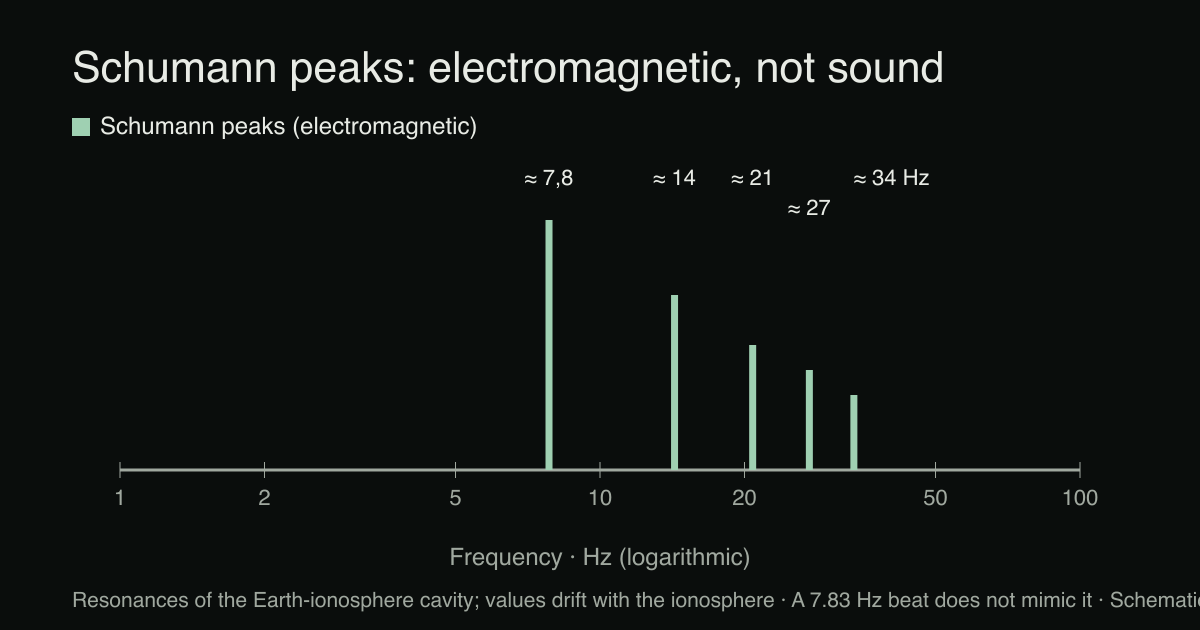
The physical phenomenon
The cavity between the Earth's surface and the ionosphere behaves like a resonator for extremely low-frequency electromagnetic waves. Lightning excites it continuously, producing peaks at certain frequencies. The values shift slightly with the state of the ionosphere.
In Frekans Studio
The Schumann session offers a 7.83 Hz beat as a listening ritual and carries a ✦ T strip. This sound does not physically tune you to the Schumann resonance.
What do the live charts show?
The "Schumann resonance today" charts that get shared are spectrograms of a monitoring station's extremely low-frequency electromagnetic field recordings. Changes in colour and brightness shift with lightning activity, the daily variation of the ionosphere and local interference. These charts do not show the frequency of a sound and do not measure any effect on people.
Measuring the sound
The two images and the table in this section were measured from the sound of the session below as it plays on the site: the audio was generated the way the engine generates it on your device, at the site's level. The measurement shows the physics of the sound; it says nothing about its effects.
Schumann 7.83 Hz · seconds 20-50
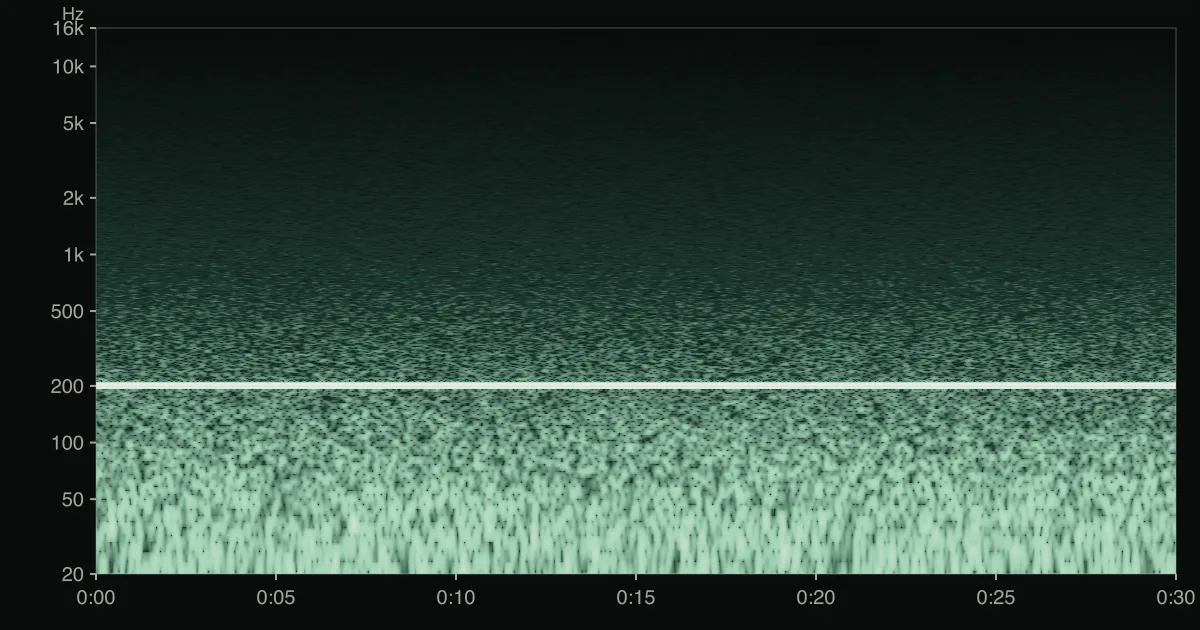
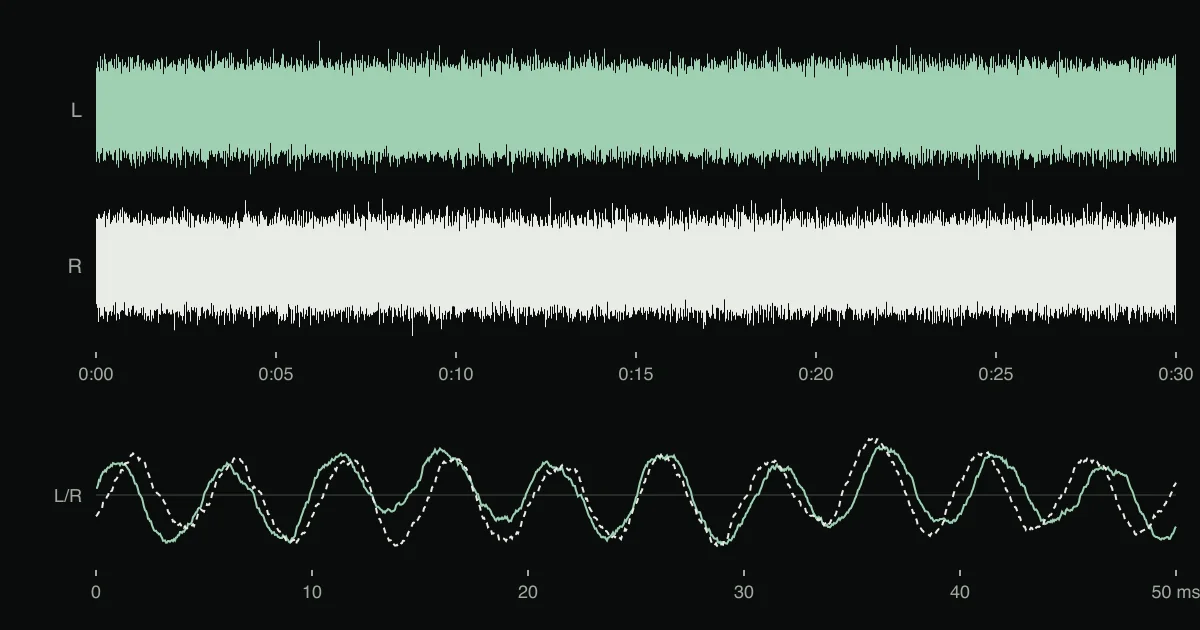
| Frequency | Channel | Level | Nearest note |
|---|---|---|---|
| 196.1 Hz | left | 0 dB | G3 +1 cents |
| 203.9 Hz | right | 0 dB | G♯3 −32 cents |
The difference between the tones in the left and right channels is 7.8 Hz: the rate of the binaural beat. This difference does not appear as a separate line in the spectrum.
What does the evidence say?
7.83 Hz and the Schumann resonance
A listening ritual; not a scientific claim. This sound does not create a physical attunement with the Schumann resonance.
What don't we know? There is no evidence that listening to a 7.83 Hz beat interacts with this electromagnetic phenomenon.
Findings and sources
Evidence levels and sources come from the database; the article adds no new claims. Evidence methodology
Studies
| Work | Type | n | Finding | Level |
|---|---|---|---|---|
| Price 2016[1] | Review | — | Lightning excites global electromagnetic resonances (Schumann resonances) at about 8, 14 and 20 Hz in the cavity between the Earth's surface and the ionosphere. The review covers their history, theory and use in lightning research. | T |
Frequently asked questions
- Is the Schumann resonance rising?
- The "resonance is rising" charts that circulate on social media are usually misreadings of monitoring stations' spectrograms. This page makes no claim on the subject.
Who is it for?
For whom
- Anyone looking for sound for relaxation, focus or a sleep routine; the sounds are generated on your device and promise no effect.
- Anyone who wants to read the evidence level of what they listen to.
- Anyone curious about the 'Earth frequency' claim; 7.83 Hz is an electromagnetic peak, not a sound, and cannot be heard; sessions represent it as a beat rate.
- Anyone trying it as a listening ritual, with no expectation of an effect.
Not for whom
- If you have epilepsy or a history of seizures, a psychiatric diagnosis, a medical device such as a pacemaker, tinnitus or any other health condition, or if you are pregnant, consult your doctor before use.
- Do not listen while driving or operating machinery.
- Keep your device volume comfortable, preferably below 60%. You can also use your device's headphone-safety settings.
Frekans Studio is not a medical device; it does not diagnose, treat or prevent any disease.
Listen and try
Schumann 7.83 Hz
Sources
Citations come from the evidence database; every source is verified with Crossref or PubMed. Links go to the publication's own page (DOI).
Where to go next
Method
- Sources
- Scientific statements rest on 1 claims in the evidence database; each claim's sources and review note are on its own page: 7.83 Hz and the Schumann resonance
- Editorial responsibility
- Murat Tunalı · Editorial responsibility lies with Murat Tunalı; no independent medical review has been carried out.
- How this article was prepared
- The first draft was prepared by an AI model (Claude); the article adds no new figures, citations or claims, and the evidence summary comes from the database. Murat Tunalı approved publication. No independent scientific adviser has reviewed it yet. Evidence methodology · Credits
- Limitations
- This article is for information only; it is not medical advice. Evidence levels are per claim; a session's level is the weakest of its linked claims.
- Updates
- Last updated: 5 November 2026
- Cite as
- Frekans Studio. “7.83 Hz and the Schumann resonance”. Last updated: 5 November 2026. https://frekans.studio/en/frequency/7-83-hz-schumann-resonance