396 Hz: the tone a perfect fourth below 528 Hz
A traditional or spiritual practice, not a scientific claim.
Session · Solfeggio 396 Hz · Pure Tone · 3 min
Tone generator and sweep · 396 Hz
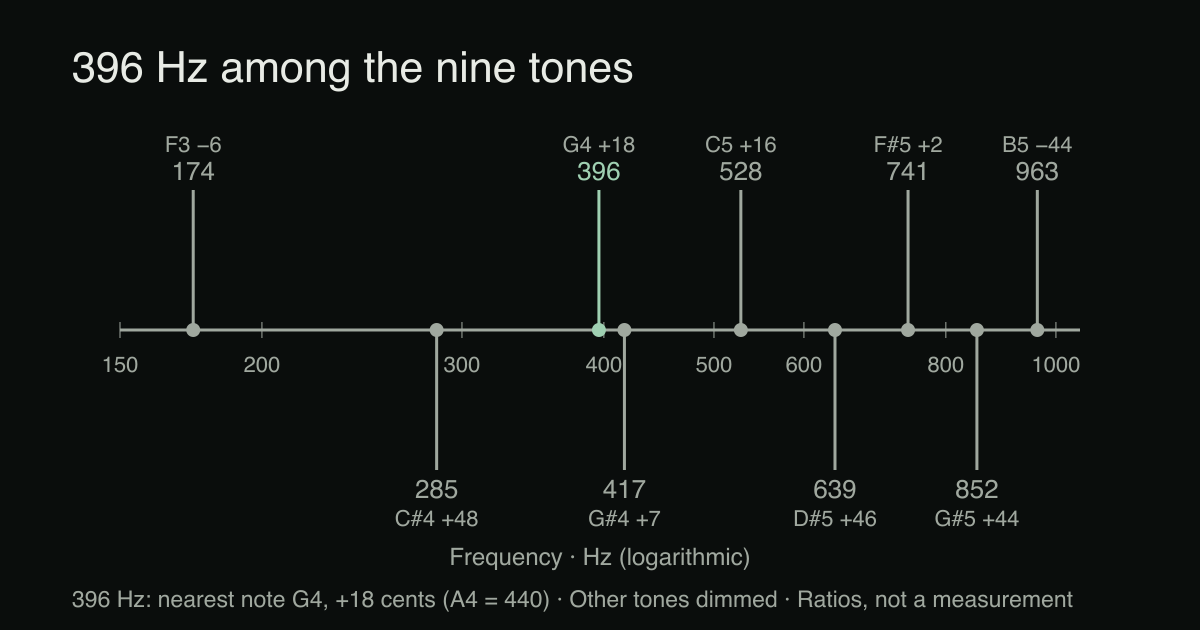
Its place in the list and the ratio with 528
396 Hz ends the first triad (174, 285, 396) and its digit sum is 18, that is 9. Its most notable feature in the list is its relation to 528 Hz: 396 : 528 = 3 : 4, an exact just fourth. Played together, their harmonics coincide (1,584 Hz = 4 × 396 = 3 × 528) and no roughness arises. 639 and 852 Hz form the same ratio; there is no other pure ratio among the nine tones.
The ratio does not come from the list's design: 396 = 528 × 0.75 is a coincidence; the other tones are not bound this neatly. It is still useful for listening: 396 and 528 Hz together make a still pair, and the Solfeggio Path plays that pair at a separate stop.
Where does it fall in music?
In equal temperament G4 is 392 Hz; 396 Hz is 18 cents above it. With A4 = 432 Hz, G4 drops to 384.87 Hz and the gap grows to 49 cents, a quarter tone. So 396 Hz is almost a G in 440 tuning and no note at all in 432 tuning. One octave down is 198, two octaves down 99 Hz: a bass G.
Tradition and evidence
The list was popularised by a non-peer-reviewed book published in 1999; this database holds no human study on 396 Hz. The page carries the ✦ T strip; the meanings attached to the tone are untested and are not written here. The two small studies on 528 Hz are summarised on the 528 Hz page; the 3:4 ratio does not carry those findings over to 396.
How to listen
The 396 Hz session in Explore and the stop on the Solfeggio Path wrap the tone in a slowly breathing texture. In the tone generator, ?hz=396; in the harmonics and tuning tool, set the root to 396 and choose 'Perfect fourth (3:4)' and the upper voice is exactly 528 Hz: hear the list's only pure ratio for yourself.
Note equivalent
396 Hz does not fall exactly on an equal-tempered note. The table maps the tone to the nearest note at three tuning references and gives the difference in cents: a cent is one hundredth of a semitone. The calculation is the equal-temperament formula in the site's tuning engine.
| Tuning (A4) | Nearest note | Note frequency | Tone's difference |
|---|---|---|---|
| 440 Hz | G4 | 392.00 Hz | +17.6 cents |
| 432 Hz | G4 | 384.87 Hz | +49.4 cents |
| 444 Hz | G4 | 395.56 Hz | +1.9 cents |
Measuring the sound
The two images and the table in this section were measured from the sound of the session below as it plays on the site: the audio was generated the way the engine generates it on your device, at the site's level. The measurement shows the physics of the sound; it says nothing about its effects.
Solfeggio 396 Hz · Pure Tone · seconds 18-48
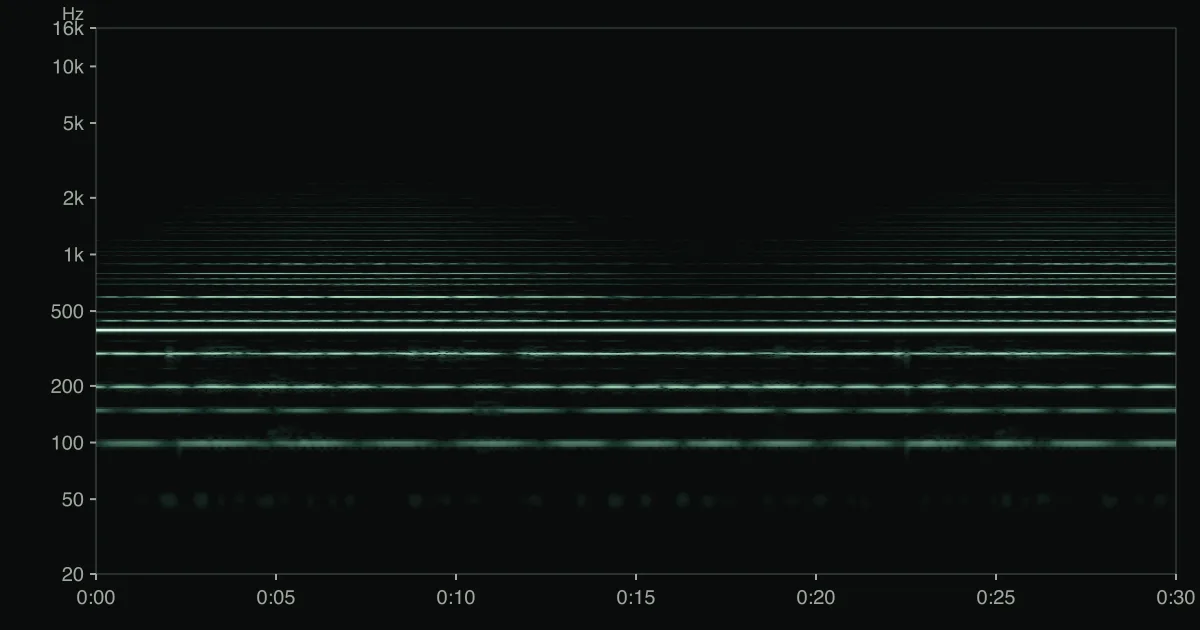
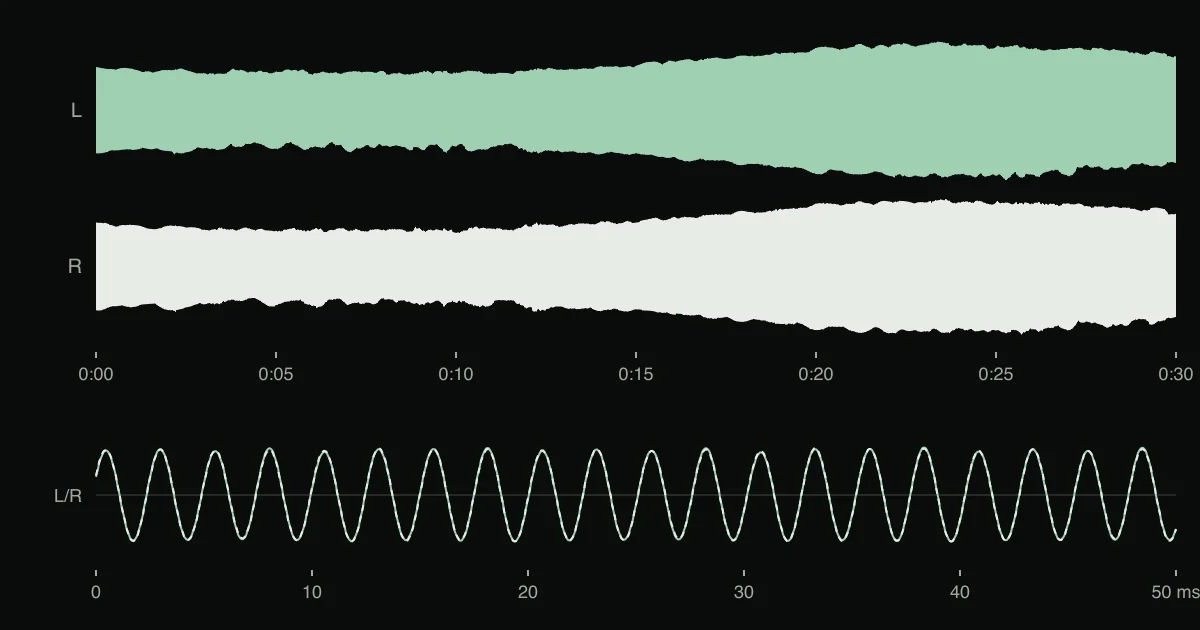
| Frequency | Channel | Level | Nearest note |
|---|---|---|---|
| 98.9 Hz | left | −40 dB | G2 +16 cents |
| 197.9 Hz | both channels | −31.1 dB | G3 +17 cents |
| 297 Hz | both channels | −26.5 dB | D4 +20 cents |
| 396 Hz | both channels | 0 dB | G4 +18 cents |
| 445.3 Hz | both channels | −33.7 dB | A4 +21 cents |
| 594.1 Hz | both channels | −25.1 dB | D5 +20 cents |
| 792 Hz | both channels | −31.6 dB | G5 +18 cents |
What does the evidence say?
The meanings of the Solfeggio frequencies
A modern spiritual interpretation; not a scientific claim.
What don't we know? The meanings given to the tones have not been scientifically tested, and different sources assign different meanings.
Findings and sources
Evidence levels and sources come from the database; the article adds no new claims. Evidence methodology
Studies
| Work | Type | n | Finding | Level |
|---|---|---|---|---|
| Horowitz 1999[1] | Book (not peer-reviewed) | — | One of the books that spread the modern 'Solfeggio frequencies' interpretation. It is not a peer-reviewed scientific study; it is cited to show where the interpretation comes from. | T |
Frequently asked questions
- Which note is 396 Hz?
- 18 cents above G4 at A4 = 440; 49 cents away from G4 in 432 tuning.
- Why do 396 and 528 Hz sound 'clean' together?
- Their ratio is exactly 3:4; their harmonics coincide at 1,584 Hz. That is a property of the just fourth, not of the tones themselves.
Who is it for?
For whom
- Anyone looking for sound for relaxation, focus or a sleep routine; the sounds are generated on your device and promise no effect.
- Anyone who wants to read the evidence level of what they listen to.
- Anyone who wants to hear 396 and 528 Hz together; the 3:4 ratio is a pure interval, and the meanings attached to the tones have not been tested.
- Anyone trying it as a listening ritual, with no expectation of an effect.
Not for whom
- If you have epilepsy or a history of seizures, a psychiatric diagnosis, a medical device such as a pacemaker, tinnitus or any other health condition, or if you are pregnant, consult your doctor before use.
- Do not listen while driving or operating machinery.
- Keep your device volume comfortable, preferably below 60%. You can also use your device's headphone-safety settings.
Frekans Studio is not a medical device; it does not diagnose, treat or prevent any disease.
Listen and try
Solfeggio 396 Hz · Pure Tone
Sources
Citations come from the evidence database; every source is verified with Crossref or PubMed. Links go to the publication's own page (DOI).
Where to go next
Method
- Sources
- Scientific statements rest on 1 claims in the evidence database; each claim's sources and review note are on its own page: The meanings of the Solfeggio frequencies
- Editorial responsibility
- Murat Tunalı · Editorial responsibility lies with Murat Tunalı; no independent medical review has been carried out.
- How this article was prepared
- The first draft was prepared by an AI model (Claude); the article adds no new figures, citations or claims, and the evidence summary comes from the database. Murat Tunalı approved publication. No independent scientific adviser has reviewed it yet. Evidence methodology · Credits
- Limitations
- This article is for information only; it is not medical advice. Evidence levels are per claim; a session's level is the weakest of its linked claims.
- Updates
- Last updated: 11 November 2026
- Cite as
- Frekans Studio. “396 Hz: the tone a perfect fourth below 528 Hz”. Last updated: 11 November 2026. https://frekans.studio/en/frequency/396-hz