Beta waves (13-30 Hz)
Session · Pre-Task Warm-Up · Alpha 10 Hz · 10 min
Binaural generator · 18 Hz beat
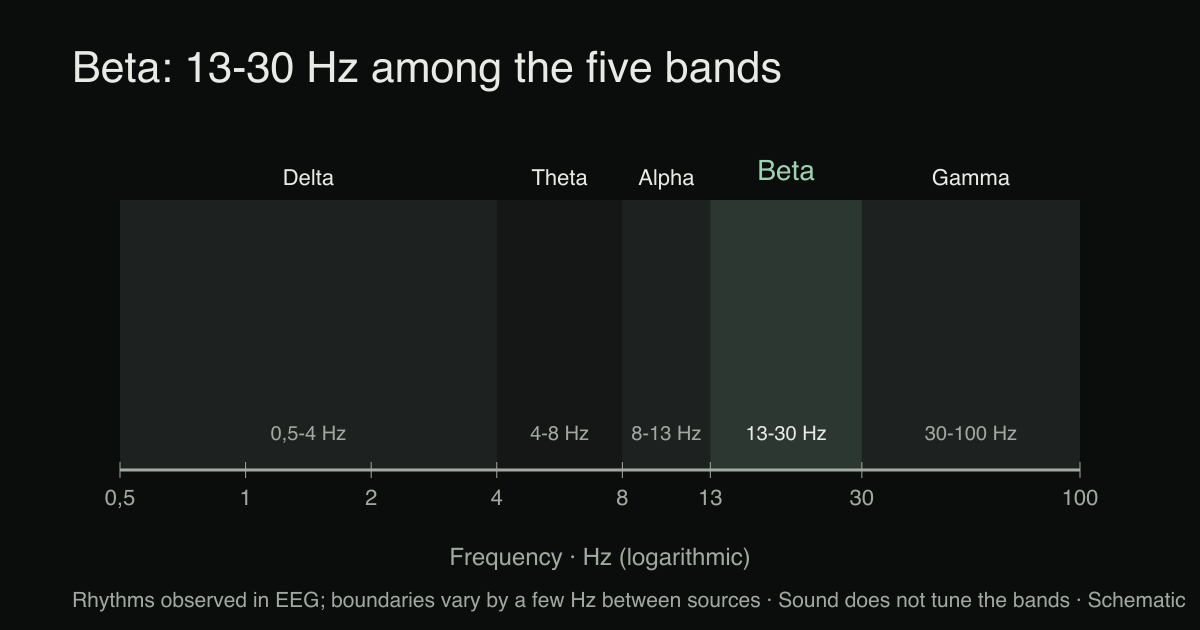
When is beta seen?
Beta activity increases during wakefulness, while concentrating on a task and when preparing movements. High beta sometimes also accompanies tension.
Can sound change the beta band?
A measurable EEG response to a beat can occur: the brainstem responds at the two tone frequencies, and a weak response at the beat frequency may appear in the cortex. For binaural beats this response is weaker than for monaural beats and weakens further under white noise. In a review of 14 EEG studies, only 5 were consistent with the hypothesis that the brain follows the beat and 8 were contradictory; the response has not been shown to change mental states reliably.
Evidence on focus is weak and conflicting. Two meta-analyses found a moderate overall effect (g = 0.40 and g = 0.45), but in two home experiments with 1,000 people in total, 15 Hz and 5 Hz beats lowered reasoning test scores. In a three-experiment study, a 16 Hz binaural beat did not improve sustained attention.
The five bands side by side
| Band | Frequency range | Most prominent in EEG | Use on this site | Evidence |
|---|---|---|---|---|
| Delta | Below 4 Hz | Deep (slow-wave) sleep | In sleep sessions the beat descends from theta to delta | C · Binaural beats and sleep |
| Theta | 4-8 Hz | Drowsiness, light sleep, some meditative states | Meditation and relaxation sessions | C · Binaural beats and short-term anxiety |
| Alpha | 8-13 Hz | Calm wakefulness with eyes closed | Relaxation sessions | C · Binaural beats and short-term anxiety |
| Beta | 13-30 Hz | Awake, attentive, active thinking | Pre-task focus session | C · Binaural beats, focus and memory |
| Gamma | Above 30 Hz | Tasks involving perception and attention | 40 Hz isochronic session, with a warning | D · 40 Hz stimulation and cognition |
Measuring the sound
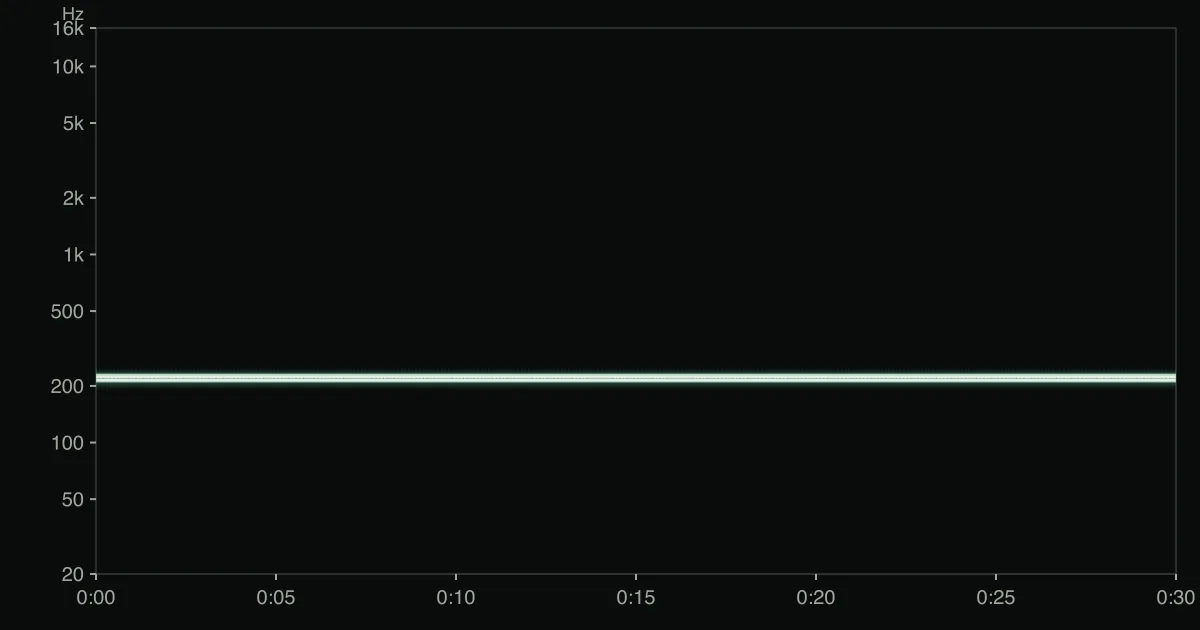
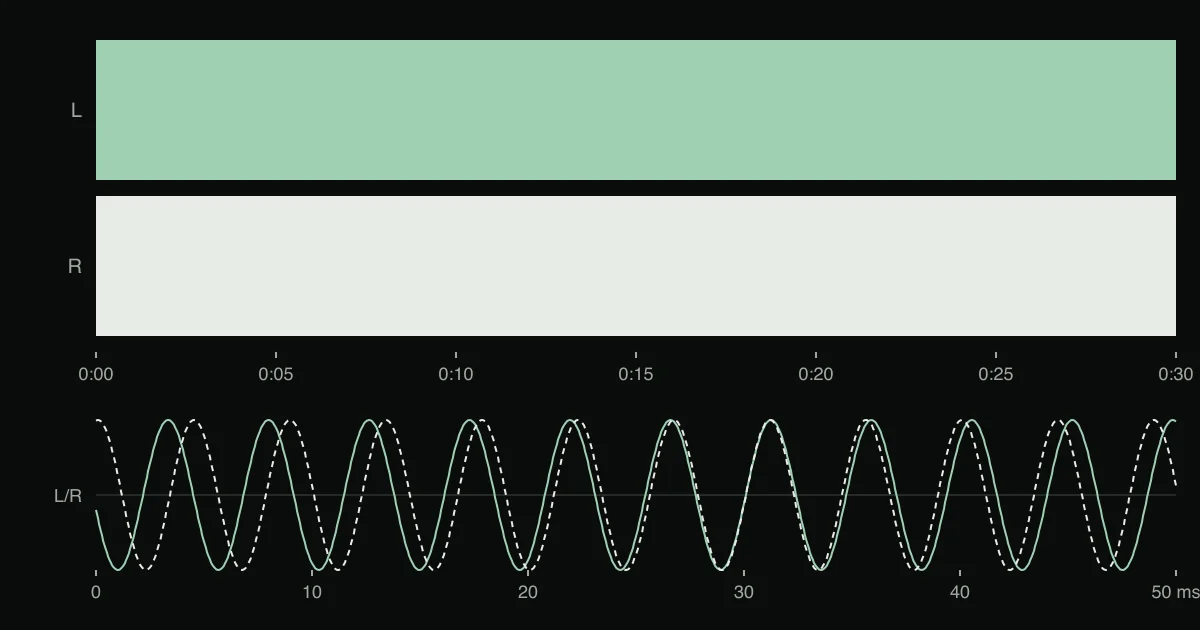
The two images and the table in this section were measured from the sound of the session below as it plays on the site: the audio was generated the way the engine generates it on your device, at the site's level. The measurement shows the physics of the sound; it says nothing about its effects.
Pre-Task Warm-Up · Alpha 10 Hz · seconds 15-45
| Frequency | Channel | Level | Nearest note |
|---|---|---|---|
| 215 Hz | left | −0.1 dB | A3 −40 cents |
| 225 Hz | right | 0 dB | A3 +39 cents |
The difference between the tones in the left and right channels is 10 Hz: the rate of the binaural beat. This difference does not appear as a separate line in the spectrum.
What does the evidence say?
Binaural beats and brainwave entrainment
The brain may show a weak response at the beat frequency; this response has not been shown to reliably change mental state.
What don't we know? In a review of 14 EEG studies, only 5 were consistent with the entrainment hypothesis and 8 contradicted it.
Findings and sourcesBinaural beats, focus and memory
Evidence is weak and conflicting; in some studies binaural beats lowered test performance.
What don't we know? Results conflict.
Findings and sources
Evidence levels and sources come from the database; the article adds no new claims. Evidence methodology
Studies
| Work | Type | n | Finding | Level |
|---|---|---|---|---|
| Melnichuk 2025[3] | Experiment | 80 | Sixteen parameter conditions were tested; 80 undergraduates were randomized and 64 analysed. 40 Hz binaural beats with a low (340 Hz) carrier improved general attention performance but did not prevent the decline of attention over time. EEG showed a response at the beat frequency that varied with parameters and weakened under white-noise masking. The authors say the finding needs replication. | C |
| Leistiko 2024[7] | Experiment | 58 | In 58 healthy adults, 40 Hz (gamma) binaural beats did not change attention-test performance (reaction time, errors, attention networks) compared with a control tone, and had no effect on a single-item self-rating of anxiety. | C |
| Basu 2023[5] | Meta-analysis | 15 studies | A meta-analysis of 15 studies found a medium, significant overall effect of binaural beats on memory and attention. The systematic review found conflicting results, especially for theta and beta beats on memory and attention tasks; the authors call for more robust designs. | C |
| Ingendoh 2023[1] | Systematic review | 14 studies | Of 14 EEG studies on binaural beats and brain oscillations, 5 were consistent with the entrainment hypothesis, 8 contradicted it and 1 was mixed. The studies differed greatly in method, which limits comparison; the authors call for standardized approaches. | C |
| Klichowski 2023[6] | Experiment | 1000 | In two online home experiments, 1,000 adults took a reasoning test. Listening to binaural beats during the second half lowered scores regardless of how the sound was framed, while silence and other sounds had no effect. The authors concluded that home-use binaural beats may weaken rather than support cognitive performance. | C |
| Robison 2022[8] | Experiment | — | Three experiments tested 16 Hz (beta) binaural beats on sustained attention. The first two gave inconsistent results; their combined data gave rather strong evidence against the hypothesis that beta beats improve sustained attention. Pupil measures showed no effect either. | C |
| Orozco 2020[2] | Experiment | 16 | In a 16-person EEG experiment, both binaural and monaural beats produced a brainstem response at the tone frequencies and a cortical response at the beat frequency; the cortical response to binaural beats was weaker than to monaural beats. Neither stimulus changed mood. | C |
| Garcia-Argibay 2019[4] | Meta-analysis | 22 studies | A meta-analysis of 22 studies on memory, attention, anxiety and pain found a medium, significant overall effect. Listening before the task (or before and during it) worked better than listening only during it, and longer exposure increased the effect. Masking with white or pink noise did not appear necessary. | C |
Frequently asked questions
- Should I choose beta for focus?
- No specific beat rate has been shown reliably to improve focus. Masking surrounding sounds with noise and taking regular breaks rest on firmer ground.
Who is it for?
For whom
- Anyone looking for sound for relaxation, focus or a sleep routine; the sounds are generated on your device and promise no effect.
- Anyone who wants to read the evidence level of what they listen to.
- Anyone who wants to understand the 13-30 Hz beat in focus sessions; beta is the rhythm of waking attention, and the evidence that listening to the beat improves focus is weak.
Not for whom
- If you have epilepsy or a history of seizures, a psychiatric diagnosis, a medical device such as a pacemaker, tinnitus or any other health condition, or if you are pregnant, consult your doctor before use.
- Do not listen while driving or operating machinery.
- Keep your device volume comfortable, preferably below 60%. You can also use your device's headphone-safety settings.
Frekans Studio is not a medical device; it does not diagnose, treat or prevent any disease.
Listen and try
Pre-Task Warm-Up · Alpha 10 Hz
Sources
- Ingendoh RM, Posny ES, Heine A. Binaural beats to entrain the brain? A systematic review of the effects of binaural beat stimulation on brain oscillatory activity, and the implications for psychological research and intervention. PLoS One. 2023;18(5):e0286023. doi:10.1371/journal.pone.0286023 PMID 37205669
- Orozco Perez HD, Dumas G, Lehmann A. Binaural Beats through the Auditory Pathway: From Brainstem to Connectivity Patterns. eNeuro. 2020;7(2):ENEURO.0232-19.2020. doi:10.1523/ENEURO.0232-19.2020 PMID 32066611
- Melnichuk A, Cooper RK, Hawk LW. A parametric investigation of binaural beats for brain entrainment and enhancing sustained attention. Sci Rep. 2025;15(1):4308. doi:10.1038/s41598-025-88517-z PMID 39910150
- Garcia-Argibay M, Santed MA, Reales JM. Efficacy of binaural auditory beats in cognition, anxiety, and pain perception: a meta-analysis. Psychol Res. 2019;83(2):357-372. doi:10.1007/s00426-018-1066-8 PMID 30073406
- Basu S, Banerjee B. Potential of binaural beats intervention for improving memory and attention: insights from meta-analysis and systematic review. Psychol Res. 2023;87(4):951-963. doi:10.1007/s00426-022-01706-7 PMID 35842538
- Klichowski M, Wicher A, Kruszwicka A, Golebiewski R. Reverse effect of home-use binaural beats brain stimulation. Sci Rep. 2023;13(1):11079. doi:10.1038/s41598-023-38313-4 PMID 37422545
- Leistiko NM, Madanat L, Yeung WKA, Stone JM. Effects of gamma frequency binaural beats on attention and anxiety. Curr Psychol. 2024;43(6):5032-5039. doi:10.1007/s12144-023-04681-3 PMID 37359672
- Robison MK, Obulasetty M, Blais C, Wingert KM, Brewer GA. The effect of binaural beat stimulation on sustained attention. Psychol Res. 2022;86(3):808-822. doi:10.1007/s00426-021-01524-3 PMID 33978805
Citations come from the evidence database; every source is verified with Crossref or PubMed. Links go to the publication's own page (DOI).
Where to go next
Method
- Sources
- Scientific statements rest on 2 claims in the evidence database; each claim's sources and review note are on its own page: Binaural beats and brainwave entrainment · Binaural beats, focus and memory
- Editorial responsibility
- Murat Tunalı · Editorial responsibility lies with Murat Tunalı; no independent medical review has been carried out.
- How this article was prepared
- The first draft was prepared by an AI model (Claude); the article adds no new figures, citations or claims, and the evidence summary comes from the database. Murat Tunalı approved publication. No independent scientific adviser has reviewed it yet. Evidence methodology · Credits
- Limitations
- This article is for information only; it is not medical advice. Evidence levels are per claim; a session's level is the weakest of its linked claims.
- Updates
- Last updated: 11 November 2026
- Cite as
- Frekans Studio. “Beta waves (13-30 Hz)”. Last updated: 11 November 2026. https://frekans.studio/en/frequency/beta-waves