Theta waves (4-8 Hz)
Session · Theta Meditation · 20 min
Binaural generator · 6 Hz beat
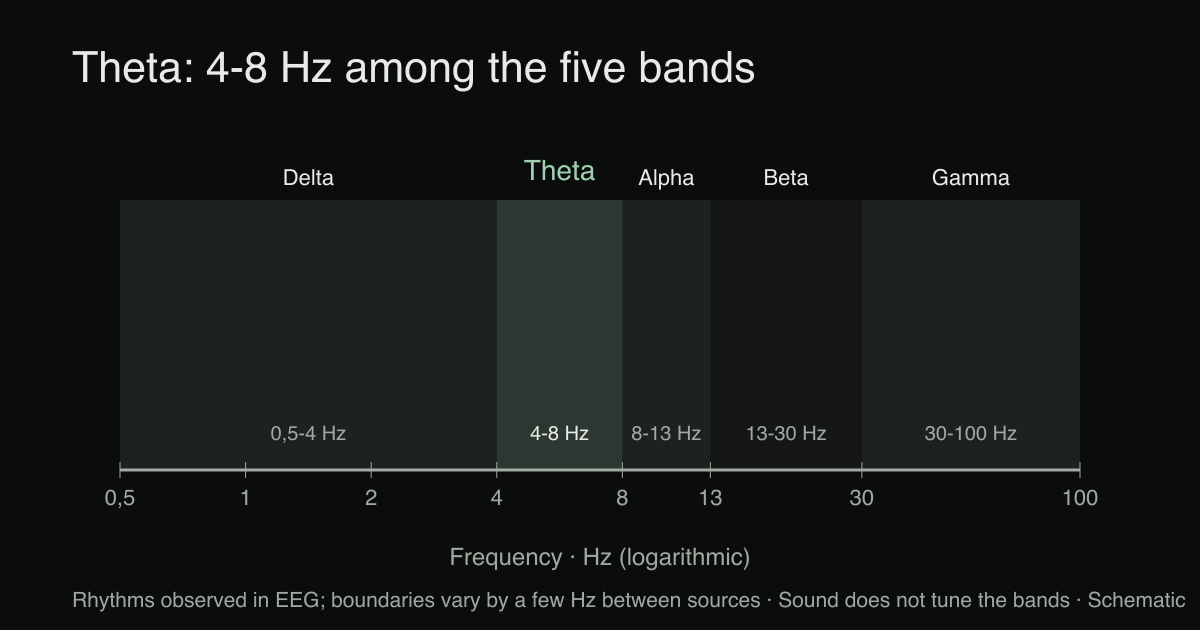
When is theta seen?
Theta activity increases with drowsiness, in light sleep and, in experienced practitioners, in some meditative states. A theta rhythm is also measured in certain brain regions during memory tasks.
Can sound change the theta band?
A measurable EEG response to a beat can occur: the brainstem responds at the two tone frequencies, and a weak response at the beat frequency may appear in the cortex. For binaural beats this response is weaker than for monaural beats and weakens further under white noise. In a review of 14 EEG studies, only 5 were consistent with the hypothesis that the brain follows the beat and 8 were contradictory; the response has not been shown to change mental states reliably.
Studies of binaural beats on anxiety and stress use different beat rates, so the results are not specific to the theta band. Of 12 randomized trials on stress, 8 reported a positive result on at least one measure and 4 found no difference; heterogeneity between studies is very high. The evidence library holds no study showing that a beat brings on a meditative state by itself.
The five bands side by side
| Band | Frequency range | Most prominent in EEG | Use on this site | Evidence |
|---|---|---|---|---|
| Delta | Below 4 Hz | Deep (slow-wave) sleep | In sleep sessions the beat descends from theta to delta | C · Binaural beats and sleep |
| Theta | 4-8 Hz | Drowsiness, light sleep, some meditative states | Meditation and relaxation sessions | C · Binaural beats and short-term anxiety |
| Alpha | 8-13 Hz | Calm wakefulness with eyes closed | Relaxation sessions | C · Binaural beats and short-term anxiety |
| Beta | 13-30 Hz | Awake, attentive, active thinking | Pre-task focus session | C · Binaural beats, focus and memory |
| Gamma | Above 30 Hz | Tasks involving perception and attention | 40 Hz isochronic session, with a warning | D · 40 Hz stimulation and cognition |
Measuring the sound
The two images and the table in this section were measured from the sound of the session below as it plays on the site: the audio was generated the way the engine generates it on your device, at the site's level. The measurement shows the physics of the sound; it says nothing about its effects.
Theta Meditation · seconds 18-48
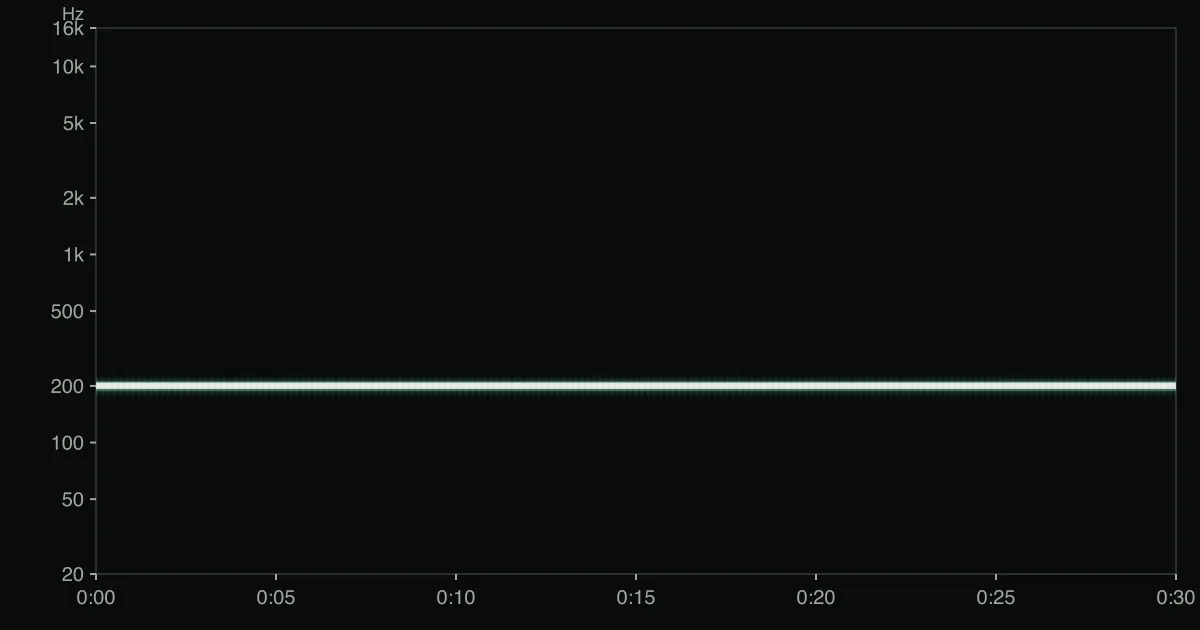
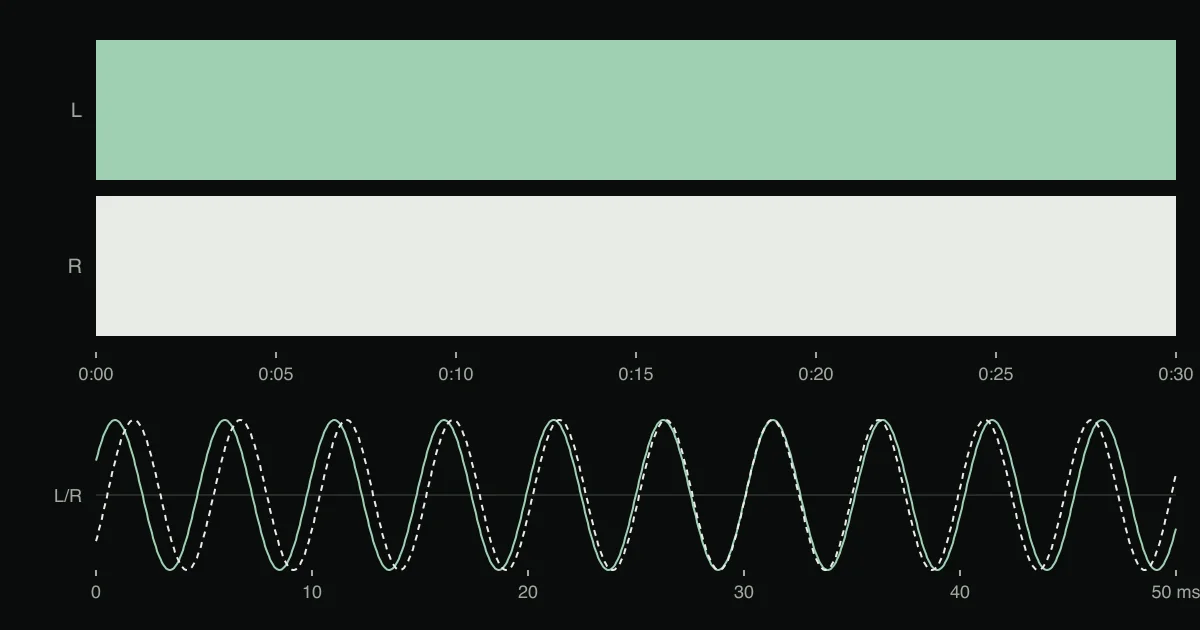
| Frequency | Channel | Level | Nearest note |
|---|---|---|---|
| 197 Hz | left | 0 dB | G3 +9 cents |
| 203 Hz | right | −0.1 dB | G♯3 −39 cents |
The difference between the tones in the left and right channels is 6 Hz: the rate of the binaural beat. This difference does not appear as a separate line in the spectrum.
What does the evidence say?
Binaural beats and brainwave entrainment
The brain may show a weak response at the beat frequency; this response has not been shown to reliably change mental state.
What don't we know? In a review of 14 EEG studies, only 5 were consistent with the entrainment hypothesis and 8 contradicted it.
Findings and sourcesBinaural beats and short-term anxiety
Listening to binaural beats may help short-term relaxation; results are inconsistent.
What don't we know? Some controlled studies found no effect: in a surgical trial with 90 patients in Türkiye, binaural and isochronic groups did not differ from a no-sound group, and in an online study of 58 people, 40 Hz beats did not change a single-item anxiety rating.
Findings and sources
Evidence levels and sources come from the database; the article adds no new claims. Evidence methodology
Studies
| Work | Type | n | Finding | Level |
|---|---|---|---|---|
| Akkurt 2026[7] | Randomised controlled trial | 90 | In 90 patients undergoing impacted lower third molar surgery in Türkiye, neither binaural beats nor isochronic tones reduced anxiety compared with no sound; only isolated physiological differences appeared. Of the patients who received sound, 78.3% said they would prefer it again in future procedures. | C |
| Melnichuk 2025[3] | Experiment | 80 | Sixteen parameter conditions were tested; 80 undergraduates were randomized and 64 analysed. 40 Hz binaural beats with a low (340 Hz) carrier improved general attention performance but did not prevent the decline of attention over time. EEG showed a response at the beat frequency that varied with parameters and weakened under white-noise masking. The authors say the finding needs replication. | C |
| Ostertag 2025[9] | Randomised controlled trial | — | In patients awaiting planned surgery, state anxiety fell slightly more in the group that listened to binaural beats before surgery than in the unstimulated control group (mean relative difference 6 percentage points, p = 0.045); anxiety fell in both groups. Alpha power did not differ between groups. | C |
| Platt 2025[6] | Systematic review | 12 studies | Of 12 randomized trials of binaural beats for stress, 8 reported at least one significant effect favouring binaural beats and 4 found none. Citing methodological heterogeneity and unclear randomisation and blinding, the authors concluded the evidence does not strongly support widespread recommendation and little is known about adverse effects. | C |
| Xiong 2025[5] | Meta-analysis | 15 studies | In a meta-analysis of 15 randomized trials in surgical patients, perioperative binaural beats were associated with lower anxiety and postoperative pain scores than blank audio. Heterogeneity between trials was very high; the authors call for standardized protocols and better trials. | C |
| Leistiko 2024[8] | Experiment | 58 | In 58 healthy adults, 40 Hz (gamma) binaural beats did not change attention-test performance (reaction time, errors, attention networks) compared with a control tone, and had no effect on a single-item self-rating of anxiety. | C |
| Ingendoh 2023[1] | Systematic review | 14 studies | Of 14 EEG studies on binaural beats and brain oscillations, 5 were consistent with the entrainment hypothesis, 8 contradicted it and 1 was mixed. The studies differed greatly in method, which limits comparison; the authors call for standardized approaches. | C |
| Orozco 2020[2] | Experiment | 16 | In a 16-person EEG experiment, both binaural and monaural beats produced a brainstem response at the tone frequencies and a cortical response at the beat frequency; the cortical response to binaural beats was weaker than to monaural beats. Neither stimulus changed mood. | C |
| Garcia-Argibay 2019[4] | Meta-analysis | 22 studies | A meta-analysis of 22 studies on memory, attention, anxiety and pain found a medium, significant overall effect. Listening before the task (or before and during it) worked better than listening only during it, and longer exposure increased the effect. Masking with white or pink noise did not appear necessary. | C |
Frequently asked questions
- Do theta beats make meditation easier?
- There is moderate evidence for meditation programmes themselves; whether a sound session alone has the same effect is not known. Think of theta sessions as a soundscape that accompanies meditation.
Who is it for?
For whom
- Anyone looking for sound for relaxation, focus or a sleep routine; the sounds are generated on your device and promise no effect.
- Anyone who wants to read the evidence level of what they listen to.
- Anyone curious about the 4-8 Hz beats in drift-off and meditation sessions; the band name describes an EEG rhythm, and it has not been shown to drive the listener's brain to that rate.
Not for whom
- If you have epilepsy or a history of seizures, a psychiatric diagnosis, a medical device such as a pacemaker, tinnitus or any other health condition, or if you are pregnant, consult your doctor before use.
- Do not listen while driving or operating machinery.
- Keep your device volume comfortable, preferably below 60%. You can also use your device's headphone-safety settings.
Frekans Studio is not a medical device; it does not diagnose, treat or prevent any disease.
Listen and try
Theta Meditation
Sources
- Ingendoh RM, Posny ES, Heine A. Binaural beats to entrain the brain? A systematic review of the effects of binaural beat stimulation on brain oscillatory activity, and the implications for psychological research and intervention. PLoS One. 2023;18(5):e0286023. doi:10.1371/journal.pone.0286023 PMID 37205669
- Orozco Perez HD, Dumas G, Lehmann A. Binaural Beats through the Auditory Pathway: From Brainstem to Connectivity Patterns. eNeuro. 2020;7(2):ENEURO.0232-19.2020. doi:10.1523/ENEURO.0232-19.2020 PMID 32066611
- Melnichuk A, Cooper RK, Hawk LW. A parametric investigation of binaural beats for brain entrainment and enhancing sustained attention. Sci Rep. 2025;15(1):4308. doi:10.1038/s41598-025-88517-z PMID 39910150
- Garcia-Argibay M, Santed MA, Reales JM. Efficacy of binaural auditory beats in cognition, anxiety, and pain perception: a meta-analysis. Psychol Res. 2019;83(2):357-372. doi:10.1007/s00426-018-1066-8 PMID 30073406
- Xiong J, Jiang X, Cai B, Zhao L, Zhang Q, Luo J. Binaural beats for perioperative anxiety and pain: A systematic review and meta-analysis. Complement Ther Med. 2025;95:103299. doi:10.1016/j.ctim.2025.103299 PMID 41176178
- Platt J, Hammond L. Is non-clinical, personal use of binaural beats audio an effective stress-management strategy? A systematic review of randomised control trials. Adv Ment Health. 2025;23(2):258-286. doi:10.1080/18387357.2024.2374759
- Akkurt O, Ekici Ö. Effect of binaural beats and isochronic tones on anxiety during impacted mandibular third molar surgery: a randomized controlled trial. Int J Oral Maxillofac Surg. 2026. doi:10.1016/j.ijom.2026.07.006 PMID 42471303
- Leistiko NM, Madanat L, Yeung WKA, Stone JM. Effects of gamma frequency binaural beats on attention and anxiety. Curr Psychol. 2024;43(6):5032-5039. doi:10.1007/s12144-023-04681-3 PMID 37359672
- Ostertag J, Zinn S, Georgii MT, Niederle MB, Pinto Campos C, Schneider G, Hayden O, Kratzer S, Kreuzer M. Binaural beat stimulation as a tool to reduce preoperative anxiety in patients undergoing elective surgery and general anesthesia - results from a randomized controlled trial. Biomed Phys Eng Express. 2025. doi:10.1088/2057-1976/adfa9d PMID 40795897
Citations come from the evidence database; every source is verified with Crossref or PubMed. Links go to the publication's own page (DOI).
Where to go next
Method
- Sources
- Scientific statements rest on 2 claims in the evidence database; each claim's sources and review note are on its own page: Binaural beats and brainwave entrainment · Binaural beats and short-term anxiety
- Editorial responsibility
- Murat Tunalı · Editorial responsibility lies with Murat Tunalı; no independent medical review has been carried out.
- How this article was prepared
- The first draft was prepared by an AI model (Claude); the article adds no new figures, citations or claims, and the evidence summary comes from the database. Murat Tunalı approved publication. No independent scientific adviser has reviewed it yet. Evidence methodology · Credits
- Limitations
- This article is for information only; it is not medical advice. Evidence levels are per claim; a session's level is the weakest of its linked claims.
- Updates
- Last updated: 11 November 2026
- Cite as
- Frekans Studio. “Theta waves (4-8 Hz)”. Last updated: 11 November 2026. https://frekans.studio/en/frequency/theta-waves