Delta waves (below 4 Hz)
Session · Drift Off · Theta to Delta · 45 min
Binaural generator · 2 Hz beat
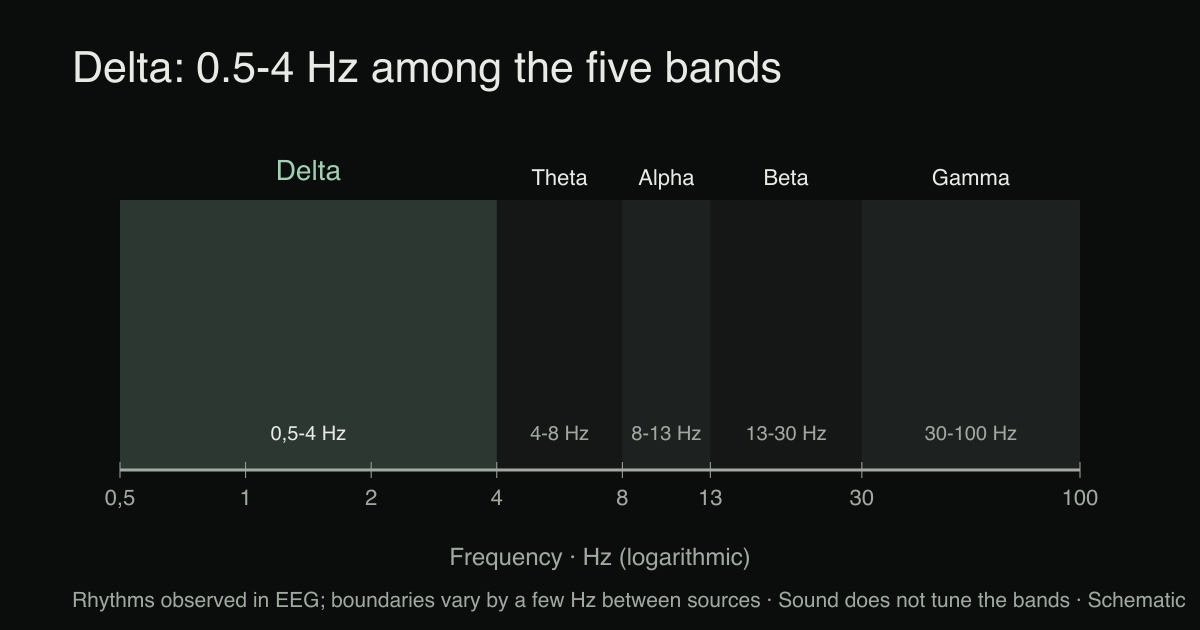
When is delta seen?
In adults delta activity is most prominent in the deep sleep of the first half of the night. Dominant delta activity while awake is not typical.
Can sound change the delta band?
A measurable EEG response to a beat can occur: the brainstem responds at the two tone frequencies, and a weak response at the beat frequency may appear in the cortex. For binaural beats this response is weaker than for monaural beats and weakens further under white noise. In a review of 14 EEG studies, only 5 were consistent with the hypothesis that the brain follows the beat and 8 were contradictory; the response has not been shown to change mental states reliably.
Research on binaural beats for sleep is at an early stage. Two small pilot studies reported positive results: in a study without a control group the sleep diaries of 20 students improved, and in a 10-person lab study the time to fall asleep shortened. But in a home study with 221 people, binaural, monaural and beat-free steady sounds made no difference to how long it took to fall asleep.
Delta in Frekans Studio
In sleep sessions the beat descends slowly from the theta band to the delta band; it is a listening routine and makes no medical claim. Sleep sessions ask you to confirm you are not driving before they start.
The five bands side by side
| Band | Frequency range | Most prominent in EEG | Use on this site | Evidence |
|---|---|---|---|---|
| Delta | Below 4 Hz | Deep (slow-wave) sleep | In sleep sessions the beat descends from theta to delta | C · Binaural beats and sleep |
| Theta | 4-8 Hz | Drowsiness, light sleep, some meditative states | Meditation and relaxation sessions | C · Binaural beats and short-term anxiety |
| Alpha | 8-13 Hz | Calm wakefulness with eyes closed | Relaxation sessions | C · Binaural beats and short-term anxiety |
| Beta | 13-30 Hz | Awake, attentive, active thinking | Pre-task focus session | C · Binaural beats, focus and memory |
| Gamma | Above 30 Hz | Tasks involving perception and attention | 40 Hz isochronic session, with a warning | D · 40 Hz stimulation and cognition |
Measuring the sound
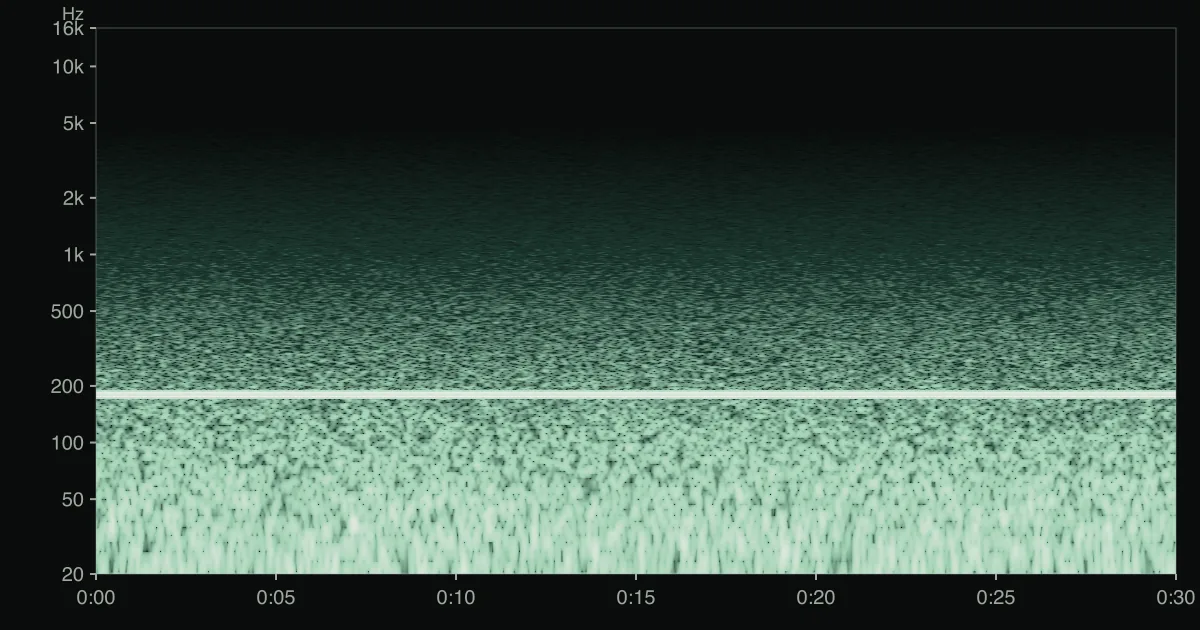
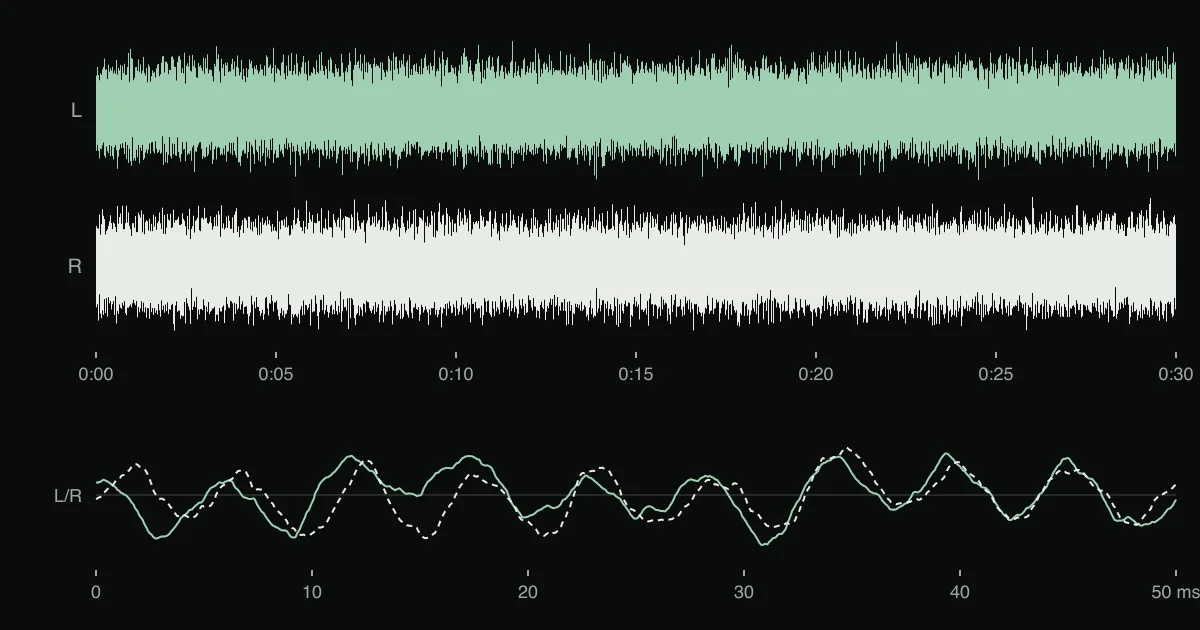
The two images and the table in this section were measured from the sound of the session below as it plays on the site: the audio was generated the way the engine generates it on your device, at the site's level. The measurement shows the physics of the sound; it says nothing about its effects.
Drift Off · Theta to Delta · seconds 20-50
| Frequency | Channel | Level | Nearest note |
|---|---|---|---|
| 176.1 Hz | left | −0.3 dB | F3 +15 cents |
| 183.9 Hz | right | 0 dB | F♯3 −10 cents |
The difference between the tones in the left and right channels is 7.8 Hz: the rate of the binaural beat. This difference does not appear as a separate line in the spectrum.
What does the evidence say?
Binaural beats and brainwave entrainment
The brain may show a weak response at the beat frequency; this response has not been shown to reliably change mental state.
What don't we know? In a review of 14 EEG studies, only 5 were consistent with the entrainment hypothesis and 8 contradicted it.
Findings and sourcesBinaural beats and sleep
Research on sleep is at an early stage; there are small pilot studies.
What don't we know? Comparison conditions are weak (no control or a silent night) and samples are very small.
Findings and sources
Evidence levels and sources come from the database; the article adds no new claims. Evidence methodology
Studies
| Work | Type | n | Finding | Level |
|---|---|---|---|---|
| Elnazer 2026[6] | Systematic review | — | In a systematic review of music and binaural-beat interventions in young adults, most studies reported a positive change in at least one of anxiety, sleep or cognition. Heterogeneity ruled out a meta-analysis, and the author notes that small samples limit certainty. | C |
| Melnichuk 2025[3] | Experiment | 80 | Sixteen parameter conditions were tested; 80 undergraduates were randomized and 64 analysed. 40 Hz binaural beats with a low (340 Hz) carrier improved general attention performance but did not prevent the decline of attention over time. EEG showed a response at the beat frequency that varied with parameters and weakened under white-noise masking. The authors say the finding needs replication. | C |
| Lee 2024[5] | Pilot study | 10 | A two-night crossover proof-of-concept study with polysomnography in 10 healthy participants: 'dynamic' binaural beats with a 0-3 Hz varying difference shortened sleep latency compared with a silent control night. | C |
| Ingendoh 2023[1] | Systematic review | 14 studies | Of 14 EEG studies on binaural beats and brain oscillations, 5 were consistent with the entrainment hypothesis, 8 contradicted it and 1 was mixed. The studies differed greatly in method, which limits comparison; the authors call for standardized approaches. | C |
| Shumov 2023[7] | Experiment | 221 | 221 people fell asleep at home with an app on their own phone while listening to three kinds of monotonous sound at the same pitch: binaural beats, monaural beats and a sound without beats. Sleep latency did not differ significantly between the three conditions (p = 0.21). | C |
| Dabiri 2022[4] | Pilot study | 20 | Twenty healthy students had a baseline week without sound, then a week of nightly 90-minute 3 Hz binaural beats (174/177 Hz). Sleep diaries showed shorter sleep latency, fewer awakenings and longer sleep. There was no control or sham group, and sleep was measured only by diary. | C |
| Orozco 2020[2] | Experiment | 16 | In a 16-person EEG experiment, both binaural and monaural beats produced a brainstem response at the tone frequencies and a cortical response at the beat frequency; the cortical response to binaural beats was weaker than to monaural beats. Neither stimulus changed mood. | C |
Frequently asked questions
- Is it safe to sleep with a delta beat?
- At a low volume no serious risk has been reported. Instead of wearing headphones all night, you can choose headphone-free sessions or a quiet speaker.
Who is it for?
For whom
- Anyone looking for sound for relaxation, focus or a sleep routine; the sounds are generated on your device and promise no effect.
- Anyone who wants to read the evidence level of what they listen to.
- Anyone who wants to understand the name of the slow beats in sleep sessions; listening to a delta-rate beat does not produce sleep, and the card says what was found.
Not for whom
- If you have epilepsy or a history of seizures, a psychiatric diagnosis, a medical device such as a pacemaker, tinnitus or any other health condition, or if you are pregnant, consult your doctor before use.
- Do not listen while driving or operating machinery.
- Keep your device volume comfortable, preferably below 60%. You can also use your device's headphone-safety settings.
Frekans Studio is not a medical device; it does not diagnose, treat or prevent any disease.
Listen and try
Drift Off · Theta to Delta
Sources
- Ingendoh RM, Posny ES, Heine A. Binaural beats to entrain the brain? A systematic review of the effects of binaural beat stimulation on brain oscillatory activity, and the implications for psychological research and intervention. PLoS One. 2023;18(5):e0286023. doi:10.1371/journal.pone.0286023 PMID 37205669
- Orozco Perez HD, Dumas G, Lehmann A. Binaural Beats through the Auditory Pathway: From Brainstem to Connectivity Patterns. eNeuro. 2020;7(2):ENEURO.0232-19.2020. doi:10.1523/ENEURO.0232-19.2020 PMID 32066611
- Melnichuk A, Cooper RK, Hawk LW. A parametric investigation of binaural beats for brain entrainment and enhancing sustained attention. Sci Rep. 2025;15(1):4308. doi:10.1038/s41598-025-88517-z PMID 39910150
- Dabiri R, Monazzam Esmaielpour MR, Salmani Nodoushan M, Khaneshenas F, Zakerian SA. The effect of auditory stimulation using delta binaural beat for a better sleep and post-sleep mood: A pilot study. Digit Health. 2022;8:20552076221102243. doi:10.1177/20552076221102243 PMID 35615269
- Lee HA, Lee WJ, Kim SU, Kim H, Ahn M, Kim J, et al. Effect of dynamic binaural beats on sleep quality: a proof-of-concept study with questionnaire and biosignals. Sleep. 2024;47(10):zsae097. doi:10.1093/sleep/zsae097 PMID 38629490
- Elnazer HY. Music and binaural beat interventions for young adults: A systematic review of effects on anxiety, sleep, and cognition. Acta Neuropsychiatr. 2026;38:e15. doi:10.1017/neu.2026.10057 PMID 41656644
- Shumov DE, Sveshnikov DS, Bakaeva ZV, Dorokhov VB. Monotonous sound stimuli embedded with either binaural or monaural beats have the same effect on sleep latency: study on a large subject group. Zh Nevrol Psikhiatr Im S S Korsakova. 2023;123(4):109-113. doi:10.17116/jnevro2023123041109 PMID 37084374
Citations come from the evidence database; every source is verified with Crossref or PubMed. Links go to the publication's own page (DOI).
Where to go next
Method
- Sources
- Scientific statements rest on 2 claims in the evidence database; each claim's sources and review note are on its own page: Binaural beats and brainwave entrainment · Binaural beats and sleep
- Editorial responsibility
- Murat Tunalı · Editorial responsibility lies with Murat Tunalı; no independent medical review has been carried out.
- How this article was prepared
- The first draft was prepared by an AI model (Claude); the article adds no new figures, citations or claims, and the evidence summary comes from the database. Murat Tunalı approved publication. No independent scientific adviser has reviewed it yet. Evidence methodology · Credits
- Limitations
- This article is for information only; it is not medical advice. Evidence levels are per claim; a session's level is the weakest of its linked claims.
- Updates
- Last updated: 11 November 2026
- Cite as
- Frekans Studio. “Delta waves (below 4 Hz)”. Last updated: 11 November 2026. https://frekans.studio/en/frequency/delta-waves