Safe listening
Level and duration
The safe-listening standard of the World Health Organization and the International Telecommunication Union (H.870) recognises that weekly sound exposure depends on level and duration together: when the level rises by 3 dB, the time for the same exposure halves.
A browser or app cannot know the actual sound pressure reaching your ears, so Frekans Studio never shows dBA or a "safe level" on screen. Your device's own headphone-safety features (e.g. "Headphone Safety" on iOS) can make this measurement.
Frekans Studio's protections
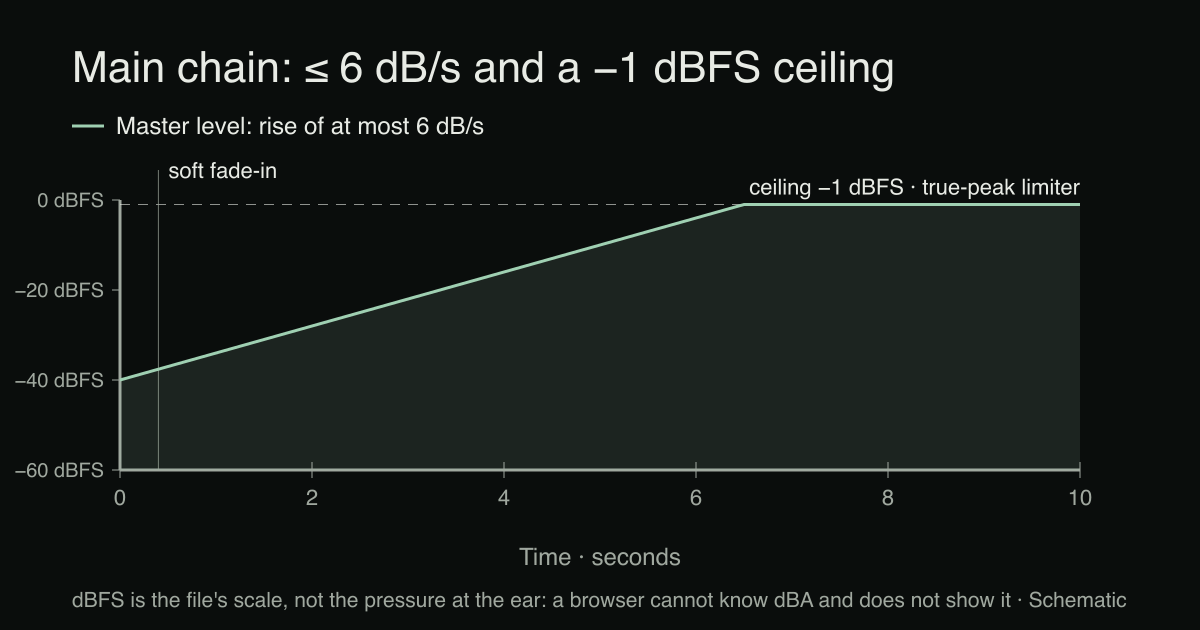
Sessions start with a fade-in, the level rises by at most 6 dB per second and the output is limited at −1 dBFS. During long headphone listening you are reminded to take a break every 2 hours. Gamma sessions show a note about ringing in the ears; if you feel discomfort, the "Report discomfort" button stops the sound immediately.
What does the evidence say?
Context · not a claim
The equal-loudness contours of pure tones vary with frequency; the 2004 review found differences from the older contours that often reach 14 dB below 500 Hz. The same numeric level is not heard as equally loud at every frequency.
Evidence levels and sources come from the database; the article adds no new claims. Evidence methodology
Studies
| Work | Type | n | Finding | Level |
|---|---|---|---|---|
| Suzuki 2004[1] | Experiment | 12 studies | Brings together the results of 12 studies from the mid-1980s onwards to propose new equal-loudness-level contours for pure tones. Differences from the 1956 Robinson and Dadson contours are greatest below 500 Hz and often reach 14 dB. |
Frequently asked questions
- How loud is too loud?
- A practical check: you should be able to talk normally with someone next to you. Keep your device volume preferably below 60%.
- My ears are ringing. What should I do?
- Stop listening and rest somewhere quiet. If the ringing persists, see a health professional.
Who is it for?
For whom
- Anyone looking for sound for relaxation, focus or a sleep routine; the sounds are generated on your device and promise no effect.
- Anyone who wants to read the evidence level of what they listen to.
- Everyone who listens for long periods or on headphones; the measure is level × duration, a browser cannot know the actual sound pressure, so the page gives rules rather than numbers.
Not for whom
- If you have epilepsy or a history of seizures, a psychiatric diagnosis, a medical device such as a pacemaker, tinnitus or any other health condition, or if you are pregnant, consult your doctor before use.
- Do not listen while driving or operating machinery.
- Keep your device volume comfortable, preferably below 60%. You can also use your device's headphone-safety settings.
Frekans Studio is not a medical device; it does not diagnose, treat or prevent any disease.
Listen and try
Sources
Citations come from the evidence database; every source is verified with Crossref or PubMed. Links go to the publication's own page (DOI).
Where to go next
Method
- Sources
- This article is not linked to a claim in the evidence database; it explains the technique and its use.
- Editorial responsibility
- Murat Tunalı · Editorial responsibility lies with Murat Tunalı; no independent medical review has been carried out.
- How this article was prepared
- The first draft was prepared by an AI model (Claude); the article adds no new figures, citations or claims, and the evidence summary comes from the database. Murat Tunalı approved publication. No independent scientific adviser has reviewed it yet. Evidence methodology · Credits
- Limitations
- This article is for information only; it is not medical advice. Evidence levels are per claim; a session's level is the weakest of its linked claims.
- Updates
- Last updated: 18 October 2026
- Cite as
- Frekans Studio. “Safe listening”. Last updated: 18 October 2026. https://frekans.studio/en/guide/safe-listening