Is sleeping with headphones harmful? Level and duration
Where does the risk come from?
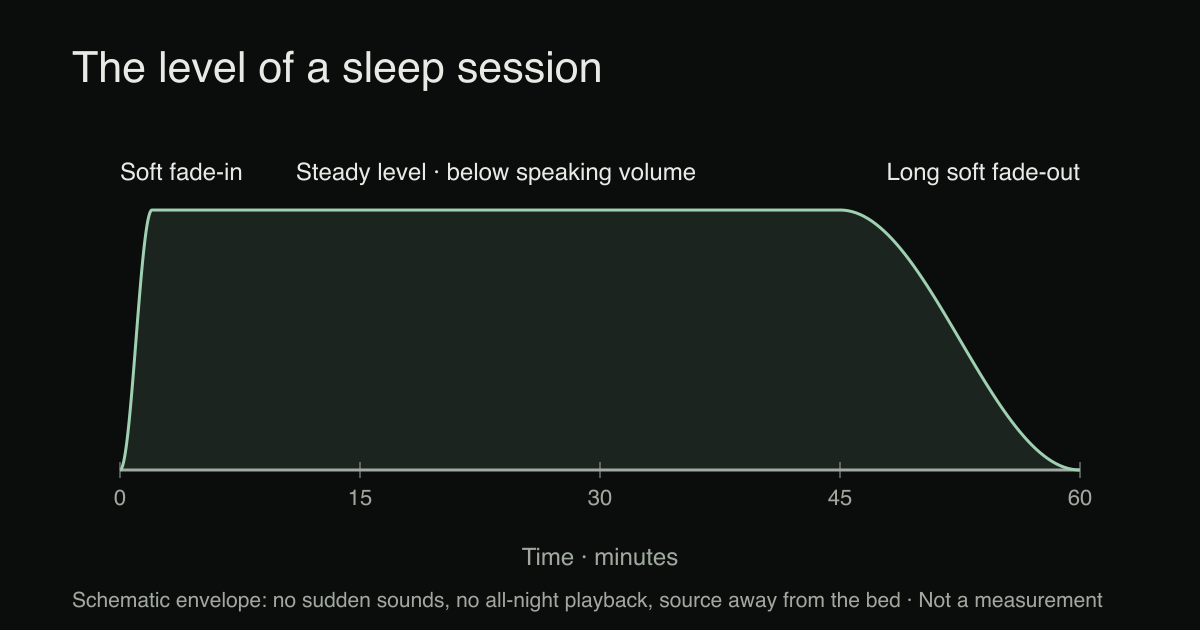
What matters for hearing is the load formed by level and duration together; sound playing all night adds several times the load of a short session. Headphones deliver sound straight into the ear canal: unlike a speaker in the room, it does not fall off with distance. Remember too that the same numeric level is not heard as equally loud at every frequency: a bass-heavy sound can be loud even when a meter reads low.
For the ear canal the problem is mechanical: in-ear headphones worn for hours can irritate the canal, trap moisture and press when you lie on your side. Over-ear headphones are uncomfortable in bed and cables can tangle. None of this has anything to do with the type of sound.
Which sound needs headphones?
Only binaural beat sessions require headphones: the two channels must not mix. Noise, nature sounds, composed nights and monaural or isochronic sessions sound the same from a speaker. That distinction decides whether headphones are really needed for sleep; research on binaural beats and sleep is at an early stage, with no finding that would justify the load of headphones.
If headphones are needed
Set the level to the lowest setting at which you hear the carrier tone comfortably; set the sleep timer so the session fades out gently after 30-60 minutes and does not play all night. Soft in-ear or headband headphones designed for sleep press less when you lie on your side. Your device's headphone safety settings can measure the weekly load; Frekans Studio shows no dBA on screen, because a browser cannot know the actual pressure at the ear.
What does the evidence say?
Binaural beats and sleep
Research on sleep is at an early stage; there are small pilot studies.
What don't we know? Comparison conditions are weak (no control or a silent night) and samples are very small.
Findings and sourcesSleeping with white, pink or brown noise
Evidence on sleep is low quality and mixed; in one study pink noise reduced REM sleep. Keep the volume low.
What don't we know? A systematic review of 38 studies rated the evidence 'very low' quality and warned that continuous noise may harm sleep and hearing.
Findings and sources
Context · not a claim
The same numeric sound level is not heard as equally loud at every frequency: the equal-loudness contours of pure tones vary with frequency, with differences from the older contours that often reach 14 dB below 500 Hz.
Evidence levels and sources come from the database; the article adds no new claims. Evidence methodology
Studies
| Work | Type | n | Finding | Level |
|---|---|---|---|---|
| Basner 2026[8] | Randomised controlled trial | 25 | A seven-night laboratory study in 25 healthy adults: intermittent environmental noise mainly reduced deep sleep (N3), whereas pink noise mainly reduced REM sleep, and adding pink noise to environmental noise worsened sleep structure further. Earplugs prevented most environmental-noise effects. The authors caution against widespread, indiscriminate use of broadband noise. | C |
| Elnazer 2026[3] | Systematic review | — | In a systematic review of music and binaural-beat interventions in young adults, most studies reported a positive change in at least one of anxiety, sleep or cognition. Heterogeneity ruled out a meta-analysis, and the author notes that small samples limit certainty. | C |
| Ding 2025[7] | Meta-analysis | 1301 | A meta-analysis of 12 randomized trials of white noise (1,301 participants: infants, adults and older adults, including intensive-care patients) found better sleep-quality scores (PSQI) in adults and older adults and longer 24-hour sleep in infants. The authors note the results are limited by heterogeneity and study quality. | C |
| Khandelwal 2025[10] | Systematic review | 496 | Seven randomised trials (496 participants) of sound machines for hospitalised adults were reviewed; six used white noise. The studies showed improved sleep efficiency with white noise, which was well tolerated. Differences in duration, participants and scales prevented a meta-analysis. | C |
| Lee 2024[2] | Pilot study | 10 | A two-night crossover proof-of-concept study with polysomnography in 10 healthy participants: 'dynamic' binaural beats with a 0-3 Hz varying difference shortened sleep latency compared with a silent control night. | C |
| Shumov 2023[4] | Experiment | 221 | 221 people fell asleep at home with an app on their own phone while listening to three kinds of monotonous sound at the same pitch: binaural beats, monaural beats and a sound without beats. Sleep latency did not differ significantly between the three conditions (p = 0.21). | C |
| Capezuti 2022[6] | Systematic review | 1103 | The review covered 34 studies (1,103 adults) of white noise, pink noise and mixed-audio interventions; 19 reported improved sleep outcomes, with a higher share for pink noise. The authors concluded there was no strong evidence supporting auditory stimulation; no adverse effects were reported with short-term use. | C |
| Dabiri 2022[1] | Pilot study | 20 | Twenty healthy students had a baseline week without sound, then a week of nightly 90-minute 3 Hz binaural beats (174/177 Hz). Sleep diaries showed shorter sleep latency, fewer awakenings and longer sleep. There was no control or sham group, and sleep was measured only by diary. | C |
| Riedy 2021[5] | Systematic review · very low certainty | 38 studies | Across 38 studies of continuous white or similar broadband noise and sleep, findings ranged from noise helping sleep to disrupting it. By GRADE, the quality of evidence that continuous noise benefits sleep was very low; the authors warn that continuous noise may also harm sleep and hearing. | C |
| Hugh 2014[9] | Experiment | — | Fourteen infant sleep machines were measured at maximum volume: at 30 cm all exceeded the 50 dBA limit recommended for hospital nurseries, and 3 exceeded 85 dBA. The authors concluded these devices can produce levels that may damage infant hearing. | C |
| Suzuki 2004[11] | Experiment | 12 studies | Brings together the results of 12 studies from the mid-1980s onwards to propose new equal-loudness-level contours for pure tones. Differences from the 1956 Robinson and Dadson contours are greatest below 500 Hz and often reach 14 dB. |
Frequently asked questions
- Are bone-conduction headphones safer?
- They leave the ear canal free, but the sound still reaches the inner ear and the load accumulates by the same rule. Level and duration are what count.
- Can children sleep with headphones?
- Frekans Studio offers no content for children or babies; for headphone use in children, ask a paediatrician.
Who is it for?
For whom
- Anyone looking for sound for relaxation, focus or a sleep routine; the sounds are generated on your device and promise no effect.
- Anyone who wants to read the evidence level of what they listen to.
- Anyone who sleeps with headphones on; the risk comes from level, duration and the pressure of the headphones rather than the kind of sound, and a timer and a low level are the first rule.
Not for whom
- If you have epilepsy or a history of seizures, a psychiatric diagnosis, a medical device such as a pacemaker, tinnitus or any other health condition, or if you are pregnant, consult your doctor before use.
- Do not listen while driving or operating machinery.
- Keep your device volume comfortable, preferably below 60%. You can also use your device's headphone-safety settings.
Frekans Studio is not a medical device; it does not diagnose, treat or prevent any disease.
Listen and try
Sources
- Dabiri R, Monazzam Esmaielpour MR, Salmani Nodoushan M, Khaneshenas F, Zakerian SA. The effect of auditory stimulation using delta binaural beat for a better sleep and post-sleep mood: A pilot study. Digit Health. 2022;8:20552076221102243. doi:10.1177/20552076221102243 PMID 35615269
- Lee HA, Lee WJ, Kim SU, Kim H, Ahn M, Kim J, et al. Effect of dynamic binaural beats on sleep quality: a proof-of-concept study with questionnaire and biosignals. Sleep. 2024;47(10):zsae097. doi:10.1093/sleep/zsae097 PMID 38629490
- Elnazer HY. Music and binaural beat interventions for young adults: A systematic review of effects on anxiety, sleep, and cognition. Acta Neuropsychiatr. 2026;38:e15. doi:10.1017/neu.2026.10057 PMID 41656644
- Shumov DE, Sveshnikov DS, Bakaeva ZV, Dorokhov VB. Monotonous sound stimuli embedded with either binaural or monaural beats have the same effect on sleep latency: study on a large subject group. Zh Nevrol Psikhiatr Im S S Korsakova. 2023;123(4):109-113. doi:10.17116/jnevro2023123041109 PMID 37084374
- Riedy SM, Smith MG, Rocha S, Basner M. Noise as a sleep aid: A systematic review. Sleep Med Rev. 2021;55:101385. doi:10.1016/j.smrv.2020.101385 PMID 33007706
- Capezuti E, Pain K, Alamag E, Chen X, Philibert V, Krieger AC. Systematic review: auditory stimulation and sleep. J Clin Sleep Med. 2022;18(6):1697-1709. doi:10.5664/jcsm.9860 PMID 34964434
- Ding Y, Sun X, Yin J, Wang Z, Zhang X, Zhang D, et al. Impact of white noise on sleep quality across age groups and in critically ill/non-critically ill patients: A systematic review and meta-analysis of randomized controlled trials. Sleep Med. 2025;136:106869. doi:10.1016/j.sleep.2025.106869 PMID 41151421
- Basner M, Smith MG, Cordoza M, Kayser MS, Carlin M, Ecker AJ, et al. Efficacy of pink noise and earplugs for mitigating the effects of intermittent environmental noise exposure on sleep. Sleep. 2026;49(5):zsag001. doi:10.1093/sleep/zsag001 PMID 41627391
- Hugh SC, Wolter NE, Propst EJ, Gordon KA, Cushing SL, Papsin BC. Infant sleep machines and hazardous sound pressure levels. Pediatrics. 2014;133(4):677-681. doi:10.1542/peds.2013-3617 PMID 24590753
- Khandelwal K, Anyim A, Shu S, Gerberi D, Yousufuddin M, Pagali S. Impact and efficacy of sound machine on sleep in hospitalized adults: A systematic review. Sleep Med X. 2025;10:100154. doi:10.1016/j.sleepx.2025.100154 PMID 41141950
- Suzuki Y, Takeshima H. Equal-loudness-level contours for pure tones. J Acoust Soc Am. 2004;116(2):918-933. doi:10.1121/1.1763601 PMID 15376658
Citations come from the evidence database; every source is verified with Crossref or PubMed. Links go to the publication's own page (DOI).
Where to go next
Method
- Sources
- Scientific statements rest on 2 claims in the evidence database; each claim's sources and review note are on its own page: Binaural beats and sleep · Sleeping with white, pink or brown noise
- Editorial responsibility
- Murat Tunalı · Editorial responsibility lies with Murat Tunalı; no independent medical review has been carried out.
- How this article was prepared
- The first draft was prepared by an AI model (Claude); the article adds no new figures, citations or claims, and the evidence summary comes from the database. Murat Tunalı approved publication. No independent scientific adviser has reviewed it yet. Evidence methodology · Credits
- Limitations
- This article is for information only; it is not medical advice. Evidence levels are per claim; a session's level is the weakest of its linked claims.
- Updates
- Last updated: 4 November 2026
- Cite as
- Frekans Studio. “Is sleeping with headphones harmful? Level and duration”. Last updated: 4 November 2026. https://frekans.studio/en/guide/sleeping-with-headphones