Headphones or speakers? Which sound needs which
Headphone test
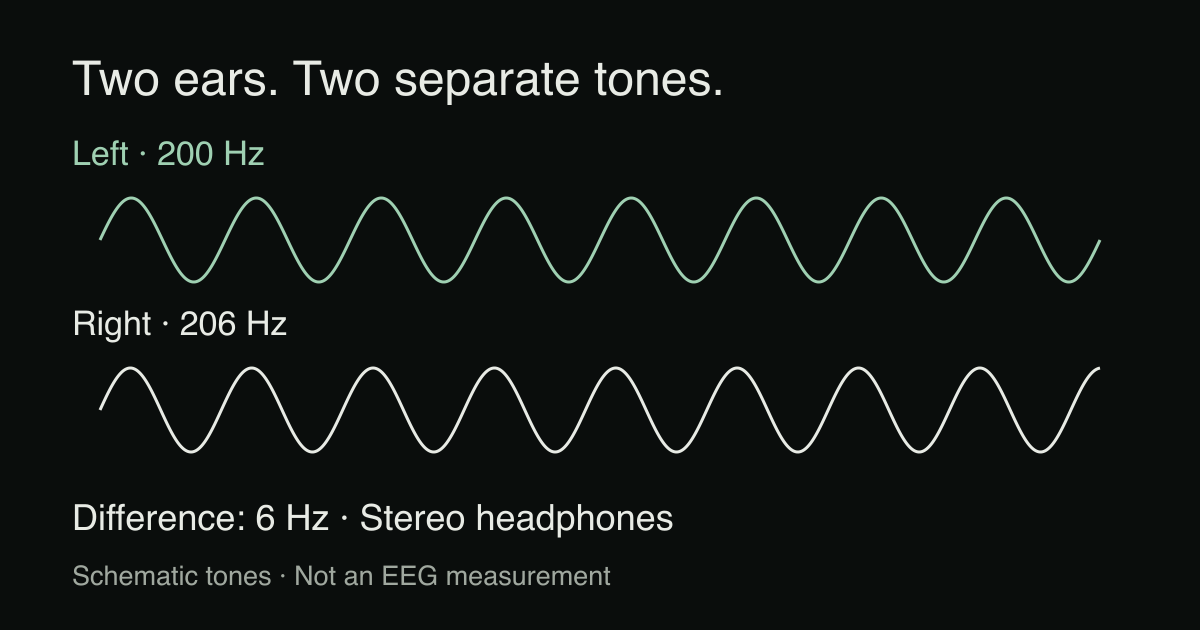
Channel separation: the one real requirement
A binaural beat sends a separate tone to each ear and the beat forms in the brainstem; through a speaker the two tones mix in the room and reach the ear as an ordinary amplitude beat. That is the only case that makes headphones mandatory. The headphone test tool shows in a few seconds that the left and right channels are in place; the speaker test checks the stereo layout.
In an EEG experiment, the cortical response to monaural beats was stronger than to binaural beats, and no stimulation changed mood. So a beat through speakers is not 'weaker'; it is a different beat, and for both methods the evidence about effects is uncertain.
Level and hearing load
A speaker's sound falls off with distance and mixes with other sounds in the room; headphones deliver sound straight into the canal and keep the surroundings out. For the same perceived loudness a lower setting suffices on headphones, but the pressure measured inside the canal is higher. Hearing load is the product of level and duration; over long listening headphones need a more careful setting, and the app reminds you of a break every 2 hours.
Which one in which situation?
For sleep, a speaker: away from your bed, out of ear level, at the lowest level you hear comfortably from across the room; headphones all night can irritate the canal. In shared spaces and while travelling, headphones: they disturb no one and a lower level suffices for masking. For a binaural session, stereo headphones in every case; mono earphones or one ear remove the beat.
What does the evidence say?
Binaural beats and brainwave entrainment
The brain may show a weak response at the beat frequency; this response has not been shown to reliably change mental state.
What don't we know? In a review of 14 EEG studies, only 5 were consistent with the entrainment hypothesis and 8 contradicted it.
Findings and sourcesBroadband noise and masking
Continuous noise probably makes surrounding sounds less noticeable.
What don't we know? It is not clear that masking translates into protected sleep: in a 25-person lab study, adding pink noise to intermittent environmental noise worsened sleep structure further, and earplugs worked better.
Findings and sources
Context · not a claim
In a 16-person EEG experiment, binaural and monaural beats both produced a cortical response at the beat frequency; the response to binaural beats was weaker than to monaural beats, and no stimulation changed mood.
Evidence levels and sources come from the database; the article adds no new claims. Evidence methodology
Studies
| Work | Type | n | Finding | Level |
|---|---|---|---|---|
| Basner 2026[5] | Randomised controlled trial | 25 | A seven-night laboratory study in 25 healthy adults: intermittent environmental noise mainly reduced deep sleep (N3), whereas pink noise mainly reduced REM sleep, and adding pink noise to environmental noise worsened sleep structure further. Earplugs prevented most environmental-noise effects. The authors caution against widespread, indiscriminate use of broadband noise. | B |
| Melnichuk 2025[3] | Experiment | 80 | Sixteen parameter conditions were tested; 80 undergraduates were randomized and 64 analysed. 40 Hz binaural beats with a low (340 Hz) carrier improved general attention performance but did not prevent the decline of attention over time. EEG showed a response at the beat frequency that varied with parameters and weakened under white-noise masking. The authors say the finding needs replication. | C |
| Ingendoh 2023[1] | Systematic review | 14 studies | Of 14 EEG studies on binaural beats and brain oscillations, 5 were consistent with the entrainment hypothesis, 8 contradicted it and 1 was mixed. The studies differed greatly in method, which limits comparison; the authors call for standardized approaches. | C |
| Riedy 2021[6] | Systematic review · very low certainty | 38 studies | Across 38 studies of continuous white or similar broadband noise and sleep, findings ranged from noise helping sleep to disrupting it. By GRADE, the quality of evidence that continuous noise benefits sleep was very low; the authors warn that continuous noise may also harm sleep and hearing. | B |
| Zhang 2021[7] | Experiment | 30 | In a lab experiment simulating a Chinese-language open-plan office, 30 participants' serial recall and sound-environment perception were measured in 14 conditions: quiet, speech only, and 12 conditions in which four maskers (speech-like pink noise, air-conditioning noise, spring water sound, babble) were presented with speech at three signal-to-noise ratios. Effects differed markedly by masker type and ratio; the best condition was spring water sound at a medium ratio (−2.4 dB). Effects could differ by gender, education level and noise sensitivity. | B |
| Orozco 2020[2] | Experiment | 16 | In a 16-person EEG experiment, both binaural and monaural beats produced a brainstem response at the tone frequencies and a cortical response at the beat frequency; the cortical response to binaural beats was weaker than to monaural beats. Neither stimulus changed mood. | C |
| Moore 2013[4] | Textbook | — | A standard textbook of auditory perception. Its chapter on frequency selectivity and masking describes how one sound raises the detection threshold of another (auditory masking) and how this depends on frequency bands. | B |
Frequently asked questions
- Do binaural beats work on Bluetooth headphones?
- Yes; lossy coding can leave a small leakage between the channels, but the beat is preserved. In exported files Frekans Studio measures and reports that leakage.
- Do I need headphones with active noise reduction?
- No. Active noise reduction lowers the surroundings and lets you use a lower level; it does not change the sound itself.
Who is it for?
For whom
- Anyone looking for sound for relaxation, focus or a sleep routine; the sounds are generated on your device and promise no effect.
- Anyone who wants to read the evidence level of what they listen to.
- Anyone unsure which sound needs headphones; only binaural beats require them, everything else plays on speakers too.
Not for whom
- If you have epilepsy or a history of seizures, a psychiatric diagnosis, a medical device such as a pacemaker, tinnitus or any other health condition, or if you are pregnant, consult your doctor before use.
- Do not listen while driving or operating machinery.
- Keep your device volume comfortable, preferably below 60%. You can also use your device's headphone-safety settings.
Frekans Studio is not a medical device; it does not diagnose, treat or prevent any disease.
Listen and try
Sources
- Ingendoh RM, Posny ES, Heine A. Binaural beats to entrain the brain? A systematic review of the effects of binaural beat stimulation on brain oscillatory activity, and the implications for psychological research and intervention. PLoS One. 2023;18(5):e0286023. doi:10.1371/journal.pone.0286023 PMID 37205669
- Orozco Perez HD, Dumas G, Lehmann A. Binaural Beats through the Auditory Pathway: From Brainstem to Connectivity Patterns. eNeuro. 2020;7(2):ENEURO.0232-19.2020. doi:10.1523/ENEURO.0232-19.2020 PMID 32066611
- Melnichuk A, Cooper RK, Hawk LW. A parametric investigation of binaural beats for brain entrainment and enhancing sustained attention. Sci Rep. 2025;15(1):4308. doi:10.1038/s41598-025-88517-z PMID 39910150
- Moore BCJ. An Introduction to the Psychology of Hearing. Brill; 2013. ISBN 9789004252424
- Basner M, Smith MG, Cordoza M, Kayser MS, Carlin M, Ecker AJ, et al. Efficacy of pink noise and earplugs for mitigating the effects of intermittent environmental noise exposure on sleep. Sleep. 2026;49(5):zsag001. doi:10.1093/sleep/zsag001 PMID 41627391
- Riedy SM, Smith MG, Rocha S, Basner M. Noise as a sleep aid: A systematic review. Sleep Med Rev. 2021;55:101385. doi:10.1016/j.smrv.2020.101385 PMID 33007706
- Zhang Y, Ou D, Kang S. The effects of masking sound and signal-to-noise ratio on work performance in Chinese open-plan offices. Appl Acoust. 2021;172:107657. doi:10.1016/j.apacoust.2020.107657
Citations come from the evidence database; every source is verified with Crossref or PubMed. Links go to the publication's own page (DOI).
Where to go next
Method
- Sources
- Scientific statements rest on 2 claims in the evidence database; each claim's sources and review note are on its own page: Binaural beats and brainwave entrainment · Broadband noise and masking
- Editorial responsibility
- Murat Tunalı · Editorial responsibility lies with Murat Tunalı; no independent medical review has been carried out.
- How this article was prepared
- The first draft was prepared by an AI model (Claude); the article adds no new figures, citations or claims, and the evidence summary comes from the database. Murat Tunalı approved publication. No independent scientific adviser has reviewed it yet. Evidence methodology · Credits
- Limitations
- This article is for information only; it is not medical advice. Evidence levels are per claim; a session's level is the weakest of its linked claims.
- Updates
- Last updated: 4 November 2026
- Cite as
- Frekans Studio. “Headphones or speakers? Which sound needs which”. Last updated: 4 November 2026. https://frekans.studio/en/guide/headphones-vs-speakers