Why are headphones needed?
Headphone test
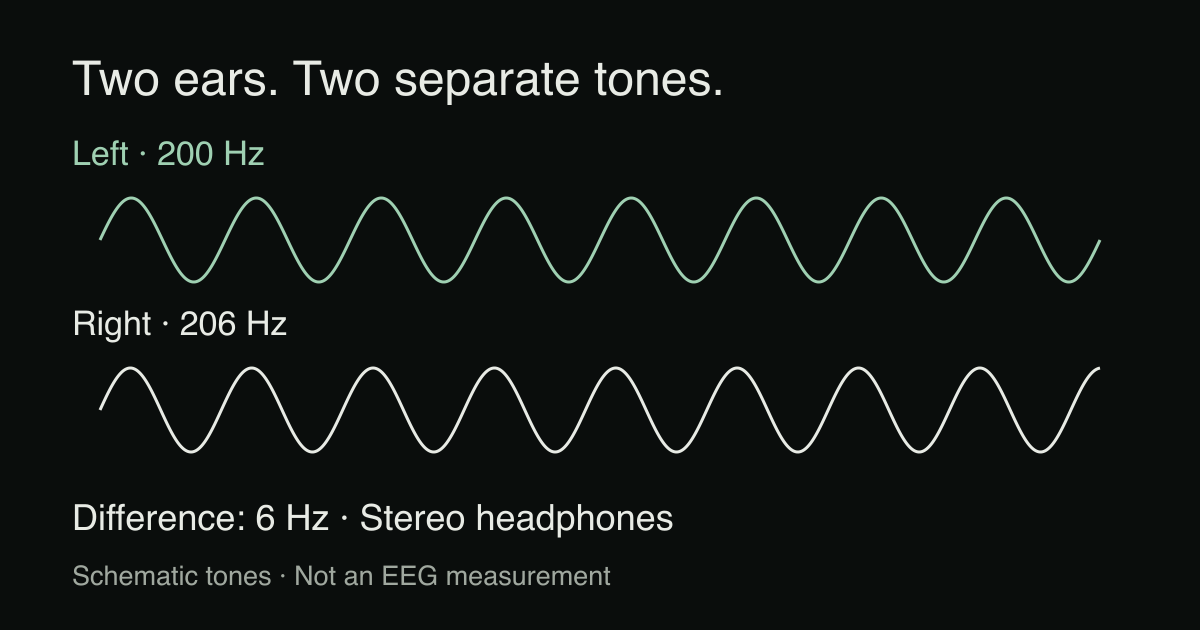
Channel separation
Headphones keep the left and right channels apart. With a speaker, both channels reach both ears. Because binaural layers rely on this separation, Frekans Studio's session cards say "Stereo headphones required".
On some devices the "mono audio" option in accessibility settings merges the two channels; if it's on, you won't hear a binaural beat.
How do I know they're on correctly?
The headphone test tool plays separate tones to the left and right ears and runs a stereo headphone check (the Woods et al. 2017 method). If the channels are reversed, you can swap left and right in the player; the choice is remembered on this device.
What does the evidence say?
Context · not a claim
In a 16-person EEG experiment, binaural and monaural beats produced a brainstem response at the tones' own frequencies and a cortical response at the beat frequency; the cortical response to the binaural beat was weaker.
Evidence levels and sources come from the database; the article adds no new claims. Evidence methodology
Studies
| Work | Type | n | Finding | Level |
|---|---|---|---|---|
| Orozco 2020[1] | Experiment | 16 | In a 16-person EEG experiment, both binaural and monaural beats produced a brainstem response at the tone frequencies and a cortical response at the beat frequency; the cortical response to binaural beats was weaker than to monaural beats. Neither stimulus changed mood. |
Frequently asked questions
- Do Bluetooth headphones work?
- Yes, as long as they are stereo the channels stay separate. Some models add latency, but that doesn't affect the beat.
- Can I listen with one ear?
- Not for binaural sessions. If you're listening without headphones or with one ear, choose monaural, isochronic or noise sessions.
Who is it for?
For whom
- Anyone looking for sound for relaxation, focus or a sleep routine; the sounds are generated on your device and promise no effect.
- Anyone who wants to read the evidence level of what they listen to.
- Anyone wondering why a binaural session asks for headphones, and anyone without headphones; the headphone-free options are listed separately.
Not for whom
- If you have epilepsy or a history of seizures, a psychiatric diagnosis, a medical device such as a pacemaker, tinnitus or any other health condition, or if you are pregnant, consult your doctor before use.
- Do not listen while driving or operating machinery.
- Keep your device volume comfortable, preferably below 60%. You can also use your device's headphone-safety settings.
Frekans Studio is not a medical device; it does not diagnose, treat or prevent any disease.
Listen and try
Sources
Citations come from the evidence database; every source is verified with Crossref or PubMed. Links go to the publication's own page (DOI).
Where to go next
Method
- Sources
- This article is not linked to a claim in the evidence database; it explains the technique and its use.
- Editorial responsibility
- Murat Tunalı · Editorial responsibility lies with Murat Tunalı; no independent medical review has been carried out.
- How this article was prepared
- The first draft was prepared by an AI model (Claude); the article adds no new figures, citations or claims, and the evidence summary comes from the database. Murat Tunalı approved publication. No independent scientific adviser has reviewed it yet. Evidence methodology · Credits
- Limitations
- This article is for information only; it is not medical advice. Evidence levels are per claim; a session's level is the weakest of its linked claims.
- Updates
- Last updated: 18 October 2026
- Cite as
- Frekans Studio. “Why are headphones needed?”. Last updated: 18 October 2026. https://frekans.studio/en/guide/why-headphones