How long should sleep music play? Duration, timer and fade-out
Session · Rain and Pink Noise · 1 h
Durations in the research
In the Cochrane review of 13 randomised trials, participants listened to 25-60 minutes of recorded music a day before bed or in bed; subjective sleep quality improved with moderate certainty, and no difference was shown in objective sleep measures. According to a narrative review, the most effective music was slow (60-80 beats per minute), gently melodic, instrumental and simple in structure; the suggested duration was 30-45 minutes.
These studies used human-made, recorded music; whether melodies generated on a device give the same effect has not been tested. That is why Frekans Studio's nights are linked to the B-level claim as 'company', not as 'the same effect'.
All night, or until you fall asleep?
Sound does its job while you fall asleep: it covers sudden sounds and anchors the routine. Sound playing after you are asleep does not do that job, but it keeps adding load: for hearing, level and duration count together, and an eight-hour night is eight times a one-hour session. Reviews of noise and sleep also warn that continuous noise may harm sleep and hearing.
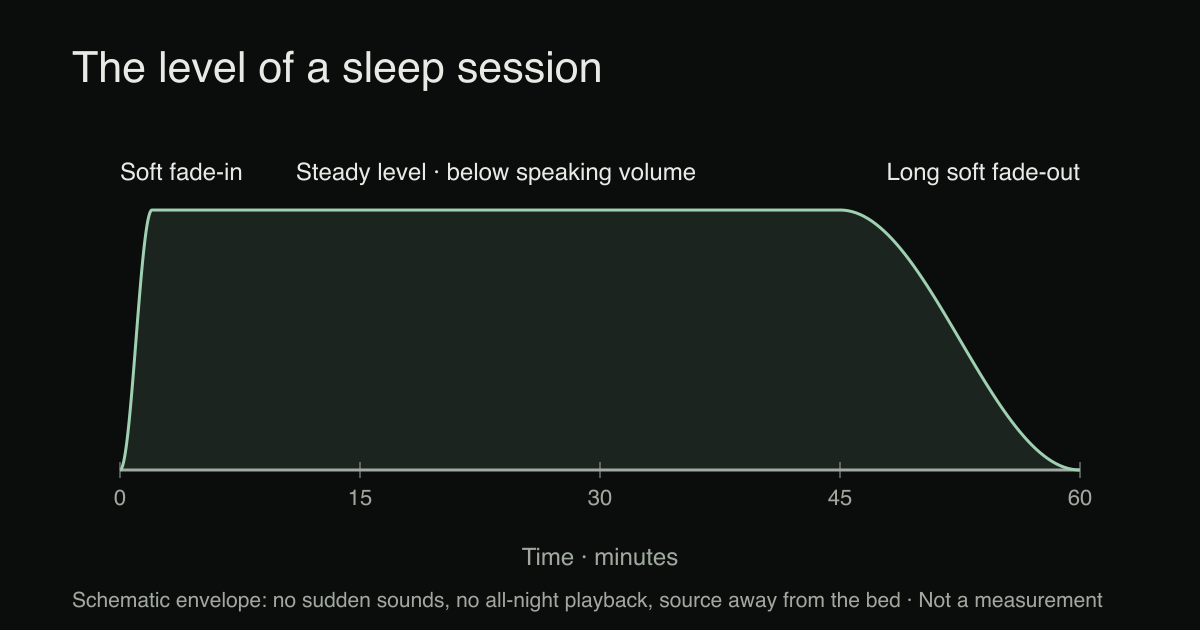
That is why Frekans Studio's sleep sessions are built with a 30-60-minute body, fade out over a long tail, and the composed nights' sleep curve thins out in the last minutes. On endless nights the timer runs on the wall clock and closes the sound with a long fade at the end.
Why does the fade-out matter?
Sound that stops abruptly can wake you: the ear registers the disappearance of a continuous sound as a change too. A long fade-out spreads that change over minutes and makes it unnoticeable. When setting the timer, make the duration a little longer than the time you usually take to fall asleep; if you wake at night and restart, a short session is enough.
What does the evidence say?
Music before bed and sleep
A slow, calm melody accompanies your bedtime routine; listening to music before bed probably improves subjective sleep quality.
What don't we know? No improvement in objective sleep measures was shown.
Findings and sourcesSleeping with white, pink or brown noise
Evidence on sleep is low quality and mixed; in one study pink noise reduced REM sleep. Keep the volume low.
What don't we know? A systematic review of 38 studies rated the evidence 'very low' quality and warned that continuous noise may harm sleep and hearing.
Findings and sources
Evidence levels and sources come from the database; the article adds no new claims. Evidence methodology
Studies
| Work | Type | n | Finding | Level |
|---|---|---|---|---|
| Basner 2026[7] | Randomised controlled trial | 25 | A seven-night laboratory study in 25 healthy adults: intermittent environmental noise mainly reduced deep sleep (N3), whereas pink noise mainly reduced REM sleep, and adding pink noise to environmental noise worsened sleep structure further. Earplugs prevented most environmental-noise effects. The authors caution against widespread, indiscriminate use of broadband noise. | C |
| Ding 2025[6] | Meta-analysis | 1301 | A meta-analysis of 12 randomized trials of white noise (1,301 participants: infants, adults and older adults, including intensive-care patients) found better sleep-quality scores (PSQI) in adults and older adults and longer 24-hour sleep in infants. The authors note the results are limited by heterogeneity and study quality. | C |
| Khandelwal 2025[9] | Systematic review | 496 | Seven randomised trials (496 participants) of sound machines for hospitalised adults were reviewed; six used white noise. The studies showed improved sleep efficiency with white noise, which was well tolerated. Differences in duration, participants and scales prevented a meta-analysis. | C |
| Li 2025[3] | Meta-analysis · very low certainty | 602 | A meta-analysis of 10 studies (6 randomized, 4 non-randomized; 602 people) in adults aged 50 and over: music interventions improved sleep quality, with high heterogeneity between studies (I² = 79%). The effect was smaller in randomized trials and not significant in non-randomized studies. GRADE certainty was very low; the authors urge caution in clinical recommendations. | B |
| Pan 2025[2] | Review | — | A narrative review drawing on randomised trials and meta-analyses: the most effective music was slow (60-80 bpm), soft and smooth in melody, instrumental and simple in structure. Suggested use is 30-45 minutes a day before bed at a comfortable volume. Long-term effects and mechanisms remain unclear. | B |
| Capezuti 2022[5] | Systematic review | 1103 | The review covered 34 studies (1,103 adults) of white noise, pink noise and mixed-audio interventions; 19 reported improved sleep outcomes, with a higher share for pink noise. The authors concluded there was no strong evidence supporting auditory stimulation; no adverse effects were reported with short-term use. | C |
| Jespersen 2022[1] | Systematic review · moderate certainty | 1007 | A Cochrane review of 13 randomised trials (1007 participants) of music listening in adults with sleep difficulties. Listening to prerecorded music for 25-60 minutes a day improved subjective sleep quality compared with no intervention, with moderate certainty. Low-certainty benefits were found for sleep-onset latency, total sleep time and sleep efficiency; three studies with objective measures suggest music may not improve these. No adverse events were reported. | B |
| Riedy 2021[4] | Systematic review · very low certainty | 38 studies | Across 38 studies of continuous white or similar broadband noise and sleep, findings ranged from noise helping sleep to disrupting it. By GRADE, the quality of evidence that continuous noise benefits sleep was very low; the authors warn that continuous noise may also harm sleep and hearing. | C |
| Hugh 2014[8] | Experiment | — | Fourteen infant sleep machines were measured at maximum volume: at 30 cm all exceeded the 50 dBA limit recommended for hospital nurseries, and 3 exceeded 85 dBA. The authors concluded these devices can produce levels that may damage infant hearing. | C |
Frequently asked questions
- Is playing white noise all night harmful?
- Harm depends on level and duration; all-night playback adds load, and reviews advise caution with continuous noise. A low level, a distant source and a timer reduce the load.
- What if the sound is still playing when I wake up?
- Without a timer the session plays to its end. Setting the sleep timer or choosing a short session prevents that.
Who is it for?
For whom
- Anyone looking for sound for relaxation, focus or a sleep routine; the sounds are generated on your device and promise no effect.
- Anyone who wants to read the evidence level of what they listen to.
- Anyone unsure how long to set the sleep timer; the studies used 25-60 minutes, and the right length depends on how long you take to fall asleep.
Not for whom
- If you have epilepsy or a history of seizures, a psychiatric diagnosis, a medical device such as a pacemaker, tinnitus or any other health condition, or if you are pregnant, consult your doctor before use.
- Do not listen while driving or operating machinery.
- Keep your device volume comfortable, preferably below 60%. You can also use your device's headphone-safety settings.
Frekans Studio is not a medical device; it does not diagnose, treat or prevent any disease.
Listen and try
Rain and Pink Noise
Sources
- Jespersen KV, Pando-Naude V, Koenig J, Jennum P, Vuust P. Listening to music for insomnia in adults. Cochrane Database Syst Rev. 2022;8(8):CD010459. doi:10.1002/14651858.CD010459.pub3 PMID 36000763
- Pan EY, Wang W. Elements of music that work to improve sleep, a narrative review. Front Sleep. 2025;4:1707162. doi:10.3389/frsle.2025.1707162 PMID 41425167
- Li C, Kumar AP, Wankhar D, Kuppusamy M, Govindasamy K. Effect of music therapy on sleep quality in elderly: A systematic review and meta-analysis. PLoS One. 2025;20(11):e0334356. doi:10.1371/journal.pone.0334356 PMID 41187137
- Riedy SM, Smith MG, Rocha S, Basner M. Noise as a sleep aid: A systematic review. Sleep Med Rev. 2021;55:101385. doi:10.1016/j.smrv.2020.101385 PMID 33007706
- Capezuti E, Pain K, Alamag E, Chen X, Philibert V, Krieger AC. Systematic review: auditory stimulation and sleep. J Clin Sleep Med. 2022;18(6):1697-1709. doi:10.5664/jcsm.9860 PMID 34964434
- Ding Y, Sun X, Yin J, Wang Z, Zhang X, Zhang D, et al. Impact of white noise on sleep quality across age groups and in critically ill/non-critically ill patients: A systematic review and meta-analysis of randomized controlled trials. Sleep Med. 2025;136:106869. doi:10.1016/j.sleep.2025.106869 PMID 41151421
- Basner M, Smith MG, Cordoza M, Kayser MS, Carlin M, Ecker AJ, et al. Efficacy of pink noise and earplugs for mitigating the effects of intermittent environmental noise exposure on sleep. Sleep. 2026;49(5):zsag001. doi:10.1093/sleep/zsag001 PMID 41627391
- Hugh SC, Wolter NE, Propst EJ, Gordon KA, Cushing SL, Papsin BC. Infant sleep machines and hazardous sound pressure levels. Pediatrics. 2014;133(4):677-681. doi:10.1542/peds.2013-3617 PMID 24590753
- Khandelwal K, Anyim A, Shu S, Gerberi D, Yousufuddin M, Pagali S. Impact and efficacy of sound machine on sleep in hospitalized adults: A systematic review. Sleep Med X. 2025;10:100154. doi:10.1016/j.sleepx.2025.100154 PMID 41141950
Citations come from the evidence database; every source is verified with Crossref or PubMed. Links go to the publication's own page (DOI).
Where to go next
Method
- Sources
- Scientific statements rest on 2 claims in the evidence database; each claim's sources and review note are on its own page: Music before bed and sleep · Sleeping with white, pink or brown noise
- Editorial responsibility
- Murat Tunalı · Editorial responsibility lies with Murat Tunalı; no independent medical review has been carried out.
- How this article was prepared
- The first draft was prepared by an AI model (Claude); the article adds no new figures, citations or claims, and the evidence summary comes from the database. Murat Tunalı approved publication. No independent scientific adviser has reviewed it yet. Evidence methodology · Credits
- Limitations
- This article is for information only; it is not medical advice. Evidence levels are per claim; a session's level is the weakest of its linked claims.
- Updates
- Last updated: 4 November 2026
- Cite as
- Frekans Studio. “How long should sleep music play? Duration, timer and fade-out”. Last updated: 4 November 2026. https://frekans.studio/en/guide/how-long-sleep-music