Meditation music and sleep music: same calm, new shape
Session · Long Sitting · 20 min · 20 min
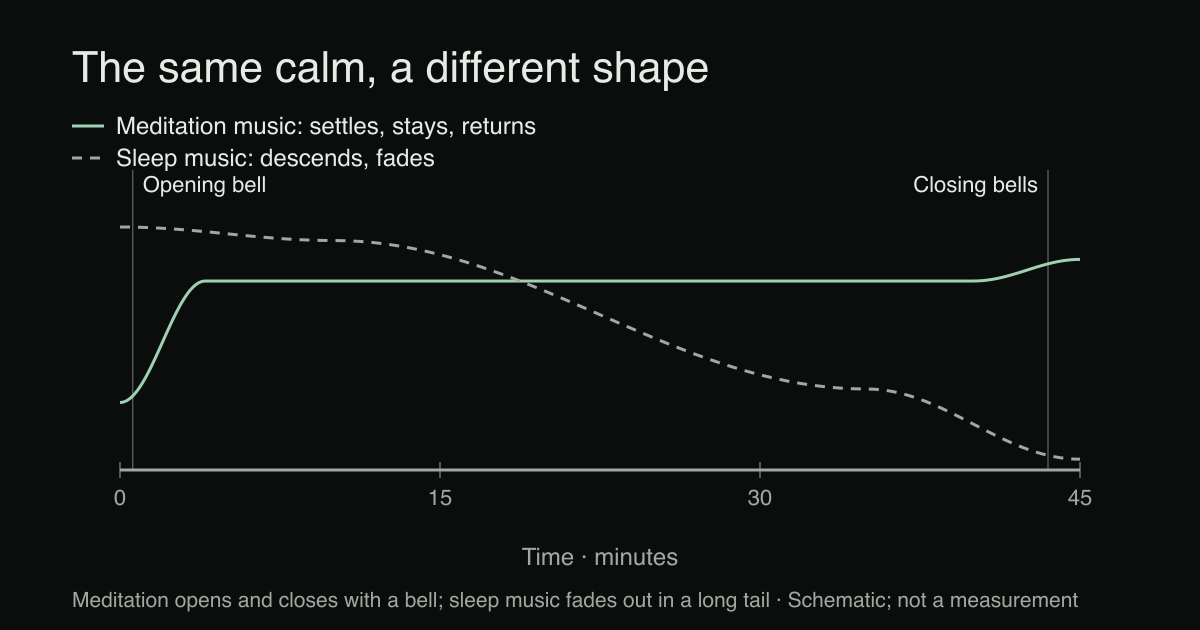
The shape: bell, settling, steady state, return
The sitting opens with a wake-up strike and a bell; in the long sitting there are three bells, about three breaths apart. Then only the drone sounds: the piano stays silent for the first few minutes while the sound settles.
Most of the time is a steady state. The piano plays short phrases with silence between them, and every few minutes a distant bowl sounds. Level and tempo do not change in this part.
At the end the melody comes home to the tonic, a short return follows and three bells close the sitting.
Why a drone, and why pure ratios?
The drone is a continuous base sound: root, fifth and octave. The fifth is a pure ratio (3:2). An equal-tempered fifth is about 2 cents narrower than a pure one; on its own this is inaudible, but it builds up in the upper partials of a rich sound and produces beating that gets faster higher up. A pure-ratio drone does not carry that beating.
The drone is tuned by octaves to the bell's pitch, so bell and drone come from the same pitch family. The same drone can also be chosen as the bed of the Silence timer.
Breath-length phrases
Each phrase has three to six notes and lasts about one breath: a short rise, a fall and a long final note. The melody comes from the G major pentatonic scale; it has no semitones, so notes that ring together under the pedal do not rub against each other.
There is no tempo or beat; at least a second passes between notes. Between phrases there are one to three breaths of silence in the sparse setting and a few seconds in the medium one. Every few minutes the left hand and the melody's centre change, so the colour turns slowly over a long sitting.
The other sittings: body, kindness, makam and breath
Body Scan Companion has seven sections, each opening with a single soft bell. There are no words; the sound's centre of gravity moves section by section: a high pad for the head and face, the middle register for the chest, the low register for the legs and feet, and finally the whole body. Each transition takes twenty-five seconds.
Kindness Melody has four sections and was written to accompany the four steps of a kindness meditation: yourself, someone close, everyone, the whole. The same motif returns in each section while the accompaniment widens: first the felt piano alone, then a warm pad, then muted strings, and finally all of them together. The tempo is steady, fifty beats a minute.
In Drone and Ney, over a drone wandering in makam Rast, a short ney phrase sounds from afar every minute or two; the ney follows the arc of the seyir and ends on the rast tonic. The tuning is 53-comma with theoretical pitches; it is an original, algorithmic seyir, not a performer's interpretation.
Breath-Led Harmony is a breath pacer: on the in-breath a pad chord appears and brightens, on the out-breath it fades, and a low bowl sounds as the out-breath begins. The first two minutes are at 7.5 breaths a minute, then 6; in the last two minutes the chord holds steady and you continue at your own pace. There is no breath holding.
How it differs from sleep music
Night Compositions follow a sleep curve: the tempo slows over the minutes, the melody thins out and the night fades towards its end. Meditation Compositions have no such curve; the sound settles at a level and stays there, then comes back gently at the end.
Sleep music descends towards darkness; meditation music is designed to stay at an awake and calm level. Both use felt piano and are composed anew on the device every time they play.
What does the evidence say?
Meditation, anxiety and stress
Meditation programs probably lead to a small reduction on some anxiety measures.
What don't we know? This evidence mostly comes from structured 8-week programs; whether listening to a sound session alone has the same effect is unknown.
Findings and sources
Evidence levels and sources come from the database; the article adds no new claims. Evidence methodology
Studies
| Work | Type | n | Finding | Level |
|---|---|---|---|---|
| Simonsson 2026[3] | Randomised controlled trial | 5049 | A secondary analysis of a randomized trial with 5,049 adults representative of the US and UK populations: 5- or 10-minute digital mindfulness, self-compassion and gratitude practices were compared with using the internet as usual. Across the sample, 4.1% of participants reported a distressing experience during the intervention and 7.1% an increase in negative affect. Those assigned to meditation were no more likely than controls to report a distressing experience and less likely to show a clinically relevant increase in negative affect. The 10-minute practice led to distressing experiences more often than the 5-minute one; adverse responses could to some degree be predicted from baseline characteristics. | B |
| National 2022[2] | Institutional page | — | NCCIH notes that much meditation and mindfulness research has been preliminary or not rigorous and may have been interpreted too optimistically. For anxiety and stress, some analyses found mindfulness-based approaches better than no intervention, while short-term results varied between studies. | B |
| Goyal 2014[1] | Meta-analysis · moderate certainty | 3515 | In a meta-analysis of 47 randomized trials with active controls (3,515 participants), mindfulness meditation programs showed small positive effects on anxiety, depression and pain with moderate-strength evidence, and low-strength evidence for stress and distress. There was no evidence that the programs were better than drugs, exercise or other behavioral approaches. Participants came from diverse clinical populations. | B |
Frequently asked questions
- Does this music deepen meditation?
- The evidence card above summarises what we know about meditation practice. This guide adds no claim to it: it describes how the music is built. The sessions are sound design and carry no claim of any effect.
- Which session should I start with?
- For a short break, Pause (5 min); for sitting, Long Sitting (20, 45 or 60 min). For working with the body, Body Scan Companion (20 min); for a kindness practice, Kindness Melody (16 min). If you want only bells and a bed, use the Silence timer, where the drone bed can be chosen too.
Who is it for?
For whom
- Anyone looking for sound for relaxation, focus or a sleep routine; the sounds are generated on your device and promise no effect.
- Anyone who wants to read the evidence level of what they listen to.
- Anyone who wants to know which session to open when; the difference lies in the structure (slowing down or returning), and neither promises an effect.
Not for whom
- If you have epilepsy or a history of seizures, a psychiatric diagnosis, a medical device such as a pacemaker, tinnitus or any other health condition, or if you are pregnant, consult your doctor before use.
- Do not listen while driving or operating machinery.
- Keep your device volume comfortable, preferably below 60%. You can also use your device's headphone-safety settings.
Frekans Studio is not a medical device; it does not diagnose, treat or prevent any disease.
Listen and try
Long Sitting · 20 min
Sources
- Goyal M, Singh S, Sibinga EM, Gould NF, Rowland-Seymour A, Sharma R, et al. Meditation programs for psychological stress and well-being: a systematic review and meta-analysis. JAMA Intern Med. 2014;174(3):357-368. doi:10.1001/jamainternmed.2013.13018 PMID 24395196
- National Center for Complementary and Integrative Health (NCCIH). Meditation and Mindfulness: Effectiveness and Safety. National Institutes of Health; 2022.
- Simonsson O, Jiwani Z, Ruiz M, Narayanan J, Osika W, Hirshberg MJ, et al. Adverse Experiences in Brief Meditation Practices: Randomized Controlled Trial. JMIR Ment Health. 2026;13:e95628. doi:10.2196/95628 PMID 42735902
Citations come from the evidence database; every source is verified with Crossref or PubMed. Links go to the publication's own page (DOI).
Where to go next
Method
- Sources
- Scientific statements rest on 1 claims in the evidence database; each claim's sources and review note are on its own page: Meditation, anxiety and stress
- Editorial responsibility
- Murat Tunalı · Editorial responsibility lies with Murat Tunalı; no independent medical review has been carried out.
- How this article was prepared
- The first draft was prepared by an AI model (Claude); the article adds no new figures, citations or claims, and the evidence summary comes from the database. Murat Tunalı approved publication. No independent scientific adviser has reviewed it yet. Evidence methodology · Credits
- Limitations
- This article is for information only; it is not medical advice. Evidence levels are per claim; a session's level is the weakest of its linked claims.
- Updates
- Last updated: 26 October 2026
- Cite as
- Frekans Studio. “Meditation music and sleep music: same calm, new shape”. Last updated: 26 October 2026. https://frekans.studio/en/guide/meditation-music-and-sleep-music