Oud Night: an unmetred seyir in maqam Nahawand
Session · Oud Night · 45 min · 45 min
Maqam and tuning
Nahawand's tonic is C and its dominant G. The lower jins, Nahawand, is C, D, E♭, F and G. The upper jins above the dominant is Hijaz on the way up (G, A♭, B, C) and Kurd on the way down (G, A♭, B♭, C): the seventh degree is B rising and B♭ falling.
Most Arabic maqamat are written with quarter tones. That notation is a convention, and without their ornaments Bayati, Rast or Sikah are not recognisable in equal temperament. Nahawand has no quarter tones and fits twelve-tone equal temperament. At night it plays at A4 = 432 Hz; the tonic C is about 257 Hz.
How does it play at night?
An oud plays the melody: a double-course plucked-string model made on the device. The bright, nasal colour of a plectrum-played oud was tuned by measuring real single-note recordings and softened a little for the night. At the start of each note the pitch begins very slightly sharp and settles within about a tenth of a second; on a real string the tension of the pluck does this.
The phrases are generated from a seed: a motif repeats one step away, there are leaps of a third and changing rhythms. In the middle of long notes the low C string (the low G in the upper jins) sounds like an open string; at cadences the lower octave joins in; within a phrase the tempo opens and closes slightly, and some phrases end with their last two notes echoed an octave lower.
In the Opening (the first fifteen minutes) the whole seyir is heard. In the Descent only phrases in the lower jins return, slower and sparser. At the Floor short cadences on the tonic come: a three-note descent, from the dominant to the tonic, or the tonic alone. The night ends on the tonic. Notes start at least half a second apart. There is no bed beneath it, only hall reverb and a barely audible room air.
The oud's tone took shape over three rounds beside the recordings. In the maqam round Nahawand was chosen over Ajam and Kurd. When the first phrases sounded monotonous, the open-string pedal, doubled notes and tempo flexibility were added. A sustained drone on the tonic was tried and removed, because in the deep phases it became a hum.
Listen
In the Library the family's night is Oud Night · 45 min: oud, hall reverb and A4 = 432 Hz tuning. This night is not among your own night's options; the Night Piano family's melodies are there.
Measuring the sound
The two images and the table in this section were measured from the sound of the session below as it plays on the site: the audio was generated the way the engine generates it on your device, at the site's level. The measurement shows the physics of the sound; it says nothing about its effects.
Oud Night · 45 min · seconds 18-48
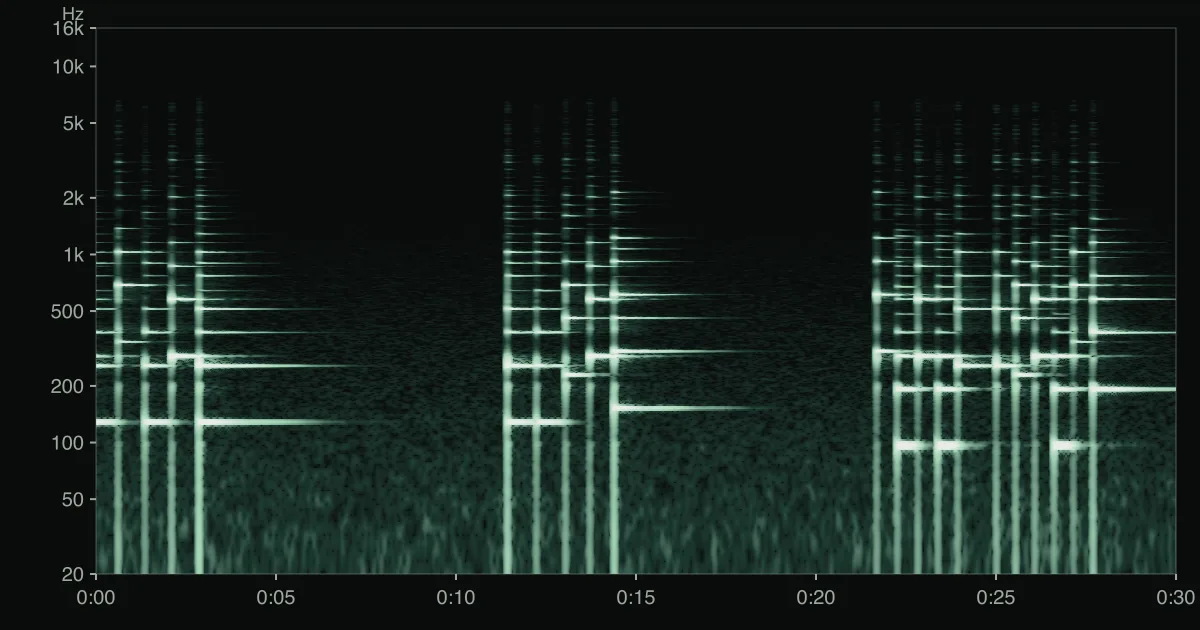
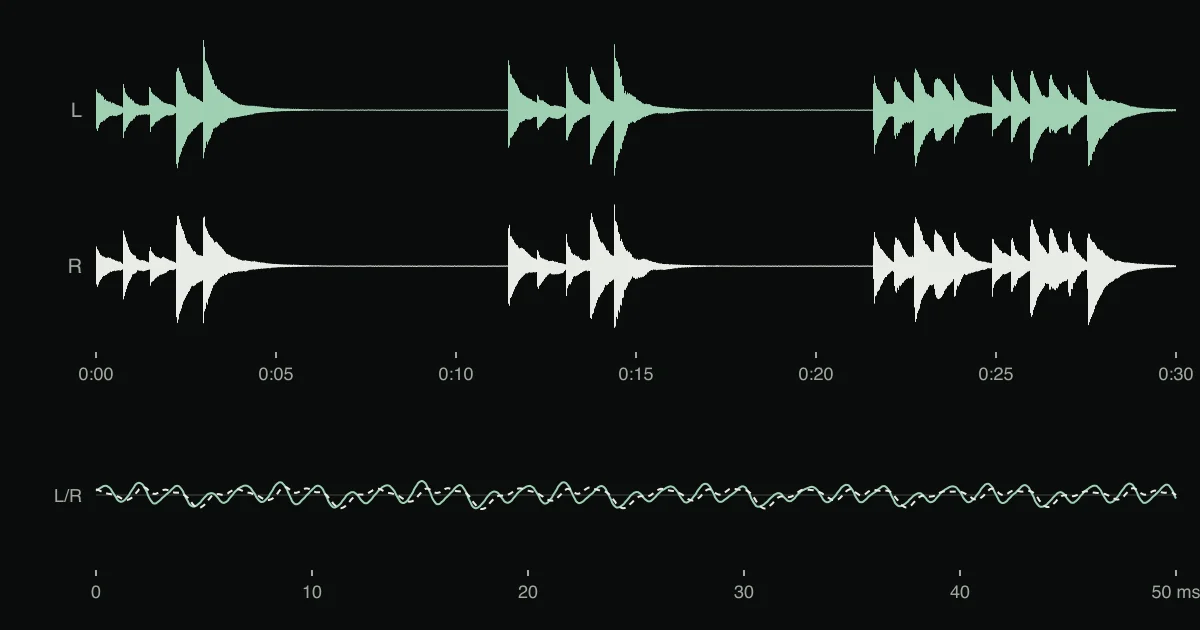
| Frequency | Channel | Level | Nearest note |
|---|---|---|---|
| 128.5 Hz | both channels | −10.5 dB | C3 −31 cents |
| 192.6 Hz | both channels | −5.4 dB | G3 −30 cents |
| 257.1 Hz | both channels | −3.4 dB | C4 −30 cents |
| 288.5 Hz | both channels | 0 dB | D4 −31 cents |
| 305.6 Hz | right | −10.8 dB | D♯4 −31 cents |
| 385.3 Hz | both channels | −8.6 dB | G4 −30 cents |
| 577.1 Hz | both channels | −2.6 dB | D5 −30 cents |
| 611.3 Hz | both channels | −7.4 dB | D♯5 −31 cents |
What does the evidence say?
Music before bed and sleep
A slow, calm melody accompanies your bedtime routine; listening to music before bed probably improves subjective sleep quality.
What don't we know? No improvement in objective sleep measures was shown.
Findings and sources
Evidence levels and sources come from the database; the article adds no new claims. Evidence methodology
Studies
| Work | Type | n | Finding | Level |
|---|---|---|---|---|
| Li 2025[3] | Meta-analysis · very low certainty | 602 | A meta-analysis of 10 studies (6 randomized, 4 non-randomized; 602 people) in adults aged 50 and over: music interventions improved sleep quality, with high heterogeneity between studies (I² = 79%). The effect was smaller in randomized trials and not significant in non-randomized studies. GRADE certainty was very low; the authors urge caution in clinical recommendations. | B |
| Pan 2025[2] | Review | — | A narrative review drawing on randomised trials and meta-analyses: the most effective music was slow (60-80 bpm), soft and smooth in melody, instrumental and simple in structure. Suggested use is 30-45 minutes a day before bed at a comfortable volume. Long-term effects and mechanisms remain unclear. | B |
| Jespersen 2022[1] | Systematic review · moderate certainty | 1007 | A Cochrane review of 13 randomised trials (1007 participants) of music listening in adults with sleep difficulties. Listening to prerecorded music for 25-60 minutes a day improved subjective sleep quality compared with no intervention, with moderate certainty. Low-certainty benefits were found for sleep-onset latency, total sleep time and sleep efficiency; three studies with objective measures suggest music may not improve these. No adverse events were reported. | B |
Frequently asked questions
- Is this a taqsim performance?
- No. Only the pitches of Nahawand and the logic of moving between its jins are used; a taqsim's identity also lies in the performer's decisions in the moment and in ornaments. The melody is original and algorithmic; there is no plectrum tremolo and no ornamentation.
- Is this an oud recording?
- No. The sound is made on the device with a model of a vibrating string; its tone was tuned by measuring public-domain (CC0) oud recordings. The notes are arranged the same way every night from a seed.
Who is it for?
For whom
- Anyone looking for sound for relaxation, focus or a sleep routine; the sounds are generated on your device and promise no effect.
- Anyone who wants to read the evidence level of what they listen to.
Not for whom
- If you have epilepsy or a history of seizures, a psychiatric diagnosis, a medical device such as a pacemaker, tinnitus or any other health condition, or if you are pregnant, consult your doctor before use.
- Do not listen while driving or operating machinery.
- Keep your device volume comfortable, preferably below 60%. You can also use your device's headphone-safety settings.
Frekans Studio is not a medical device; it does not diagnose, treat or prevent any disease.
Listen and try
Oud Night · 45 min
Listen from inside the night
As the night goes on it slows and thins out. To hear the difference, start from the middle or near the end.
The night's sound is made in this browser, on your device's processor: none of it is downloaded from a server and no listening data is sent. You can check in your browser's network tab; the only sound file downloaded is the buttons' short interface sounds.
Sources
- Jespersen KV, Pando-Naude V, Koenig J, Jennum P, Vuust P. Listening to music for insomnia in adults. Cochrane Database Syst Rev. 2022;8(8):CD010459. doi:10.1002/14651858.CD010459.pub3 PMID 36000763
- Pan EY, Wang W. Elements of music that work to improve sleep, a narrative review. Front Sleep. 2025;4:1707162. doi:10.3389/frsle.2025.1707162 PMID 41425167
- Li C, Kumar AP, Wankhar D, Kuppusamy M, Govindasamy K. Effect of music therapy on sleep quality in elderly: A systematic review and meta-analysis. PLoS One. 2025;20(11):e0334356. doi:10.1371/journal.pone.0334356 PMID 41187137
Citations come from the evidence database; every source is verified with Crossref or PubMed. Links go to the publication's own page (DOI).
Where to go next
Method
- Sources
- Scientific statements rest on 1 claims in the evidence database; each claim's sources and review note are on its own page: Music before bed and sleep
- Editorial responsibility
- Murat Tunalı · Editorial responsibility lies with Murat Tunalı; no independent medical review has been carried out.
- How this article was prepared
- The first draft was prepared by an AI model (Claude); the article adds no new figures, citations or claims, and the evidence summary comes from the database. Murat Tunalı approved publication. No independent scientific adviser has reviewed it yet. Evidence methodology · Credits
- Limitations
- This article is for information only; it is not medical advice. Evidence levels are per claim; a session's level is the weakest of its linked claims.
- Updates
- Last updated: 11 November 2026
- Cite as
- Frekans Studio. “Oud Night: an unmetred seyir in maqam Nahawand”. Last updated: 11 November 2026. https://frekans.studio/en/melody/oud-night