Dusty Keys: a swinging lo-fi night on felt piano
Session · Dusty Keys · Felt · 45 min · 45 min
How it was written
There are three original themes: A stays open like a question, A' returns to F5 like an answer, and B starts from the chord on the fourth degree. All are in F major and 4/4; the melody moves between C5 and A5, mostly on the notes of the pentatonic scale. The harmony always sits over an F in the bass: F6/9 and B♭maj9 sway in turn.
The swing is in the grid: the off-beat quaver falls not halfway through the beat but at about three fifths of it. Because note starts are at least half a second apart, the beat after an off-beat quaver stays empty; that is where the melody's «da-DA, rest» flow comes from. The left hand plays the bass and the chord on the downbeat, the fifth on the third beat and the chord again just after it.
The chord's voicing is chosen bar by bar: the third first, then the seventh or sixth, the ninth and the fifth. If the notes ringing together under the pedal fail the roughness check, the least important note is dropped; there are no semitone neighbours and no fundamentals closer than 43 Hz. In the melody E and F never ring together in the same bar.
How does it play at night?
The night passes through four phases. In the Opening the themes play in full; in the Descent the long notes stay and the chord comes on the first and third beats; at the Floor a long melody note comes every other bar with one chord a bar and the bass every other bar; in the Long floor the two chords sway and a long note is heard at most every four bars. The night ends on D5, C5 and F5.
The tempo falls from about 63 to 48 beats a minute and only ever slows; the level drops gently too. The lo-fi colour has three layers: only the vinyl crackle and room air of a lo-fi layer without drums, a slowly wavering tape echo of the piano (the waver is in the echo only, at most twice a second), and a light copy passed through a bit reducer. There is no pumping, hi-hat or snare.
It took shape over two listening rounds: out of three harmonic languages (9th and 13th jazz chords, plain sevenths, a sway over an F pedal) the sway was chosen; out of four colours (dry, with crackle, with tape echo, with colour) the one with all of them.
Listen
In the Library the family's night is Dusty Keys · Felt · 45 min: felt piano, A4 = 432 Hz tuning and hall reverb. The electric-piano Dusty Keys · 45 min is in the Library too: jazz chords, a soft bass and a sparse kalimba melody in the same drumless lo-fi language. These nights are not among your own night's options.
Measuring the sound
The two images and the table in this section were measured from the sound of the session below as it plays on the site: the audio was generated the way the engine generates it on your device, at the site's level. The measurement shows the physics of the sound; it says nothing about its effects.
Dusty Keys · Felt · 45 min · seconds 16-46
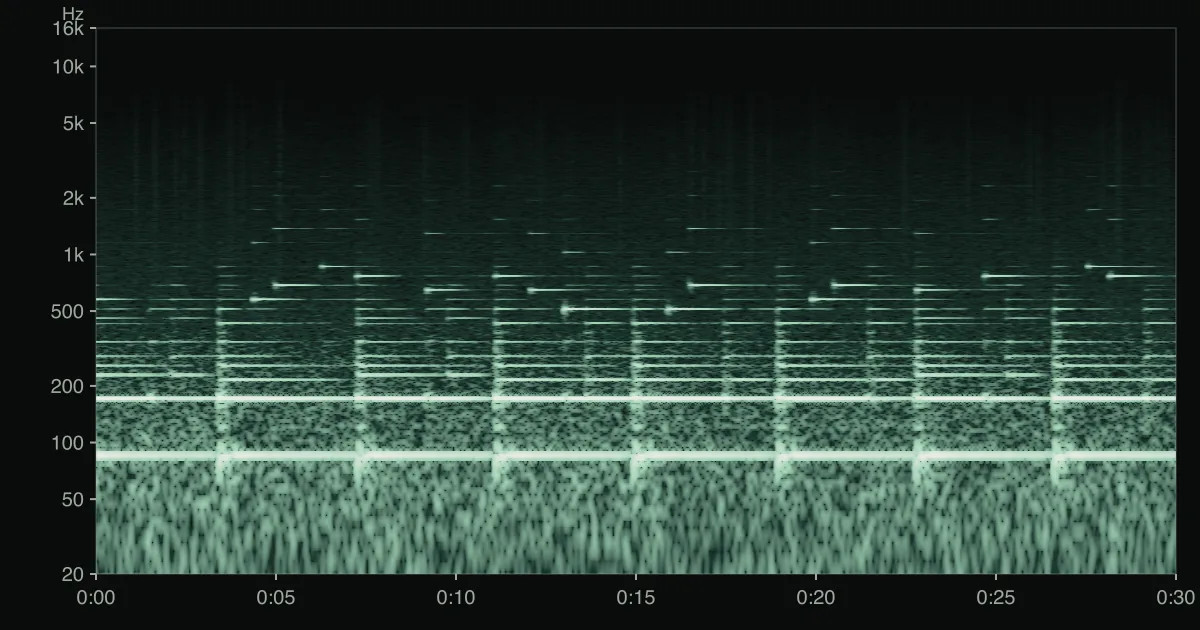
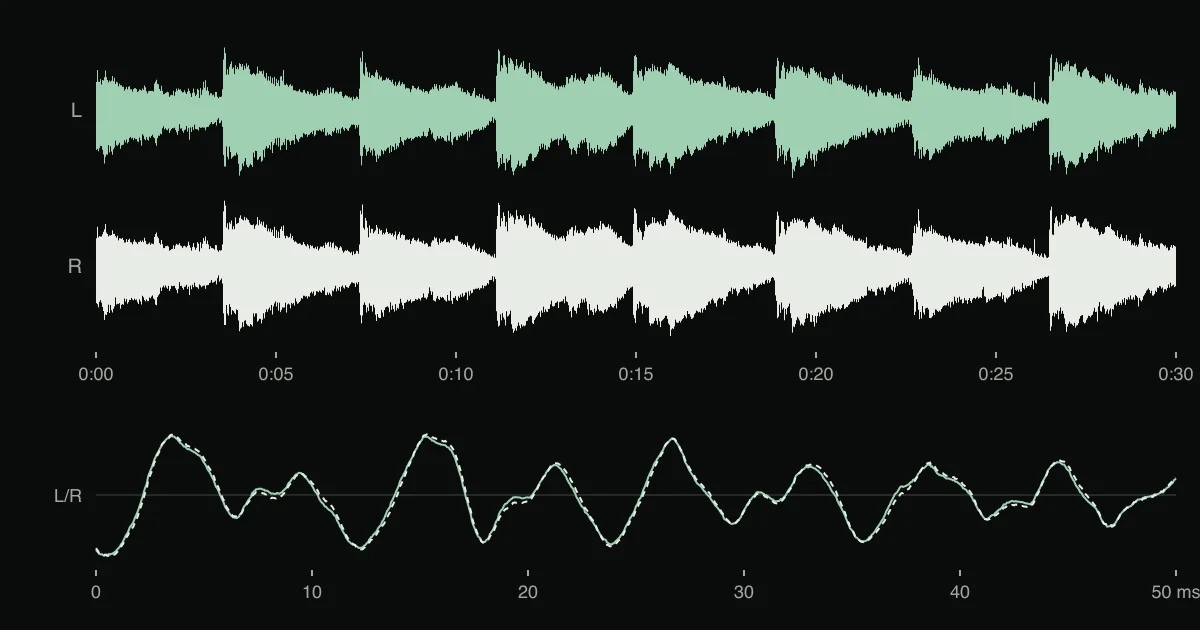
| Frequency | Channel | Level | Nearest note |
|---|---|---|---|
| 85.7 Hz | both channels | −6.2 dB | F2 −32 cents |
| 171.6 Hz | both channels | 0 dB | F3 −30 cents |
| 216.1 Hz | both channels | −14.1 dB | A3 −31 cents |
| 228.8 Hz | both channels | −20.7 dB | A♯3 −32 cents |
| 257.2 Hz | both channels | −20.8 dB | C4 −30 cents |
| 513.8 Hz | both channels | −17.5 dB | C5 −32 cents |
| 685.9 Hz | both channels | −20.3 dB | F5 −31 cents |
| 769.7 Hz | both channels | −20.4 dB | G5 −32 cents |
What does the evidence say?
Music before bed and sleep
A slow, calm melody accompanies your bedtime routine; listening to music before bed probably improves subjective sleep quality.
What don't we know? No improvement in objective sleep measures was shown.
Findings and sources
Evidence levels and sources come from the database; the article adds no new claims. Evidence methodology
Studies
| Work | Type | n | Finding | Level |
|---|---|---|---|---|
| Li 2025[3] | Meta-analysis · very low certainty | 602 | A meta-analysis of 10 studies (6 randomized, 4 non-randomized; 602 people) in adults aged 50 and over: music interventions improved sleep quality, with high heterogeneity between studies (I² = 79%). The effect was smaller in randomized trials and not significant in non-randomized studies. GRADE certainty was very low; the authors urge caution in clinical recommendations. | B |
| Pan 2025[2] | Review | — | A narrative review drawing on randomised trials and meta-analyses: the most effective music was slow (60-80 bpm), soft and smooth in melody, instrumental and simple in structure. Suggested use is 30-45 minutes a day before bed at a comfortable volume. Long-term effects and mechanisms remain unclear. | B |
| Jespersen 2022[1] | Systematic review · moderate certainty | 1007 | A Cochrane review of 13 randomised trials (1007 participants) of music listening in adults with sleep difficulties. Listening to prerecorded music for 25-60 minutes a day improved subjective sleep quality compared with no intervention, with moderate certainty. Low-certainty benefits were found for sleep-onset latency, total sleep time and sleep efficiency; three studies with objective measures suggest music may not improve these. No adverse events were reported. | B |
Frequently asked questions
- Is this a recording of a lo-fi track?
- No. The sound is made on the device: the felt piano is a model and the notes are arranged the same way every night from a seed. No samples, recordings or melodies from other tracks are used.
- Why are there no drums?
- The lo-fi language chosen for the night has no drums: pumping, hi-hats and snares bring regular, sharp hits. The swing stays in the timing of the melody and the chords.
Who is it for?
For whom
- Anyone looking for sound for relaxation, focus or a sleep routine; the sounds are generated on your device and promise no effect.
- Anyone who wants to read the evidence level of what they listen to.
Not for whom
- If you have epilepsy or a history of seizures, a psychiatric diagnosis, a medical device such as a pacemaker, tinnitus or any other health condition, or if you are pregnant, consult your doctor before use.
- Do not listen while driving or operating machinery.
- Keep your device volume comfortable, preferably below 60%. You can also use your device's headphone-safety settings.
Frekans Studio is not a medical device; it does not diagnose, treat or prevent any disease.
Listen and try
Dusty Keys · Felt · 45 min
Listen from inside the night
As the night goes on it slows and thins out. To hear the difference, start from the middle or near the end.
The night's sound is made in this browser, on your device's processor: none of it is downloaded from a server and no listening data is sent. You can check in your browser's network tab; the only sound file downloaded is the buttons' short interface sounds.
Sources
- Jespersen KV, Pando-Naude V, Koenig J, Jennum P, Vuust P. Listening to music for insomnia in adults. Cochrane Database Syst Rev. 2022;8(8):CD010459. doi:10.1002/14651858.CD010459.pub3 PMID 36000763
- Pan EY, Wang W. Elements of music that work to improve sleep, a narrative review. Front Sleep. 2025;4:1707162. doi:10.3389/frsle.2025.1707162 PMID 41425167
- Li C, Kumar AP, Wankhar D, Kuppusamy M, Govindasamy K. Effect of music therapy on sleep quality in elderly: A systematic review and meta-analysis. PLoS One. 2025;20(11):e0334356. doi:10.1371/journal.pone.0334356 PMID 41187137
Citations come from the evidence database; every source is verified with Crossref or PubMed. Links go to the publication's own page (DOI).
Where to go next
Method
- Sources
- Scientific statements rest on 1 claims in the evidence database; each claim's sources and review note are on its own page: Music before bed and sleep
- Editorial responsibility
- Murat Tunalı · Editorial responsibility lies with Murat Tunalı; no independent medical review has been carried out.
- How this article was prepared
- The first draft was prepared by an AI model (Claude); the article adds no new figures, citations or claims, and the evidence summary comes from the database. Murat Tunalı approved publication. No independent scientific adviser has reviewed it yet. Evidence methodology · Credits
- Limitations
- This article is for information only; it is not medical advice. Evidence levels are per claim; a session's level is the weakest of its linked claims.
- Updates
- Last updated: 11 November 2026
- Cite as
- Frekans Studio. “Dusty Keys: a swinging lo-fi night on felt piano”. Last updated: 11 November 2026. https://frekans.studio/en/melody/dusty-keys