Music while studying: does it help or distract?
Session · Deep Focus · Brown Noise · 2 h
Focus timer
Music, noise or silence?
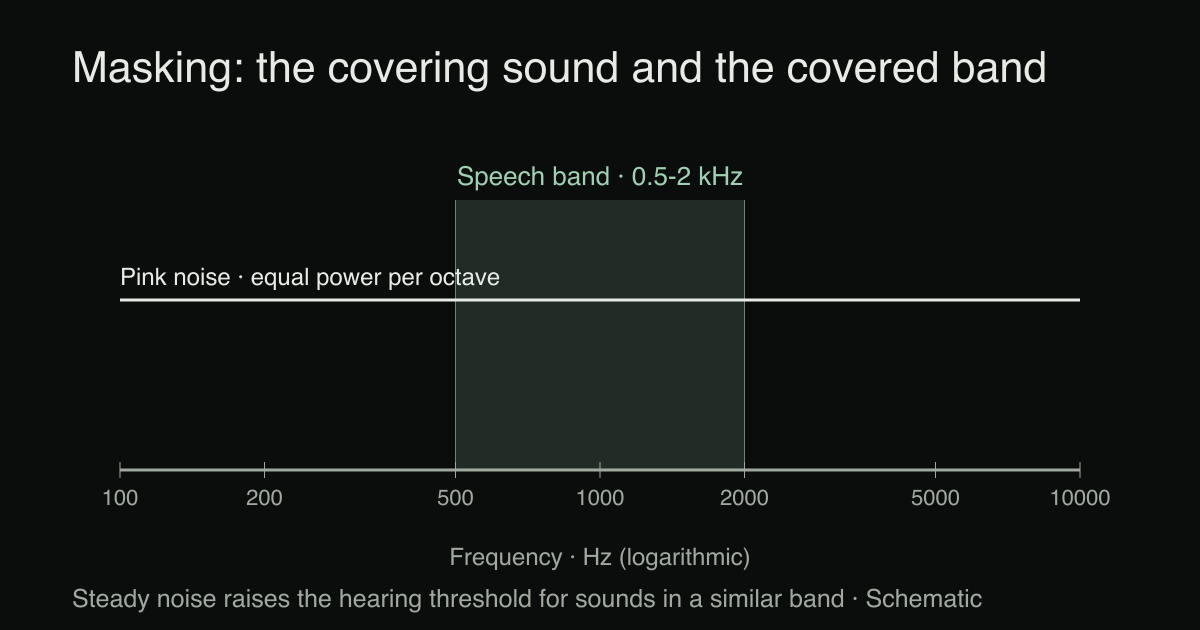
The three options do different jobs. Silence adds the least load, but only if the surroundings are quiet; in a café, a dormitory or an open office there is no silence, and a continuous sound raises the threshold at which distractions such as speech are heard. Noise and slow, wordless music do that job. Music with lyrics competes with language itself in language tasks such as reading and writing, and can distract more.
The difference between people is large: in a meta-analysis of 13 studies, white and pink noise gave a small benefit on laboratory attention tasks in children and young people with high attention-difficulty symptoms, and slightly reduced performance in those without them. Brown noise was never tested.
Binaural beats and listening before the task
Meta-analyses report a moderate average effect on memory and attention tasks, but the results conflict; in a large at-home experiment some beats lowered reasoning scores. In a subgroup analysis of one meta-analysis, listening before a task did better than listening only during it: weak as it is, that is the one pattern consistent with the evidence. If you want beats while studying, try a short pre-task session and continue the work in silence or with noise alone.
Run your own comparison
The most reliable way to learn which sound suits you is your own experiment: do the same kind of work one day in silence, one day with noise, one day with wordless music, and leave a short note in the Journal. The study timer sets up that cycle: a background sound, a work-break cycle and a soft bell announcing each switch. Leave the volume at the lowest level at which you can't make out the words from the next desk; anything louder adds hearing load.
What does the evidence say?
White or pink noise and attention
The effect of noise on attention varies from person to person: small benefits in some, small harms in others.
What don't we know? In people without marked attention difficulties noise slightly worsened performance (g = −0.212), so it cannot be said to improve focus for users in general.
Findings and sourcesBinaural beats, focus and memory
Evidence is weak and conflicting; in some studies binaural beats lowered test performance.
What don't we know? Results conflict.
Findings and sourcesBinaural beats before a task
Listening to binaural beats before a task may give better results than listening only during it.
What don't we know? This rests on a moderator comparison within one meta-analysis; few experiments test the question directly, and in a small experiment that directly varied onset time, results were mixed.
Findings and sourcesBroadband noise and masking
Continuous noise probably makes surrounding sounds less noticeable.
What don't we know? It is not clear that masking translates into protected sleep: in a 25-person lab study, adding pink noise to intermittent environmental noise worsened sleep structure further, and earplugs worked better.
Findings and sources
Evidence levels and sources come from the database; the article adds no new claims. Evidence methodology
Studies
| Work | Type | n | Finding | Level |
|---|---|---|---|---|
| Basner 2026[9] | Randomised controlled trial | 25 | A seven-night laboratory study in 25 healthy adults: intermittent environmental noise mainly reduced deep sleep (N3), whereas pink noise mainly reduced REM sleep, and adding pink noise to environmental noise worsened sleep structure further. Earplugs prevented most environmental-noise effects. The authors caution against widespread, indiscriminate use of broadband noise. | B |
| Melnichuk 2025[4] | Experiment | 80 | Sixteen parameter conditions were tested; 80 undergraduates were randomized and 64 analysed. 40 Hz binaural beats with a low (340 Hz) carrier improved general attention performance but did not prevent the decline of attention over time. EEG showed a response at the beat frequency that varied with parameters and weakened under white-noise masking. The authors say the finding needs replication. | C |
| Leistiko 2024[6] | Experiment | 58 | In 58 healthy adults, 40 Hz (gamma) binaural beats did not change attention-test performance (reaction time, errors, attention networks) compared with a control tone, and had no effect on a single-item self-rating of anxiety. | C |
| Nigg 2024[1] | Meta-analysis | 13 studies | In children and young adults with ADHD or high attention-problem symptoms (13 studies, 335 people), white and pink noise gave a small benefit on laboratory attention tasks. In comparison groups without these symptoms (11 studies) the effect was small and negative. No studies of brown noise were found. | C |
| Basu 2023[3] | Meta-analysis | 15 studies | A meta-analysis of 15 studies found a medium, significant overall effect of binaural beats on memory and attention. The systematic review found conflicting results, especially for theta and beta beats on memory and attention tasks; the authors call for more robust designs. | C |
| Klichowski 2023[5] | Experiment | 1000 | In two online home experiments, 1,000 adults took a reasoning test. Listening to binaural beats during the second half lowered scores regardless of how the sound was framed, while silence and other sounds had no effect. The authors concluded that home-use binaural beats may weaken rather than support cognitive performance. | C |
| Robison 2022[7] | Experiment | — | Three experiments tested 16 Hz (beta) binaural beats on sustained attention. The first two gave inconsistent results; their combined data gave rather strong evidence against the hypothesis that beta beats improve sustained attention. Pupil measures showed no effect either. | C |
| Riedy 2021[10] | Systematic review · very low certainty | 38 studies | Across 38 studies of continuous white or similar broadband noise and sleep, findings ranged from noise helping sleep to disrupting it. By GRADE, the quality of evidence that continuous noise benefits sleep was very low; the authors warn that continuous noise may also harm sleep and hearing. | B |
| Zhang 2021[11] | Experiment | 30 | In a lab experiment simulating a Chinese-language open-plan office, 30 participants' serial recall and sound-environment perception were measured in 14 conditions: quiet, speech only, and 12 conditions in which four maskers (speech-like pink noise, air-conditioning noise, spring water sound, babble) were presented with speech at three signal-to-noise ratios. Effects differed markedly by masker type and ratio; the best condition was spring water sound at a medium ratio (−2.4 dB). Effects could differ by gender, education level and noise sensitivity. | B |
| Garcia-Argibay 2019[2] | Meta-analysis | 22 studies | A meta-analysis of 22 studies on memory, attention, anxiety and pain found a medium, significant overall effect. Listening before the task (or before and during it) worked better than listening only during it, and longer exposure increased the effect. Masking with white or pink noise did not appear necessary. | C |
| Moore 2013[8] | Textbook | — | A standard textbook of auditory perception. Its chapter on frequency selectivity and masking describes how one sound raises the detection threshold of another (auditory masking) and how this depends on frequency bands. | B |
Frequently asked questions
- Which noise colour for exam revision?
- There is no reliable comparison showing which colour is better; brown and pink noise sound softer and may be less tiring over long sessions. Noise can slightly reduce attention in some people; silence is an option too.
- Do study-music playlists work?
- Wordless, slow music without surprises breaks attention less; this database holds no reliable study showing that a particular playlist or genre improves learning.
Who is it for?
For whom
- Anyone looking for sound for relaxation, focus or a sleep routine; the sounds are generated on your device and promise no effect.
- Anyone who wants to read the evidence level of what they listen to.
- Students who study with sound and those who don't; sound's job is to cover the surroundings, not to sharpen attention, and music with lyrics can interrupt reading.
Not for whom
- If you have epilepsy or a history of seizures, a psychiatric diagnosis, a medical device such as a pacemaker, tinnitus or any other health condition, or if you are pregnant, consult your doctor before use.
- Do not listen while driving or operating machinery.
- Keep your device volume comfortable, preferably below 60%. You can also use your device's headphone-safety settings.
Frekans Studio is not a medical device; it does not diagnose, treat or prevent any disease.
Listen and try
Deep Focus · Brown Noise
Sources
- Nigg JT, Bruton A, Kozlowski MB, Johnstone JM, Karalunas SL. Systematic Review and Meta-Analysis: Do White Noise or Pink Noise Help With Task Performance in Youth With Attention-Deficit/Hyperactivity Disorder or With Elevated Attention Problems?. J Am Acad Child Adolesc Psychiatry. 2024;63(8):778-788. doi:10.1016/j.jaac.2023.12.014 PMID 38428577
- Garcia-Argibay M, Santed MA, Reales JM. Efficacy of binaural auditory beats in cognition, anxiety, and pain perception: a meta-analysis. Psychol Res. 2019;83(2):357-372. doi:10.1007/s00426-018-1066-8 PMID 30073406
- Basu S, Banerjee B. Potential of binaural beats intervention for improving memory and attention: insights from meta-analysis and systematic review. Psychol Res. 2023;87(4):951-963. doi:10.1007/s00426-022-01706-7 PMID 35842538
- Melnichuk A, Cooper RK, Hawk LW. A parametric investigation of binaural beats for brain entrainment and enhancing sustained attention. Sci Rep. 2025;15(1):4308. doi:10.1038/s41598-025-88517-z PMID 39910150
- Klichowski M, Wicher A, Kruszwicka A, Golebiewski R. Reverse effect of home-use binaural beats brain stimulation. Sci Rep. 2023;13(1):11079. doi:10.1038/s41598-023-38313-4 PMID 37422545
- Leistiko NM, Madanat L, Yeung WKA, Stone JM. Effects of gamma frequency binaural beats on attention and anxiety. Curr Psychol. 2024;43(6):5032-5039. doi:10.1007/s12144-023-04681-3 PMID 37359672
- Robison MK, Obulasetty M, Blais C, Wingert KM, Brewer GA. The effect of binaural beat stimulation on sustained attention. Psychol Res. 2022;86(3):808-822. doi:10.1007/s00426-021-01524-3 PMID 33978805
- Moore BCJ. An Introduction to the Psychology of Hearing. Brill; 2013. ISBN 9789004252424
- Basner M, Smith MG, Cordoza M, Kayser MS, Carlin M, Ecker AJ, et al. Efficacy of pink noise and earplugs for mitigating the effects of intermittent environmental noise exposure on sleep. Sleep. 2026;49(5):zsag001. doi:10.1093/sleep/zsag001 PMID 41627391
- Riedy SM, Smith MG, Rocha S, Basner M. Noise as a sleep aid: A systematic review. Sleep Med Rev. 2021;55:101385. doi:10.1016/j.smrv.2020.101385 PMID 33007706
- Zhang Y, Ou D, Kang S. The effects of masking sound and signal-to-noise ratio on work performance in Chinese open-plan offices. Appl Acoust. 2021;172:107657. doi:10.1016/j.apacoust.2020.107657
Citations come from the evidence database; every source is verified with Crossref or PubMed. Links go to the publication's own page (DOI).
Where to go next
Method
- Sources
- Scientific statements rest on 4 claims in the evidence database; each claim's sources and review note are on its own page: White or pink noise and attention · Binaural beats, focus and memory · Binaural beats before a task · Broadband noise and masking
- Editorial responsibility
- Murat Tunalı · Editorial responsibility lies with Murat Tunalı; no independent medical review has been carried out.
- How this article was prepared
- The first draft was prepared by an AI model (Claude); the article adds no new figures, citations or claims, and the evidence summary comes from the database. Murat Tunalı approved publication. No independent scientific adviser has reviewed it yet. Evidence methodology · Credits
- Limitations
- This article is for information only; it is not medical advice. Evidence levels are per claim; a session's level is the weakest of its linked claims.
- Updates
- Last updated: 4 November 2026
- Cite as
- Frekans Studio. “Music while studying: does it help or distract?”. Last updated: 4 November 2026. https://frekans.studio/en/guide/music-while-studying