Sound in the ocean: the SOFAR channel and hydrophones
Session · Unseen Creatures · The Humpback's Song · 5 min
Depth
What does the depth effect change?
As you go deeper, the high frequencies of the synthesized layers are filtered out (the cutoff falls from 12 kHz to 600 Hz) and the echo grows longer (from about 0.9 s to 5 s). This is a simulation, not a measurement of how sound is heard at depth: it carries the darkness and breadth of the water to the ear. The underwater ambience zone is also chosen from the depth: waves and bubbles near the surface, a low rumble deep down.
In the ocean, low-frequency sound can travel very far: water layered by differences in salinity and temperature bends sound between its layers in the SOFAR channel and carries it hundreds of miles. Hydrophones on the channel's axis can record whale calls and earthquakes a vast distance away.
Physics mode: distance, absorption and SOFAR
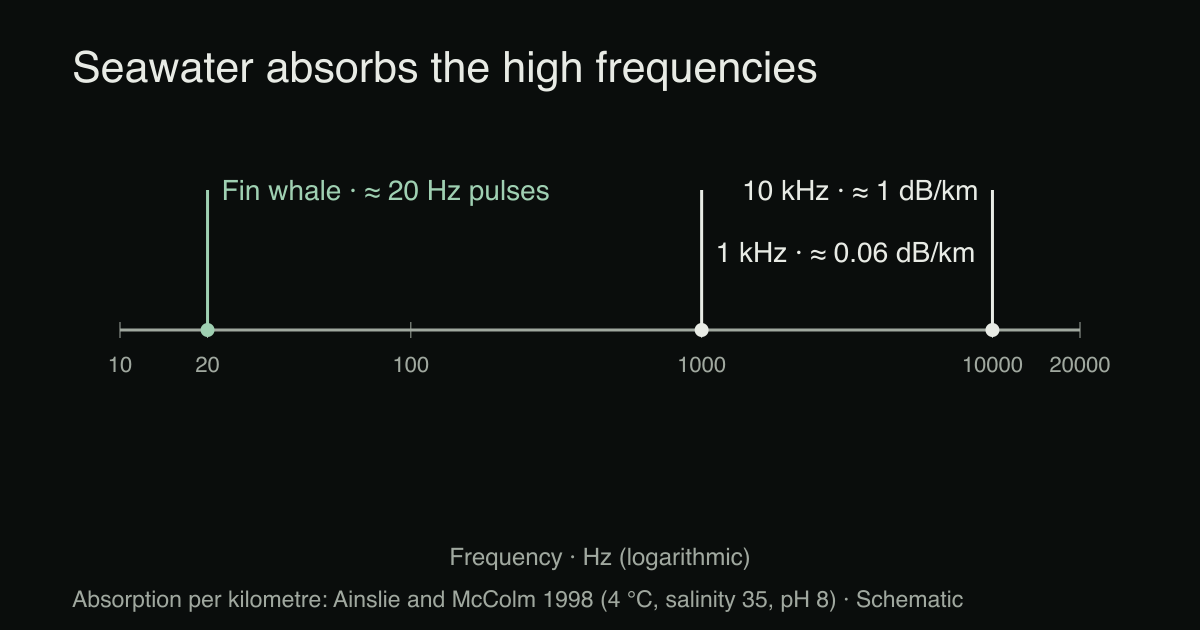
In the real ocean it is not depth but the distance to the source that muffles a sound. In physics mode the calls are 1-1000 km away: seawater absorption is calculated with the formula of Ainslie and McColm 1998 (a simplified form of Francois and Garrison 1982; for deep water 4 °C, salinity 35, pH 8). Absorption rises quickly with frequency: about 0.06 dB per kilometre at 1 kHz, about 1 dB at 10 kHz. That is why the dolphin whistles fade with distance while the fin whale's low pulses remain. The recording layer moves away too: absorption uses the same calculation, and a quarter of the spreading loss is applied (at most 6 dB), because the recording already carries its own distance.
The speed of sound changes with depth: it rises with temperature near the surface and with pressure deep down, with an axis of lowest speed in between. The curve in the column is the canonical Munk profile (Munk 1974; constants from the example in Jensen et al. 1994): axis at 1,300 m, 1,500 m/s there. With the hydrophone inside the channel, sound stays in the channel and weakens less with distance; the tool calculates this with a rough rule (cylindrical spreading in the channel, spherical outside). In reality the axis depth varies with place and season.
When you measure by echo, the ping goes down from the hydrophone to the bottom and comes back; the time is calculated from the same profile's sound speed and passes in real time. From the surface, the echo from a bottom at average depth takes about 4.9 seconds.
Species in the column and the dive's recordings
With Species on, ten species are marked in the column; each mark is a measured deepest dive or a feeding depth: Atlantic spotted dolphin 61 m and narwhal 1,200 m (NOAA Fisheries), North Atlantic right whale feeding dives 80-175 m (Baumgartner and Mate 2003), regular blue whale feeding at 250-300 m (Calambokidis et al. 2007), fin whale at least 470 m (Panigada et al. 1999), harbor seal 481 m (Eguchi and Harvey 2005), humpback whale 616 m (Derville et al. 2020), the offshore bottlenose dolphins of Bermuda 1,000 m (Fahlman et al. 2023), killer whale 1,087 m (Towers et al. 2019) and sperm whale 1,330 m (Watkins et al. 2002). The numbers are measurements from single studies, not absolute records for the species; species whose sources give no depth in metres (oyster toadfish, snapping shrimp) are not in the column.
In the narrated dive, six thresholds each play their own recording: a humpback whale at the end of the sunlit zone, a sperm whale at the end of the twilight zone, a blue whale on the SOFAR axis, a submarine earthquake at the start of the abyss, and in the hadal zone and the Challenger Deep the ship and the whale that NOAA PMEL recorded at the bottom of the trench in 2015. Apart from the two Challenger Deep recordings, the recordings were not made at that depth; the threshold tells how the sound relates to that depth.
Where do the hydrophone recordings come from?
The two humpback whale recordings come from a hydrophone the US National Park Service (NPS) anchored near the mouth of Glacier Bay, Alaska, to monitor ambient noise, in September 2001. Bloop is a low sound recorded by NOAA hydrophones in the summer of 1997; the recording is sped up 16 times. According to NOAA it is consistent with icequakes generated by large icebergs as they crack and fracture.
The blue whale recording is from the Northeast Pacific page of the NOAA PMEL Acoustics Program; the recorded signal is sped up 10 times (the blue whale's sound lies below our hearing range). According to PMEL, the information on its pages is public and may be distributed freely with the source credited.
On 1 November 2026 thirty-one more recordings were added: dolphins and orcas, the sperm whale, the narwhal, the right whale and the fin whale, seals, the toadfish, snapping shrimp and a reef, ocean events (icebergs, Upsweep, Slow Down, an undersea earthquake, rain, ships) and a whale and a ship recorded in 2015 from the floor of the Challenger Deep. Their sources are the passive acoustics recordings of NOAA Fisheries' Northeast and Southwest Fisheries Science Centers (NEFSC, SWFSC), NPS Glacier Bay, NOAA PMEL and the Alfred Wegener Institute's Polar Sounds; the Caribbean dolphins are a CC0 recording by Felix Blume (Freesound). Clips credited to other institutions on NOAA's page were not taken. Every recording passed the 4-40 Hz criterion: the envelope spectrum has no periodic line standing out from the noise floor (minke pulses and the bearded seal's trill were left out for this reason). Bloop was replaced with PMEL's original file, because the Commons copy did not pass this criterion. For sped-up recordings the factor is written on the card.
Apart from the Caribbean dolphins (CC0) and the narwhal and Weddell seal (Alfred Wegener Institute, Helmholtz Center for Polar and Marine Research, 2022, CC BY 4.0; trimmed and converted to mono AAC), all are in the public domain as official work of US federal agencies. The recordings download the first time they play and are not part of the app install.
What does the evidence say?
Context · not a claim
According to NOAA, the ocean is layered by differences in salinity and temperature; in the SOFAR channel, low-frequency sound emitted at a certain depth bends between these layers and can travel hundreds of miles. Hydrophones at the channel's axis can record whale calls and earthquakes very far away.
According to Wenz, the ocean's ambient noise is made of at least three overlapping components: turbulent pressure fluctuations at 1-100 Hz, wind-dependent surface noise at 50 Hz-20 kHz and, in many areas, shipping traffic at 10-1000 Hz.
The fin whale's 20 Hz signals are 1-second pulses sweeping down from about 23 to 18 Hz, typically repeated every 7-26 seconds.
The average ocean depth is 3,682 metres; the deepest point, the Challenger Deep in the Mariana Trench, is about 10,935 metres.
Evidence levels and sources come from the database; the article adds no new claims. Evidence methodology
Studies
| Work | Type | n | Finding | Level |
|---|---|---|---|---|
| NOAA 2026[4] | Institutional page | — | The average ocean depth is 3,682 meters (12,080 feet). The deepest part of the ocean is the Challenger Deep, at the southern end of the Mariana Trench: approximately 10,935 meters (35,876 feet) deep. | |
| NOAA 2026[1] | Institutional page | — | The ocean is layered by differences in salinity and temperature: saltier and colder water lies beneath less salty, warmer water. Because of SOFAR, sound emitted at a certain depth bounces between these layers and can travel for hundreds of miles; this up-and-down bending of low-frequency sound waves lets them travel great distances without the signal losing significant energy. Hydrophones placed at the axis of the sound channel can record whale calls, earthquakes and man-made noise occurring vast distances away. | |
| Watkins 1987[3] | Experiment | — | The 20-Hz signals of finback whales were analyzed from more than 25 years of recordings: 1-s pulses of sinusoidal waveform sweeping down from approximately 23 to 18 Hz, usually with slightly lower levels at the beginning and end of sequences. The pulses were produced in bouts lasting as long as 32.5 h, regularly repeated at intervals of 7-26 s (typically), either at one pulse rate or at two alternating (doublet) intervals. Bouts were interrupted by rests of 1-20 min at roughly 15-min intervals and by irregular gaps of 20-120 min; the sound sequences were never exactly replicated. | |
| Wenz 1962[2] | Review | — | Ambient-noise measurements in the ocean were compared as pressure spectra in the band 1 Hz to 20 kHz. According to the author, ambient noise is generally a composite of at least three overlapping components: turbulent-pressure fluctuations at 1-100 Hz; wind-dependent noise from bubbles and spray resulting primarily from surface agitation, 50 Hz to 20 kHz; and, in many areas, shipping traffic at 10-1000 Hz. |
Frequently asked questions
- Why does sound travel farther in water?
- Seawater absorbs low frequencies very little: about 0.06 dB per kilometre at 1 kHz and about 1 dB at 10 kHz. In the SOFAR channel sound bends between the layers, keeps most of its energy and can travel hundreds of miles.
- Are the recordings in the Depth tool real?
- Layers tagged RECORDING are real hydrophone recordings; some are sped up so they can be heard, and the factor is shown on the recording card. Layers tagged SYNTHESIS are representative sounds built from published measurements.
- How deep is the ocean?
- According to NOAA the average depth is 3,682 metres; the deepest point, the Challenger Deep, is about 10,935 metres. The Depth tool's column goes from the surface down to that bottom.
Who is it for?
For whom
- Anyone looking for sound for relaxation, focus or a sleep routine; the sounds are generated on your device and promise no effect.
- Anyone who wants to read the evidence level of what they listen to.
- Anyone curious about the Depth tool's physics mode, the SOFAR channel and where its hydrophone recordings come from; the guide is a sourced summary, not a measurement.
Not for whom
- If you have epilepsy or a history of seizures, a psychiatric diagnosis, a medical device such as a pacemaker, tinnitus or any other health condition, or if you are pregnant, consult your doctor before use.
- Do not listen while driving or operating machinery.
- Keep your device volume comfortable, preferably below 60%. You can also use your device's headphone-safety settings.
Frekans Studio is not a medical device; it does not diagnose, treat or prevent any disease.
Listen and try
Unseen Creatures · The Humpback's Song
Sources
- NOAA National Ocean Service. What is SOFAR?. National Oceanic and Atmospheric Administration; 2026.
- Wenz GM. Acoustic ambient noise in the ocean: spectra and sources. J Acoust Soc Am. 1962;34(12):1936-1956. doi:10.1121/1.1909155
- Watkins WA, Tyack P, Moore KE, Bird JE. The 20-Hz signals of finback whales (Balaenoptera physalus). J Acoust Soc Am. 1987;82(6):1901-1912. doi:10.1121/1.395685
- NOAA National Ocean Service. How deep is the ocean?. National Oceanic and Atmospheric Administration; 2026.
Citations come from the evidence database; every source is verified with Crossref or PubMed. Links go to the publication's own page (DOI).
Where to go next
Method
- Sources
- This article is not linked to a claim in the evidence database; it explains the technique and its use.
- Editorial responsibility
- Murat Tunalı · Editorial responsibility lies with Murat Tunalı; no independent medical review has been carried out.
- How this article was prepared
- The first draft was prepared by an AI model (Claude); the article adds no new figures, citations or claims, and the evidence summary comes from the database. Murat Tunalı approved publication. No independent scientific adviser has reviewed it yet. Evidence methodology · Credits
- Limitations
- This article is for information only; it is not medical advice. Evidence levels are per claim; a session's level is the weakest of its linked claims.
- Updates
- Last updated: 5 November 2026
- Cite as
- Frekans Studio. “Sound in the ocean: the SOFAR channel and hydrophones”. Last updated: 5 November 2026. https://frekans.studio/en/guide/sound-in-the-ocean