What is sound? From pressure wave to hearing
Spectrum analyzer
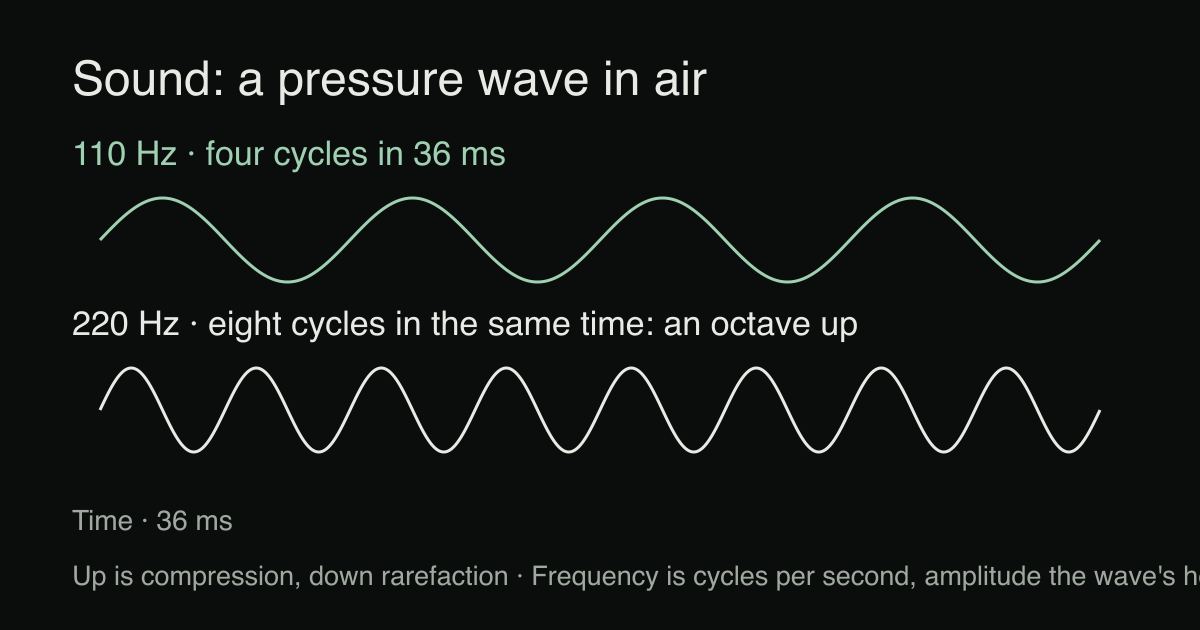
The wave: compression and rarefaction
When a loudspeaker cone moves forward it compresses the air in front of it; when it moves back it rarefies it. These regions of compression and rarefaction travel away from the source; the air particles only oscillate in place, and what travels is the pressure pattern. At 20 °C it moves at about 343 metres per second. Wavelength is speed divided by frequency: a 20 Hz sound is 17 metres long, a 20 kHz sound 1.7 centimetres.
Sound needs a medium: it does not travel in a vacuum. In water it is about four and a half times faster, in steel fifteen times; part of the character of deep-sea recordings comes from this. The pressure change reaching the ear is tiny: at the threshold of hearing, a few billionths of atmospheric pressure.
Three properties: frequency, amplitude, shape
Frequency is how many times per second the pressure pattern repeats; its unit is the hertz and its heard counterpart is pitch. Amplitude is the size of the pressure swing; its heard counterpart is level, measured in decibels. The waveform is the shape of one period: a pure sine has a single component, every other shape carries multiples of the fundamental (harmonics), and that mixture is heard as timbre.
The three can be set independently: a sound can be quiet or loud at the same pitch, thin or full at the same level. Playing the same frequency as a sine and as a triangle in the tone generator shows the difference within seconds.
What does the ear hear?
A young ear hears roughly 20 Hz to 20 kHz; the upper limit falls with age. Sensitivity is not flat: the ear is most sensitive around a few kHz, and at low frequencies the same loudness needs far more pressure. Below 20 Hz (infrasound) is felt more than heard; above 20 kHz (ultrasound) is silent to humans.
The brain judges frequency by ratio, not by difference: the gap between 100 and 200 Hz is an octave, while the gap between 10,000 and 10,100 Hz is barely audible. That is why the frequency rulers on this site are logarithmic.
In Frekans Studio
No sound here is a recording: every session is generated mathematically on your device and passes through the main chain (fade-in and fade-out, a level rise of at most 6 dB per second, a −1 dBFS ceiling). The Anatomy of Sound journey turns the seven ideas of this article into listening sessions; the frequency visualiser draws the wave and the spectrum of whatever is playing.
What does the evidence say?
Context · not a claim
Moore's textbook on the psychology of hearing defines sound as a pressure fluctuation in air, gives the hearing range as roughly 20 Hz-20 kHz and explains that pitch perception follows frequency roughly logarithmically rather than linearly.
Suzuki and Takeshima's 2004 compilation of equal-loudness contours (the basis of ISO 226:2003) shows that the ear is most sensitive around a few kHz and that low frequencies need far more sound pressure for the same loudness.
Evidence levels and sources come from the database; the article adds no new claims. Evidence methodology
Studies
| Work | Type | n | Finding | Level |
|---|---|---|---|---|
| Moore 2013[1] | Textbook | — | A standard textbook of auditory perception. Its chapter on frequency selectivity and masking describes how one sound raises the detection threshold of another (auditory masking) and how this depends on frequency bands. | |
| Suzuki 2004[2] | Experiment | 12 studies | Brings together the results of 12 studies from the mid-1980s onwards to propose new equal-loudness-level contours for pure tones. Differences from the 1956 Robinson and Dadson contours are greatest below 500 Hz and often reach 14 dB. |
Frequently asked questions
- Does sound travel in a vacuum?
- No. Sound is the pressure fluctuation of a medium; without air, water or a solid there is nothing to carry it. That is why space is silent.
- Which frequency is the ear most sensitive to?
- Around a few kHz; equal-loudness contours show that region as the most sensitive. A 50 Hz tone at the same level sounds much quieter.
Who is it for?
For whom
- Anyone looking for sound for relaxation, focus or a sleep routine; the sounds are generated on your device and promise no effect.
- Anyone who wants to read the evidence level of what they listen to.
- Anyone starting the physics of sound from scratch, or preparing for the Anatomy of Sound journey; textbook level, no claim of effect.
Not for whom
- If you have epilepsy or a history of seizures, a psychiatric diagnosis, a medical device such as a pacemaker, tinnitus or any other health condition, or if you are pregnant, consult your doctor before use.
- Do not listen while driving or operating machinery.
- Keep your device volume comfortable, preferably below 60%. You can also use your device's headphone-safety settings.
Frekans Studio is not a medical device; it does not diagnose, treat or prevent any disease.
Listen and try
Sources
- Moore BCJ. An Introduction to the Psychology of Hearing. Brill; 2013. ISBN 9789004252424
- Suzuki Y, Takeshima H. Equal-loudness-level contours for pure tones. J Acoust Soc Am. 2004;116(2):918-933. doi:10.1121/1.1763601 PMID 15376658
Citations come from the evidence database; every source is verified with Crossref or PubMed. Links go to the publication's own page (DOI).
Where to go next
Method
- Sources
- This article is not linked to a claim in the evidence database; it explains the technique and its use.
- Editorial responsibility
- Murat Tunalı · Editorial responsibility lies with Murat Tunalı; no independent medical review has been carried out.
- How this article was prepared
- The first draft was prepared by an AI model (Claude); the article adds no new figures, citations or claims, and the evidence summary comes from the database. Murat Tunalı approved publication. No independent scientific adviser has reviewed it yet. Evidence methodology · Credits
- Limitations
- This article is for information only; it is not medical advice. Evidence levels are per claim; a session's level is the weakest of its linked claims.
- Updates
- Last updated: 4 November 2026
- Cite as
- Frekans Studio. “What is sound? From pressure wave to hearing”. Last updated: 4 November 2026. https://frekans.studio/en/guide/what-is-sound