What is an octave? Twice the frequency, the same note
Harmonics and tuning
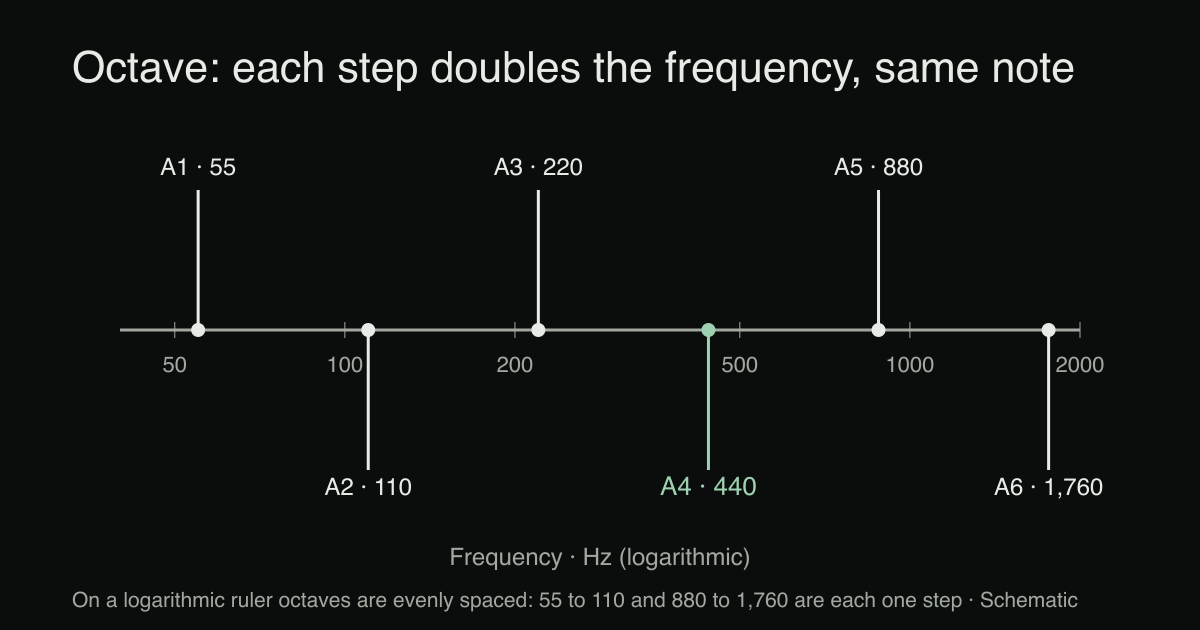
A ratio, not a difference
An octave is a ratio of frequencies, not a difference. The octave from 55 to 110 Hz is 55 Hz wide; the octave from 5,500 to 11,000 Hz is 5,500 Hz wide, and the ear hears both as a step of the same size. An octave is 1,200 cents, twelve semitones. On a linear ruler the low octaves collapse into a point, which is why sound rulers are drawn on a logarithmic scale that gives every octave equal room.
Why does it sound like the same note?
The harmonics of a 110 Hz sound are 220, 330, 440, 550 Hz and so on; those of a 220 Hz sound are 440, 660, 880 Hz. Every harmonic of the upper sound is already in the lower sound's series: played together they add no new component and no roughness. The brain reads that kinship as 'the same note'; pitch has a height and, within the octave, a class (C, D, E…).
The Shepard tone pulls those two faces apart: the class keeps rising while the height circles in place, and an endless ascent is heard. The octave number writes the second face: A3 220, A4 440, A5 880 Hz; the number goes up by one at C.
The octave ladder: making the inaudible audible
Moving a frequency up n octaves means multiplying it by 2ⁿ. That is how events too slow or too fast to hear are carried into the audible range: a pulse once a second (1 Hz) becomes a 256 Hz tone 8 octaves up; one Earth year becomes 136.1 Hz 32 octaves up. The result is a representation, not the 'real sound' of the event; the only thing carried over is the ratio.
The Octave Converter does this arithmetic and plays the result; the sonification article explains the method's limits. The cosmic-octave set and numbers such as 136.1 Hz come from this arithmetic; the arithmetic is right, and the effects attributed to the numbers have not been tested.
In Frekans Studio
In the tone generator the ×2 and ×½ buttons move the sound an octave up or down; hearing the same sound in two octaves one after the other gives the 'same, only higher' feeling within seconds. The Beyond Perception journey lays out octave equivalence and pitch illusions as listening sessions.
What does the evidence say?
Context · not a claim
Shepard's 1964 experiment showed that pitch has two faces: the note class within the octave (chroma) and height. With tones arranged around a circle, listeners heard sounds an octave apart as the same class; pitch judgements turned out circular.
Moore's textbook explains octave equivalence by the fact that the harmonics of the upper tone are a subset of the lower tone's harmonic series, and by the logarithmic progression of pitch perception.
Evidence levels and sources come from the database; the article adds no new claims. Evidence methodology
Studies
| Work | Type | n | Finding | Level |
|---|---|---|---|---|
| Moore 2013[2] | Textbook | — | A standard textbook of auditory perception. Its chapter on frequency selectivity and masking describes how one sound raises the detection threshold of another (auditory masking) and how this depends on frequency bands. | |
| Shepard 1964[1] | Experiment | — | When computer-generated complex tones were arranged at equal steps around a circle, listeners heard each tone's clockwise neighbour as higher and its counterclockwise neighbour as lower, and were unsure which of two diametrically opposed tones was higher. The judgements are circular rather than transitive; the author attributes this to a proximity principle along the frequency continuum and concludes that perceived pitch cannot be fully represented on a single rectilinear scale. |
Frequently asked questions
- How many cents is an octave?
- 1,200 cents; in equal temperament twelve semitones of 100 cents each. The ratio is always exactly 2:1, whatever the tuning system.
- How many octaves can a human hear?
- About ten, from 20 Hz to 20 kHz (2¹⁰ = 1,024). A piano covers a little more than seven, from 27.5 to 4,186 Hz.
Who is it for?
For whom
- Anyone looking for sound for relaxation, focus or a sleep routine; the sounds are generated on your device and promise no effect.
- Anyone who wants to read the evidence level of what they listen to.
- Anyone who wants to understand the octave ladder and 'cosmic octave' calculations; shifting by octaves is arithmetic, and it gives the shifted number no meaning.
Not for whom
- If you have epilepsy or a history of seizures, a psychiatric diagnosis, a medical device such as a pacemaker, tinnitus or any other health condition, or if you are pregnant, consult your doctor before use.
- Do not listen while driving or operating machinery.
- Keep your device volume comfortable, preferably below 60%. You can also use your device's headphone-safety settings.
Frekans Studio is not a medical device; it does not diagnose, treat or prevent any disease.
Listen and try
Sources
- Shepard RN. Circularity in Judgments of Relative Pitch. J Acoust Soc Am. 1964;36(12):2346-2353. doi:10.1121/1.1919362
- Moore BCJ. An Introduction to the Psychology of Hearing. Brill; 2013. ISBN 9789004252424
Citations come from the evidence database; every source is verified with Crossref or PubMed. Links go to the publication's own page (DOI).
Where to go next
Method
- Sources
- This article is not linked to a claim in the evidence database; it explains the technique and its use.
- Editorial responsibility
- Murat Tunalı · Editorial responsibility lies with Murat Tunalı; no independent medical review has been carried out.
- How this article was prepared
- The first draft was prepared by an AI model (Claude); the article adds no new figures, citations or claims, and the evidence summary comes from the database. Murat Tunalı approved publication. No independent scientific adviser has reviewed it yet. Evidence methodology · Credits
- Limitations
- This article is for information only; it is not medical advice. Evidence levels are per claim; a session's level is the weakest of its linked claims.
- Updates
- Last updated: 4 November 2026
- Cite as
- Frekans Studio. “What is an octave? Twice the frequency, the same note”. Last updated: 4 November 2026. https://frekans.studio/en/guide/what-is-an-octave