Notes and frequencies: why is A4 440 Hz?
Chromatic tuner
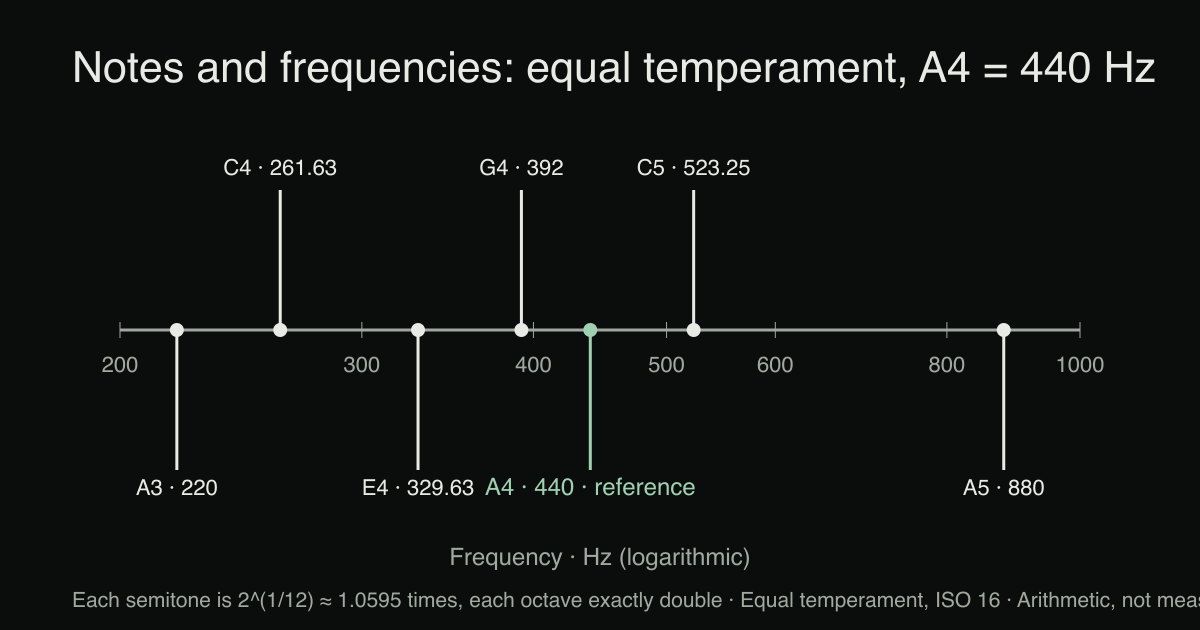
The arithmetic of equal temperament
Equal temperament divides the octave into twelve equal semitones: each semitone multiplies the frequency by 2^(1/12), and twelve of them make exactly a doubling. A note n semitones from A4 has the frequency 440 · 2^(n/12) Hz. The middle octave: C4 261.63, D4 293.66, E4 329.63, F4 349.23, G4 392.00, A4 440, B4 493.88, C5 523.25 Hz.
The octave number changes at C: after B3 comes C4. The lowest key of a piano is A0 at 27.5 Hz, the highest C8 at 4,186 Hz; middle C is C4. The same note name repeats in every octave at twice the frequency: A2 110, A3 220, A4 440, A5 880 Hz.
Cents: a hundredth of a semitone
Fine tuning differences are written in cents: a semitone is 100 cents, an octave 1,200, and the distance between two frequencies is 1,200 · log₂(f₂ / f₁). The gap between 432 and 440 Hz is 31.8 cents, a third of a semitone. In a sound playing alone a few cents go unheard; in two sounds playing side by side they show up at once as a beat.
What changes when the reference changes?
A4 = 440 Hz is a convention (ISO 16, 1975); baroque ensembles use 415, France in 1859 used 435, and many orchestras today use 442-443 Hz. When the reference moves, every note moves by the same ratio and the intervals stay put: at 432 tuning C4 becomes 256.87 Hz, and C4 to G4 is still 700 cents.
The tuning system also shapes the link between name and frequency. In just intonation the fifth is exactly 3:2 (702 cents), in equal temperament 700; the major third is 5:4 (386 cents) in just intonation and 400 in equal temperament. The same name 'E4' moves by a few Hz with the system; the World of Tunings journey lets you hear those differences.
In Frekans Studio
The chromatic tuner reads your instrument's note and its deviation in cents; you can set the reference to 432, 440, 442 or 443. The harmonics and tuning tool plays the scale at the A4 reference you choose, and the tone generator gives any frequency as a pure sine. The Tuning Experiment compares 440 and 432 blind and with measurement; the history of 440 Hz has a page of its own.
What does the evidence say?
Context · not a claim
Hall's 1974 study compares tuning systems (equal, just, mean-tone) numerically by how far their intervals depart from pure ratios: in equal temperament the fifth is 2 cents from its pure value, the major third 14 cents.
Kopiez's 2003 experiment measured how far expert musicians adapt their intonation when the accompaniment is played in equal temperament or in just intervals; the note name stays the same while the frequency played shifts with the system.
Evidence levels and sources come from the database; the article adds no new claims. Evidence methodology
Studies
| Work | Type | n | Finding | Level |
|---|---|---|---|---|
| Kopiez 2003[2] | Experiment | — | Two professional trumpet players played the missing upper voice of a four-part example while the other three parts sounded in adaptive five-limit just intonation or in equal temperament. The mean deviation did not differ significantly between the two systems (4.9 cents in equal temperament, 6.7 cents in just intonation). According to the author, the musicians used the same intonation in both versions and could not adapt to just intonation, probably a consequence of long-term practice with equal temperament. | |
| Hall 1974[1] | Review | — | The acoustical and mathematical basis of the problem of how best to tune the twelve-tone chromatic scale was reviewed, with emphasis on understanding why there cannot be any perfect solution. A quantitative measure was devised of how well a tuning provides just intonation for a specific piece of music; applying it to musical examples clarified the reasons for certain historical tuning practices. |
Frequently asked questions
- How many Hz is C4?
- 261.63 Hz in equal temperament with A4 = 440 Hz. With a 432 reference it is 256.87 Hz; the so-called 'scientific pitch' C4 = 256 Hz puts A4 at 430.54 Hz.
- How do I convert a note to a frequency?
- Count the semitones (n) from A4 and compute 440 · 2^(n/12). Example: E5 is 7 semitones above A4: 440 · 2^(7/12) = 659.26 Hz.
Who is it for?
For whom
- Anyone looking for sound for relaxation, focus or a sleep routine; the sounds are generated on your device and promise no effect.
- Anyone who wants to read the evidence level of what they listen to.
- Musicians who want to convert a note to a frequency and anyone using the tuner; the formula is for equal temperament, and the numbers change in just intonation.
Not for whom
- If you have epilepsy or a history of seizures, a psychiatric diagnosis, a medical device such as a pacemaker, tinnitus or any other health condition, or if you are pregnant, consult your doctor before use.
- Do not listen while driving or operating machinery.
- Keep your device volume comfortable, preferably below 60%. You can also use your device's headphone-safety settings.
Frekans Studio is not a medical device; it does not diagnose, treat or prevent any disease.
Listen and try
Sources
- Hall DE. Quantitative evaluation of musical scale tunings. Am J Phys. 1974;42(7):543-552. doi:10.1119/1.1987774
- Kopiez R. Intonation of harmonic intervals: adaptability of expert musicians to equal temperament and just intonation. Music Percept. 2003;20(4):383-410. doi:10.1525/mp.2003.20.4.383
Citations come from the evidence database; every source is verified with Crossref or PubMed. Links go to the publication's own page (DOI).
Where to go next
Method
- Sources
- This article is not linked to a claim in the evidence database; it explains the technique and its use.
- Editorial responsibility
- Murat Tunalı · Editorial responsibility lies with Murat Tunalı; no independent medical review has been carried out.
- How this article was prepared
- The first draft was prepared by an AI model (Claude); the article adds no new figures, citations or claims, and the evidence summary comes from the database. Murat Tunalı approved publication. No independent scientific adviser has reviewed it yet. Evidence methodology · Credits
- Limitations
- This article is for information only; it is not medical advice. Evidence levels are per claim; a session's level is the weakest of its linked claims.
- Updates
- Last updated: 4 November 2026
- Cite as
- Frekans Studio. “Notes and frequencies: why is A4 440 Hz?”. Last updated: 4 November 2026. https://frekans.studio/en/guide/notes-and-frequencies