What are harmonics? Overtones and timbre
Frequency visualizer
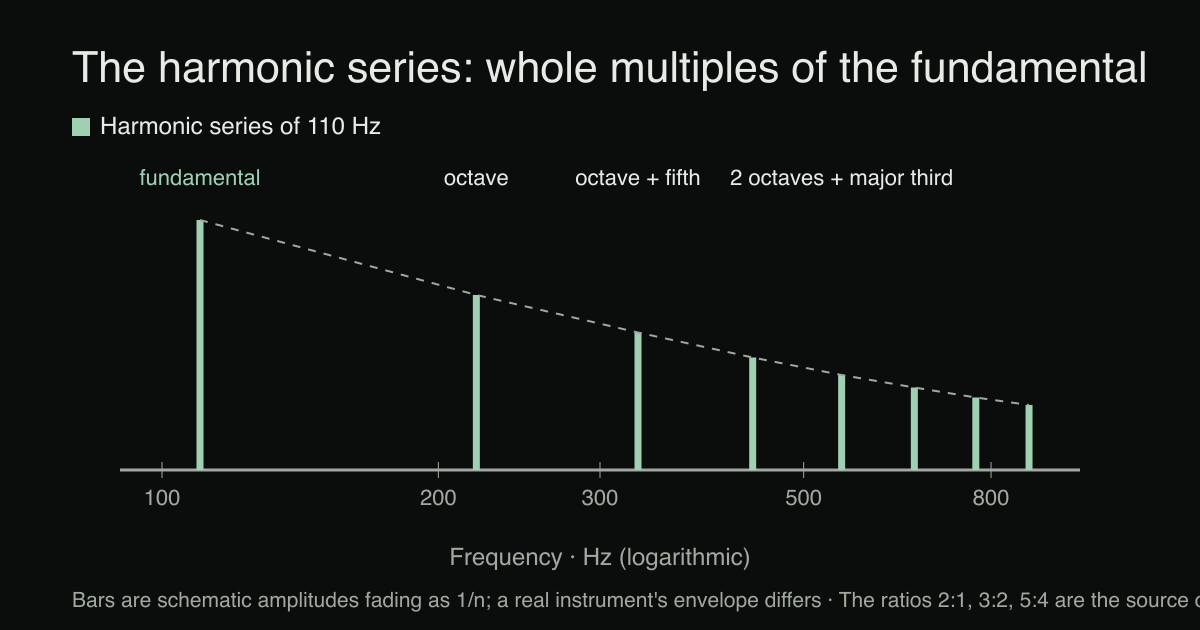
The harmonic series
A stretched string or a column of air vibrates not only at its fundamental but also at its whole-number multiples. The series of a 110 Hz string runs 110, 220, 330, 440, 550, 660, 770, 880 Hz: the second harmonic is an octave up, the third an octave and a fifth, the fifth two octaves and a major third. The ratios within the series (2:1, 3:2, 5:4) are the source of musical intervals.
The first harmonic is the fundamental itself; overtones are counted from the second, so 'second harmonic' and 'first overtone' name the same component. The ear hears the whole series as a single sound and takes its pitch from the fundamental; even when the fundamental is very weak, the series implies it.
Timbre: the mix of harmonics
A sine wave has a single component and sounds 'empty'. A triangle wave carries only odd harmonics, and they fade quickly (1/n²): soft. A square wave carries the odd harmonics at 1/n: full and sharp. A sawtooth carries every harmonic at 1/n: the brightest. In real instruments this envelope changes with the instrument, the note and the playing; that is why a violin and a flute sound different on the same note.
The ear fuses harmonics into one sound. When a harmonic is mistuned far enough the fusion breaks and that component drops out as a separate tone; two components close together in a narrow band instead create beats and roughness.
Partials that are not harmonics: bells, bowls, bars
Not every vibrating body vibrates at whole multiples. The modes of a bell, a bowl, a bar or a membrane sit at ratios that are not whole multiples of the fundamental; such components are called partials, not harmonics. A bell's 'ding' and 'hum' tones and the slowly wavering colour of a Tibetan bowl come from these inharmonic partials. The ear struggles to assign them a clear pitch, so bell-like sounds are heard as colour more than as pitch.
Roughness and the 4-40 Hz rule
When two components are very close (inside the same critical band) the ear does not separate them but hears a fluctuation as fast as their difference: a slow beat at a few Hz, roughness around 20-40 Hz. Frekans Studio's session rule follows from this: in sustained sounds, partials are not placed closer than 4-40 Hz to one another; where a beat is wanted it is built deliberately and labelled. The harmonics and tuning tool shows which harmonics a chosen ratio makes coincide; the spectrum analyser draws the partials of whatever is playing.
What does the evidence say?
Context · not a claim
Plomp and Levelt's 1965 experiment showed that the roughness of two pure tones arises from a frequency difference within the critical band, that roughness peaks at about a quarter of the band, and that in complex sounds consonance is tied to coinciding harmonics.
In Moore's 1986 measurements a partial of a harmonic sound began to be heard as a separate tone once it was mistuned far enough (about one to three percent for the low harmonics): the ear fuses harmonics into one sound and segregates what falls outside.
Evidence levels and sources come from the database; the article adds no new claims. Evidence methodology
Studies
| Work | Type | n | Finding | Level |
|---|---|---|---|---|
| Moore 1986[2] | Experiment | — | When a low harmonic in a harmonic complex is mistuned by a sufficient amount it is heard as a separate tone, standing out from the whole. For complexes of 10 or 12 equal-amplitude components on fundamentals of 100, 200 and 400 Hz, the threshold for the first six harmonics was mostly 1-3% of the harmonic frequency, depending on the listener; it rose by a factor of 3-5 as duration fell from 1610 ms to 50 ms. | |
| Plomp 1965[1] | Experiment | — | The experiments support von Helmholtz's view that the difference between consonant and dissonant intervals is related to beating between adjacent partials, and refine it: the transition depends on the critical bandwidth. Two simple tones count as consonant when their frequency difference exceeds the critical band; the most dissonant interval lies at about a quarter of it. Chord analyses from Bach and Dvořák suggest the critical band plays a role in music as well. |
Frequently asked questions
- Are overtones and harmonics the same thing?
- Harmonics are whole-number multiples of the fundamental; an overtone is any component above the fundamental, including those that are not whole multiples. In strings and air columns the overtones are harmonic; in a bell they are not.
- Why does a pure sine sound 'empty'?
- It has a single component; the mix of harmonics that makes timbre is missing. The ear hears it as clean but colourless, slightly 'electronic'; pure sines hardly exist in nature.
Who is it for?
For whom
- Anyone looking for sound for relaxation, focus or a sleep routine; the sounds are generated on your device and promise no effect.
- Anyone who wants to read the evidence level of what they listen to.
- Anyone curious about timbre and the roughness rules, and anyone using the harmonics tool; the page is acoustics and does not assess 'harmonic frequency' claims.
Not for whom
- If you have epilepsy or a history of seizures, a psychiatric diagnosis, a medical device such as a pacemaker, tinnitus or any other health condition, or if you are pregnant, consult your doctor before use.
- Do not listen while driving or operating machinery.
- Keep your device volume comfortable, preferably below 60%. You can also use your device's headphone-safety settings.
Frekans Studio is not a medical device; it does not diagnose, treat or prevent any disease.
Listen and try
Sources
- Plomp R, Levelt WJM. Tonal Consonance and Critical Bandwidth. J Acoust Soc Am. 1965;38(4):548-560. doi:10.1121/1.1909741 PMID 5831012
- Moore BCJ, Glasberg BR, Peters RW. Thresholds for hearing mistuned partials as separate tones in harmonic complexes. J Acoust Soc Am. 1986;80(2):479-483. doi:10.1121/1.394043 PMID 3745680
Citations come from the evidence database; every source is verified with Crossref or PubMed. Links go to the publication's own page (DOI).
Where to go next
Method
- Sources
- This article is not linked to a claim in the evidence database; it explains the technique and its use.
- Editorial responsibility
- Murat Tunalı · Editorial responsibility lies with Murat Tunalı; no independent medical review has been carried out.
- How this article was prepared
- The first draft was prepared by an AI model (Claude); the article adds no new figures, citations or claims, and the evidence summary comes from the database. Murat Tunalı approved publication. No independent scientific adviser has reviewed it yet. Evidence methodology · Credits
- Limitations
- This article is for information only; it is not medical advice. Evidence levels are per claim; a session's level is the weakest of its linked claims.
- Updates
- Last updated: 4 November 2026
- Cite as
- Frekans Studio. “What are harmonics? Overtones and timbre”. Last updated: 4 November 2026. https://frekans.studio/en/guide/what-are-harmonics