What is frequency? Hertz, pitch and bands
Tone generator and sweep
Hertz: how many times per second?
One hertz is one repetition per second. The period is the inverse of the frequency: one cycle of a 440 Hz tone lasts 2.27 milliseconds; six breaths a minute is 0.1 Hz, and one breath lasts 10 seconds. The same unit measures the pitch of a sine, the rate of a pulse train and the slowness of a fluctuation; context says which.
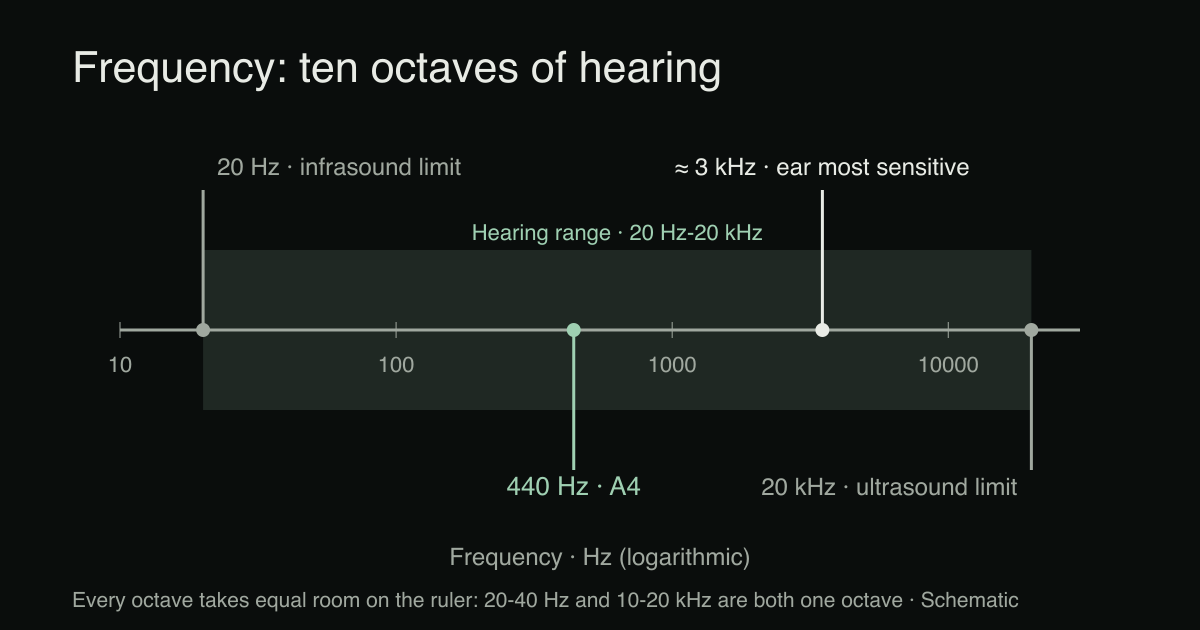
For sound the frequency scale is very wide: there is a factor of a thousand between the lowest audible tone and the highest. Placing 20 Hz and 20,000 Hz linearly on the same ruler squeezes the low region into a point; the rulers on this site use a logarithmic scale that gives every octave equal room.
Pitch: the ear hears ratios
The musical distance between two frequencies depends on their ratio, not their difference. A 2:1 ratio is an octave everywhere: between 55 and 110 Hz as much as between 5,500 and 11,000 Hz. In equal temperament a semitone is a factor of 1.0595; the fine measure is the cent, a hundredth of a semitone. A 100 Hz difference is a whole octave at the bottom and an unnoticed shift at the top.
The ear is very sensitive in the middle range: frequency differences below one percent can be told apart. Two close tones played together, on the other hand, create a fluctuation as fast as their difference, a beat; that is the basis of binaural and monaural beats.
Which frequencies can be heard?
The hearing range is roughly 20 Hz to 20 kHz. Below 20 Hz is infrasound: felt, not heard as pitch. Above 20 kHz is ultrasound: bats and dolphins use it, humans do not hear it. The ear is most sensitive around a few kHz; a 50 Hz tone at the same level sounds much quieter.
Brain-wave bands (delta 0.5-4 Hz, theta 4-8, alpha 8-13, beta 13-30, gamma above 30 Hz) are written in hertz too, but they are EEG rhythms, not sounds. A session saying '10 Hz' does not mean it plays a 10 Hz tone; it means a 10 Hz fluctuation produced by the difference between two tones.
What does Hz mean on a session card?
It can be one of three things: the pitch of a tone (say, an A at 432 Hz), a beat rate (say, 6 Hz binaural) or the centre of a noise band. The card says which it means. For claims that particular numbers have an effect of their own, the evidence level sits on the card as a letter and a shape; the evidence status of popular frequencies is collected in a separate article. The tone generator plays any frequency you choose as a pure sine in 0.01 Hz steps.
What does the evidence say?
Context · not a claim
According to Moore's textbook, pitch perception follows the ratio of frequencies rather than their difference: an octave is always a doubling, and in the middle range the ear can tell frequency differences below one percent apart.
Evidence levels and sources come from the database; the article adds no new claims. Evidence methodology
Studies
| Work | Type | n | Finding | Level |
|---|---|---|---|---|
| Moore 2013[1] | Textbook | — | A standard textbook of auditory perception. Its chapter on frequency selectivity and masking describes how one sound raises the detection threshold of another (auditory masking) and how this depends on frequency bands. |
Frequently asked questions
- Are Hz and dB the same thing?
- No. Hz is the number of repetitions per second (how high); dB is a ratio measure of level (how loud). A sound can be 440 Hz and −20 dB at the same time.
- Why is a beat rate written in Hz?
- A beat is also a fluctuation repeating a set number of times per second, so hertz is its natural unit. But a beat is not a tone: a 6 Hz beat is two tones 6 Hz apart heard together.
Who is it for?
For whom
- Anyone looking for sound for relaxation, focus or a sleep routine; the sounds are generated on your device and promise no effect.
- Anyone who wants to read the evidence level of what they listen to.
- Anyone who wants to read the Hz numbers on session cards; a tone's pitch and a beat rate are different things, and the page keeps them apart.
Not for whom
- If you have epilepsy or a history of seizures, a psychiatric diagnosis, a medical device such as a pacemaker, tinnitus or any other health condition, or if you are pregnant, consult your doctor before use.
- Do not listen while driving or operating machinery.
- Keep your device volume comfortable, preferably below 60%. You can also use your device's headphone-safety settings.
Frekans Studio is not a medical device; it does not diagnose, treat or prevent any disease.
Listen and try
Sources
Citations come from the evidence database; every source is verified with Crossref or PubMed. Links go to the publication's own page (DOI).
Where to go next
Method
- Sources
- This article is not linked to a claim in the evidence database; it explains the technique and its use.
- Editorial responsibility
- Murat Tunalı · Editorial responsibility lies with Murat Tunalı; no independent medical review has been carried out.
- How this article was prepared
- The first draft was prepared by an AI model (Claude); the article adds no new figures, citations or claims, and the evidence summary comes from the database. Murat Tunalı approved publication. No independent scientific adviser has reviewed it yet. Evidence methodology · Credits
- Limitations
- This article is for information only; it is not medical advice. Evidence levels are per claim; a session's level is the weakest of its linked claims.
- Updates
- Last updated: 4 November 2026
- Cite as
- Frekans Studio. “What is frequency? Hertz, pitch and bands”. Last updated: 4 November 2026. https://frekans.studio/en/guide/what-is-frequency